
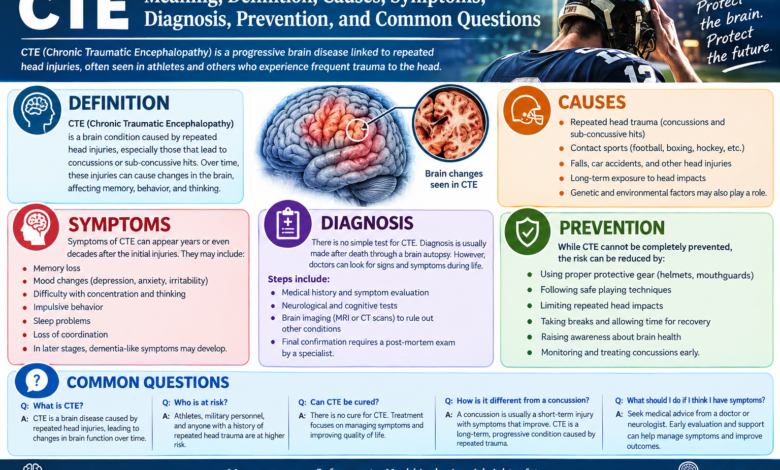
CTE meaning usually refers to Chronic Traumatic Encephalopathy, a brain disease associated with long-term exposure to repeated head impacts. The condition has received considerable attention because researchers have identified changes linked to CTE in the brains of some people who experienced repeated head trauma, particularly those involved in certain contact sports or other activities involving frequent impacts.
In simple English, CTE is a disease involving changes in the brain that have been associated with repeated head impacts over time. Researchers have found abnormal deposits of a protein called tau in the brains of people who had CTE. However, there is still a great deal to learn about why some people develop these changes and others don’t.


It’s also important not to jump to conclusions after a single concussion. Having a concussion or experiencing a head impact doesn’t automatically mean a person will develop CTE. Scientists are still investigating the relationship between repeated head impacts, brain changes, and symptoms.
This article explains the CTE meaning in clear, age-appropriate language, including its causes, possible symptoms, research findings, diagnosis, prevention, and frequently asked questions.
What Does CTE Meaning Mean in Simple English?
The CTE meaning is Chronic Traumatic Encephalopathy.
The name can sound complicated, so breaking it down makes it easier:
- Chronic means something that lasts or develops over a long period.
- Traumatic relates to physical injury or trauma.
- Encephalopathy is a general medical term for a disorder affecting the brain.
Put together, Chronic Traumatic Encephalopathy is a brain disease associated with repeated head impacts.
These impacts can happen in different circumstances. For example, researchers have studied CTE in people who participated in sports involving repeated collisions, as well as in other groups exposed to repeated head trauma.
However, CTE shouldn’t be confused with a normal concussion. A concussion is a type of traumatic brain injury that can happen after a blow, bump, or jolt to the head or body. CTE, by contrast, is a neurodegenerative disease associated with repetitive head impacts over time.
That difference is an important part of understanding the CTE meaning.
What Is Chronic Traumatic Encephalopathy?
Chronic Traumatic Encephalopathy is described by researchers as a neurodegenerative disease associated with repetitive head impacts.
“Neurodegenerative” means that changes involving nerve cells and brain function can occur over time. Scientists studying CTE have found an abnormal form of tau, a protein normally found in nerve cells.
Normally, tau helps support the internal structure of nerve cells. In certain neurodegenerative diseases, however, abnormal tau can collect in the brain.
Researchers studying CTE have identified a distinctive pattern of abnormal tau deposits in brain tissue. This finding has helped scientists distinguish CTE from other neurological conditions.
There is an important limitation, though. CTE can currently only be definitively diagnosed by examining brain tissue after death. Doctors don’t have a routine clinical test that can confirm CTE in a living person.
Researchers are actively studying possible biomarkers and other methods that could eventually make diagnosis during life possible.
So, when discussing the CTE meaning, it’s important to separate established scientific findings from things researchers are still investigating.
CTE Meaning and Repeated Head Impacts
Repeated head impacts are central to the current understanding of CTE.
A head impact doesn’t necessarily mean that someone has a concussion. A person can experience an impact or jolt without immediately noticing symptoms.
Researchers therefore study repetitive head impacts rather than focusing only on diagnosed concussions.
These impacts may occur in activities where people regularly experience collisions, falls, or contact. The amount and type of exposure can vary considerably from one person to another.
Scientists are interested in questions such as:
- How frequently did head impacts occur?
- How many years did the exposure continue?
- How intense were the impacts?
- At what age did exposure begin?
- Were there long periods without exposure?
- What other factors might have affected brain health?
Importantly, researchers haven’t established a simple formula saying that a particular number of head impacts will cause CTE. There isn’t such a straightforward rule.
That’s why the CTE meaning should never be interpreted as “any repeated head impact equals CTE.”
What Causes CTE?
Researchers believe that repeated head impacts are associated with the development of CTE. These impacts may include blows that cause concussions as well as impacts that don’t produce obvious concussion symptoms.
Still, scientists don’t yet understand every factor involved.
The development of CTE may be influenced by several variables, including the nature and duration of exposure to head impacts. Researchers are also investigating possible genetic, environmental, and other biological factors.
It’s worth emphasizing that scientists can’t currently predict with certainty which individual will develop CTE.
This uncertainty is one reason why ongoing research matters. Rather than assuming that every person exposed to head impacts will develop the disease, scientists are studying large groups and examining brain tissue to better understand the risks.
The safest practical approach is to reduce unnecessary head impacts whenever possible and follow appropriate medical guidance after a suspected concussion.
That approach is consistent with what people need to know about the CTE meaning.
CTE Meaning and Concussions
CTE and concussion are related to head trauma, but they’re not the same thing.
A concussion is a type of mild traumatic brain injury. It can cause symptoms such as headache, dizziness, confusion, difficulty concentrating, sensitivity to light or noise, or feeling unusually tired.
Most people recover from a concussion, although recovery time can vary. Anyone who may have a concussion should be evaluated and guided by a qualified healthcare professional, particularly if symptoms are significant or worsening.
CTE is different. It is a neurodegenerative disease associated with repetitive head impacts and is identified by characteristic changes in brain tissue.
Researchers are studying whether repeated concussions increase the likelihood of CTE, but the relationship is complicated. A person who has had one concussion shouldn’t assume that they have CTE.
Similarly, someone can experience repeated head impacts without having a diagnosed concussion.
Understanding this distinction prevents unnecessary fear and gives a more accurate picture of the CTE meaning.
What Are the Symptoms Associated With CTE?
Researchers have reported a range of symptoms in people who were later found to have CTE. These can include changes involving thinking, mood, behavior, and movement.
Reported symptoms may include:
- Problems with memory or thinking.
- Difficulty concentrating.
- Changes in mood.
- Irritability.
- Impulsive behavior.
- Depression-related symptoms.
- Problems with balance or movement.
- Confusion.
- Difficulties with planning or decision-making.
However, here’s a crucial point: these symptoms aren’t specific to CTE.
Many different physical, neurological, emotional, or psychological conditions can produce similar symptoms. Stress, sleep problems, other medical conditions, medications, and many other factors can affect memory, concentration, mood, and behavior.
Therefore, experiencing one or more of these symptoms doesn’t mean someone has CTE.
This is particularly important for young people. If a teenager experiences symptoms after a head injury, they should tell a parent, guardian, school health professional, coach, or healthcare professional rather than trying to diagnose themselves.
That’s a responsible way to apply knowledge about the CTE meaning.
CTE Meaning and Changes in the Brain
One of the most important discoveries in CTE research involves abnormal tau protein.
Researchers examining the brains of people with CTE have found an unusual pattern of tau accumulation. These deposits can occur around small blood vessels and in specific areas of the brain.
Over time, these changes may be associated with damage to brain cells and changes in brain structure.
Scientists study these patterns using brain tissue donated for research. Examining actual brain tissue allows researchers to understand what happens at a microscopic level.
However, there’s a major limitation: researchers generally study donated brains from people who had symptoms or histories that made CTE a concern. This can make it difficult to determine exactly how common CTE is among the broader population.
In other words, finding CTE in donated brains doesn’t tell us that everyone exposed to head impacts will develop it.
The science is developing, and that’s why responsible sources avoid making overly simple claims about the CTE meaning.
Can CTE Be Diagnosed in a Living Person?
At present, there is no established clinical test that can definitively diagnose CTE in a living person.
CTE is confirmed by examining brain tissue after death. Researchers can then look for the characteristic pattern of abnormal tau associated with the disease.
Scientists are investigating possible tools that might someday help identify CTE during life. These areas of research include brain imaging, blood-based biomarkers, and other biological measurements.
But a research tool isn’t automatically a reliable medical diagnostic test.
This distinction is important because people sometimes encounter online claims suggesting that a scan, quiz, or simple examination can prove someone has CTE. Such claims should be treated carefully.
If someone is experiencing headaches, memory problems, mood changes, dizziness, or other symptoms following a head injury, the appropriate step is to speak with a qualified healthcare professional.
Understanding this limitation is a key part of the CTE meaning.
CTE Meaning in Sports
CTE has received significant attention in sports because some athletes can experience repeated head impacts over many years.
Researchers have studied former athletes from sports such as American football, boxing, hockey, and other activities where repeated collisions can occur.
However, the presence of CTE in some former athletes doesn’t mean that everyone who plays a contact sport will develop the disease.
Sports organizations have introduced various measures intended to reduce head injuries, such as improved rules, better medical protocols, education, and return-to-play procedures.
For young athletes, safety should always come first. Playing a sport doesn’t require ignoring symptoms or hiding an injury.
If a young athlete suspects a concussion, they should stop participating and tell a responsible adult or healthcare professional. Returning to activity should follow appropriate medical advice rather than pressure from teammates, coaches, or anyone else.
These practical safety measures are more useful than worrying about an uncertain diagnosis, and they help put the CTE meaning into proper context.
Why CTE Research Is Important
Research into CTE can help scientists understand how repeated head impacts affect the brain.
Researchers are studying questions such as:
- Why does CTE develop in some people?
- What role does repeated exposure play?
- Are there biological factors that influence risk?
- How do brain changes relate to symptoms?
- Can CTE be detected during life?
- Can future treatments slow or prevent the disease?
These questions don’t have complete answers yet.
Scientific research takes time because researchers need reliable evidence from many studies. New findings can improve or sometimes change earlier ideas.
That may sound frustrating, but it’s actually a strength of science. Good research doesn’t pretend to know something before the evidence is available.
The growing body of CTE research may eventually lead to better ways of preventing, detecting, and treating brain diseases associated with repeated trauma.
How Is CTE Different From Other Brain Conditions?
CTE is one of several conditions involving the brain, and its symptoms can overlap with other disorders.
For example, memory problems can occur for many reasons. Changes in mood can have numerous causes. Difficulty concentrating can be linked to sleep, stress, medications, neurological conditions, or other factors.
This means that symptoms alone aren’t enough to identify CTE.
| Condition or situation | General description | Can it involve head trauma? |
| CTE | Neurodegenerative disease associated with repetitive head impacts | Yes |
| Concussion | Type of traumatic brain injury | Yes |
| Traumatic brain injury | Brain injury caused by external physical force | Yes |
| Migraine | Neurological condition often involving recurring headaches | Not necessarily |
| Sleep problems | Conditions affecting sleep quality or duration | Not necessarily |
| Stress-related difficulties | Emotional or physical effects associated with stress | Not necessarily |
This table is only a basic comparison, not a diagnostic guide.
If someone has concerning symptoms, a healthcare professional can consider their medical history and symptoms and determine what evaluation may be appropriate.
That’s another reason why understanding the CTE meaning doesn’t mean trying to diagnose yourself.
CTE Meaning and Prevention
There currently isn’t a guaranteed way to prevent CTE, because researchers are still learning about exactly how and why it develops.
However, reducing unnecessary head impacts is an important safety principle.
For young people involved in sports, useful safety measures include:
- Follow the rules designed to reduce dangerous contact.
- Use properly fitted protective equipment where appropriate.
- Follow instructions from coaches and medical professionals.
- Never hide symptoms after a head injury.
- Tell a trusted adult if you feel unwell after an impact.
- Follow medical guidance before returning to sports after a concussion.
- Avoid deliberately taking unnecessary hits to the head.
- Encourage teammates to report injuries rather than hiding them.
Protective equipment can reduce certain injuries, but no helmet or other equipment can make a sport completely free of concussion risk.
The best protection also involves good coaching, sensible rules, proper medical care, and honest communication.
These habits provide a practical and hopeful way to think about the CTE meaning.
What Should You Do After a Head Injury?
If someone experiences a significant blow or jolt to the head, they shouldn’t simply assume everything is fine because they feel okay immediately.
Symptoms can sometimes appear later.
A young person should tell a parent, guardian, coach, teacher, school nurse, or healthcare professional if they’ve had a head injury and don’t feel right afterward.
Possible concussion symptoms can include:
- Headache.
- Dizziness.
- Nausea.
- Confusion.
- Trouble concentrating.
- Feeling unusually tired.
- Sensitivity to light or sound.
- Problems with balance.
- Changes in vision.
Some symptoms require urgent medical attention. Emergency care is especially important after a head injury if someone becomes difficult to wake, has a seizure, has repeated vomiting, develops worsening or severe symptoms, or behaves in a way that is seriously unusual for them.
Don’t try to diagnose CTE after an injury. CTE is not something that can be confirmed through a quick home check.
Instead, focus on getting appropriate care and following professional advice.
That’s the safest and most sensible response when considering the CTE meaning.
CTE Meaning and Young People
CTE research has mainly focused on long-term exposure to repetitive head impacts, particularly in adults whose exposure occurred over many years.
Scientists are still investigating what repeated head impacts mean for developing brains. Because young people’s brains are still developing, protecting them from unnecessary head injuries is particularly important.
Young athletes should never feel that they need to hide a concussion because they don’t want to leave a game or disappoint their team.
Speaking up isn’t weakness. It’s responsible behavior.
Parents, guardians, coaches, teachers, and healthcare professionals can help by creating an environment where young people feel comfortable reporting symptoms.
The goal isn’t to make young people afraid of sports or normal activities. Physical activity can have many benefits. The goal is to make participation safer and ensure that head injuries receive appropriate attention.
That balanced approach is important when explaining the CTE meaning to younger readers.
Common Myths About CTE
CTE is widely discussed online, and not every claim is accurate. Let’s clear up several common misunderstandings.
Myth: One Concussion Means You Have CTE
False. A single concussion doesn’t automatically mean a person has CTE.
CTE is associated with repetitive head impacts, and researchers are still studying the risk factors involved.
Myth: Every Person With Repeated Head Impacts Develops CTE
False. Scientists don’t currently have enough evidence to say that everyone exposed to repeated head impacts will develop CTE.
Myth: CTE Can Be Confirmed With a Simple Brain Scan
Not currently. CTE can be definitively diagnosed by examining brain tissue after death. Researchers are investigating possible methods for diagnosis during life.
Myth: CTE and Concussion Are the Same
False. A concussion is a traumatic brain injury. CTE is a neurodegenerative disease associated with repetitive head impacts.
Myth: CTE Is Fully Understood
Not yet. Scientists have learned a great deal, particularly about abnormal tau deposits, but important questions remain.
These distinctions make discussions about the CTE meaning more accurate and less frightening.
What Does the Future of CTE Research Look Like?
The future of CTE research is focused on answering important questions and improving brain health.
Researchers are investigating possible biomarkers that might eventually allow doctors to identify CTE during a person’s lifetime. They are also studying brain imaging, genetics, biological changes, and the relationship between exposure to head impacts and later symptoms.
Better research could lead to improved prevention strategies.
Future discoveries may also help doctors distinguish CTE from other conditions that cause similar symptoms. If reliable diagnostic tools are developed, they could potentially improve research and medical care.
Treatment research is another important area. Scientists want to understand whether therapies could reduce or slow the effects of disease associated with abnormal tau.
While there are still unanswered questions, ongoing research offers reason for optimism.
The scientific community continues to learn more about the brain, and each carefully conducted study adds another piece to the puzzle surrounding the CTE meaning.
Frequently Asked Questions About CTE Meaning
What is the CTE meaning?
CTE meaning usually refers to Chronic Traumatic Encephalopathy, a neurodegenerative brain disease associated with repeated head impacts over time.
What does CTE stand for?
CTE stands for Chronic Traumatic Encephalopathy.
Is CTE caused by one concussion?
No. CTE is associated with repetitive head impacts. A single concussion doesn’t mean that someone has CTE.
Can a living person be diagnosed with CTE?
Currently, there isn’t an established clinical test that can definitively diagnose CTE in a living person. Definitive diagnosis currently requires examination of brain tissue after death.
What protein is associated with CTE?
Researchers have found abnormal deposits of tau protein in the brains of people with CTE.
What are possible symptoms associated with CTE?
Researchers have reported problems involving memory, thinking, mood, behavior, and movement in people who were later found to have CTE. However, these symptoms can have many other causes and don’t prove that someone has CTE.
Can young people develop CTE?
Scientists are still researching how repeated head impacts affect developing brains and the long-term risk of CTE. Protecting young people from unnecessary head impacts is an important safety goal.
Does wearing a helmet prevent CTE?
No protective equipment can guarantee that CTE or concussion won’t occur. Helmets can provide protection against certain types of injury, but they don’t make activities completely free of head-injury risk.
Should someone stop playing sports after a concussion?
A person with a suspected concussion should stop participating and be evaluated by an appropriate healthcare professional. Returning to sports should follow professional medical guidance.
Is there a cure for CTE?
There is currently no proven cure for CTE. Researchers are continuing to study the disease, its causes, possible diagnostic tools, and potential treatments.
Final Thoughts on CTE Meaning
The CTE meaning refers to Chronic Traumatic Encephalopathy, a neurodegenerative brain disease associated with repeated head impacts. Researchers have identified characteristic abnormal tau deposits in the brains of people with CTE, but many questions about the disease remain unanswered.
One of the most important facts to remember is that a concussion or head impact does not automatically mean a person has CTE. CTE can’t currently be definitively diagnosed in a living person, and symptoms associated with it can also occur for many other reasons.
For young people, the practical message is straightforward: take head injuries seriously, tell a trusted adult when an injury occurs, follow medical advice, and don’t feel pressured to hide symptoms. Sports and physical activity can still be enjoyable and valuable when safety is taken seriously.
Science continues to move forward. Researchers are working to understand risk factors, improve diagnosis, develop better prevention strategies, and explore future treatments. With better knowledge and responsible safety practices, we can make smarter decisions about brain health while avoiding unnecessary fear.