
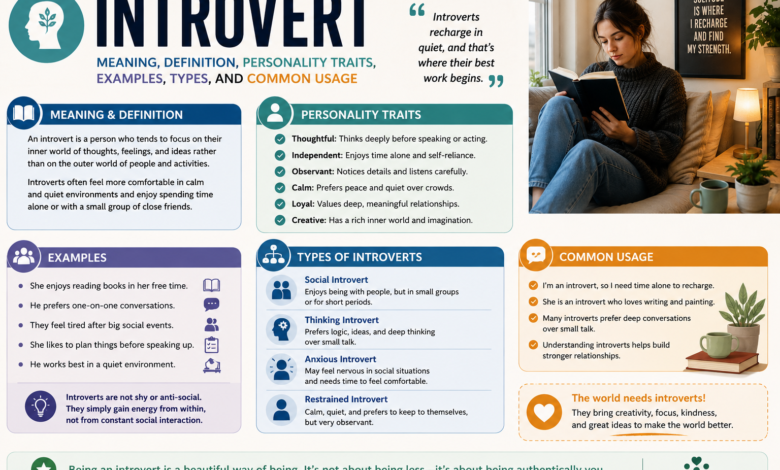
Introvert Meaning: Definition, Personality Traits, Examples, Types, and Common Usage
Introvert meaning is generally used to describe a person who tends to feel comfortable with quiet surroundings, enjoys spending time alone or with a small group, and often prefers to think before speaking. Being an introvert doesn’t mean someone is shy, unfriendly, or unable to communicate. Instead, introversion is commonly understood as a personality trait related to how a person responds to social interaction and where they tend to direct their attention and energy.
In everyday life, introverts can be students, teachers, artists, business owners, athletes, scientists, leaders, and friends. They may enjoy conversations just as much as anyone else, but they often prefer meaningful discussions over constant social activity. After a busy social day, an introverted person may want some quiet time to relax and recharge.


Understanding the introvert meaning can help people avoid common stereotypes and appreciate the many different ways personalities work.
What Does Introvert Meaning Mean in Simple English?
The simplest introvert meaning is a person who tends to enjoy quieter environments and may feel more comfortable with solitude or small social groups.
An introvert might enjoy reading a book alone, listening to music, working on a personal project, walking somewhere peaceful, or having a thoughtful conversation with one close friend. That doesn’t mean the person dislikes people. In fact, many introverts have strong friendships and enjoy social events when they feel comfortable with the people and setting.
For example, imagine a student who enjoys spending lunch with two close friends rather than sitting in a large, noisy group. After school, the student might prefer drawing, playing a game, reading, or simply relaxing at home. These preferences could be signs of introversion, although one behavior alone doesn’t determine someone’s personality.
So, in plain English, the introvert meaning is connected more with a preference for quiet and reflective environments than with being antisocial.
Introvert Meaning and the Difference Between Introversion and Shyness
A common misunderstanding is that every introvert is shy. That’s not true.
Shyness usually involves discomfort, nervousness, or fear in social situations. Introversion, on the other hand, describes a personality tendency. An introverted person may confidently speak in front of a class, participate in a discussion, or meet new people.
For example, an introverted student might give an excellent presentation but still prefer a quiet afternoon afterward. A shy student might want to join a group but feel nervous about approaching people.
A person can also be both introverted and shy, but the two concepts aren’t identical.
| Introversion | Shyness |
| Personality trait | Emotional or behavioral tendency |
| Often involves enjoying solitude or smaller groups | Often involves nervousness in social situations |
| Doesn’t necessarily involve fear | Can involve fear or self-consciousness |
| Introverts can be socially confident | Shy people may struggle with social confidence |
| Can occur without social anxiety | May sometimes be connected with social anxiety |
This distinction is essential when explaining the introvert meaning because labeling every quiet person as shy can create an inaccurate picture of their personality.
What Are Common Traits of an Introvert?
Introverts don’t all behave in exactly the same way. Personality exists on a broad spectrum, so two introverted people may have completely different interests and habits.
Still, some characteristics are commonly associated with introversion.
Enjoying Quiet Time
Many introverts appreciate having time alone. Quiet moments can help them relax, organize their thoughts, or focus on hobbies.
Preferring Smaller Groups
Large gatherings can sometimes feel overwhelming or tiring. An introvert may prefer spending time with a few close friends instead.
Thinking Before Speaking
Introverts may take a little more time to organize their thoughts before responding. This can make their communication thoughtful and deliberate.
Enjoying Deep Conversations
Some introverts prefer meaningful conversations instead of quick small talk. They may enjoy discussing books, ideas, hobbies, science, technology, or personal interests.
Becoming Tired After Lots of Social Activity
An introverted person may enjoy a party and still need quiet time afterward. Social enjoyment and social energy aren’t necessarily the same thing.
These characteristics help explain the introvert meaning, but they shouldn’t be treated as strict rules. People are wonderfully complicated, and no personality label can describe someone perfectly.
Introvert Meaning in Psychology
In psychology, introversion is commonly discussed as one part of personality. The concept became especially well known through the work of Swiss psychiatrist Carl Jung, who used the terms introversion and extraversion when discussing different orientations of psychological energy.
Modern personality psychology often examines introversion through broader personality models rather than treating people as simply “introverts” or “extroverts.”
One widely used framework is the Big Five personality model. In this model, extraversion is one of the major personality dimensions. A person can fall anywhere along that spectrum, from relatively low to relatively high in extraversion.
This means personality isn’t necessarily an either-or situation. Someone might be somewhat introverted in some situations and highly social in others.
That flexibility is important because the introvert meaning shouldn’t be reduced to a simple stereotype.
Introvert vs. Extrovert: What’s the Difference?
The terms introvert and extrovert are often presented as opposites. While they can describe different personality tendencies, real people aren’t always at one extreme or the other.
An introvert may generally prefer quiet settings, while an extrovert may enjoy frequent social interaction and lively environments.
Here’s a simple comparison:
| Feature | Introvert | Extrovert |
| Social setting | Often prefers smaller groups | Often enjoys larger groups |
| Free time | May enjoy solitude | May seek social activities |
| Communication | May think before speaking | May think while talking |
| Environment | Often appreciates quiet | Often enjoys energetic surroundings |
| Social energy | May need alone time after social activity | May feel energized by social interaction |
| Conversation | May prefer deeper discussions | May enjoy frequent conversation |
Neither personality style is automatically better. Both can bring valuable strengths to friendships, schools, workplaces, and communities.
That’s the bigger lesson behind the introvert meaning: personality differences are normal.
Can an Introvert Be Social?
Absolutely.
Being an introvert doesn’t mean avoiding people. Many introverts are friendly, funny, confident, and highly social when they’re in a comfortable environment.
An introverted person might enjoy going to a birthday party, joining a club, playing sports with friends, or participating in a school activity. However, they may also appreciate some quiet time before or after the event.
Think of it this way: someone can enjoy socializing without wanting to socialize constantly.
For instance, an introverted student might happily spend an afternoon with friends and then go home to read or listen to music. There’s no contradiction there.
This is one of the most important points to remember when learning the introvert meaning.
Introvert Meaning and Friendships
Introverts can form strong and lasting friendships.
They may sometimes prefer a smaller circle of close friends rather than having a huge number of acquaintances. Quality can matter more than quantity.
An introverted friend might show care through listening, remembering details, offering thoughtful advice, or spending one-on-one time together. They may not always be the loudest person in the room, but that doesn’t mean they don’t care.
Healthy friendships depend on trust, respect, communication, and shared experiences. Personality type doesn’t determine whether someone can be a good friend.
In fact, introverted people can be excellent listeners and thoughtful companions, although these qualities obviously vary from person to person.
Understanding this aspect of the introvert meaning helps remove the unfair idea that quiet people don’t value relationships.
Introvert Meaning in School and Learning
Introversion can influence how a student prefers to learn, but it doesn’t determine intelligence or academic ability.
Some introverted students may enjoy studying independently because they can concentrate without interruptions. Others may enjoy group work when the group is small and organized.
A student who doesn’t immediately raise their hand in class isn’t necessarily confused or uninterested. They may simply prefer to think about the question before answering.
Teachers can support different personality styles by offering a mixture of activities, such as:
- Individual assignments.
- Small-group discussions.
- Quiet reading time.
- Creative projects.
- Class presentations.
- Written reflection.
- Collaborative activities.
A balanced classroom gives different students opportunities to demonstrate what they know.
The introvert meaning therefore shouldn’t be used to make assumptions about a student’s ability, confidence, or intelligence.
Introverts and Communication Styles
Communication isn’t only about how much someone talks.
Some introverts may communicate best through writing because it gives them time to organize their thoughts. Others may enjoy face-to-face conversations, especially with people they trust.
An introverted communicator might:
- Listen carefully before responding.
- Prefer one-on-one discussions.
- Think about an answer before speaking.
- Enjoy written communication.
- Avoid unnecessary small talk.
- Express ideas thoughtfully.
- Need occasional quiet time.
Of course, these characteristics aren’t universal. Some introverts are very talkative, while some extroverts are quiet.
Personality describes tendencies, not fixed rules.
That’s why the introvert meaning should always be understood as a general personality concept rather than a strict description of how every person behaves.
Common Myths About Introverts
There are plenty of myths surrounding introversion. Let’s clear up a few.
Myth: Introverts Hate People
This is one of the biggest misconceptions.
Introverts can enjoy friendships, family gatherings, clubs, sports, and social events. They may simply prefer different amounts or types of social interaction.
Myth: Introverts Are Always Quiet
Not necessarily. Some introverts are very talkative with people they know well.
Myth: Introverts Are Weak Leaders
Absolutely not. Leadership depends on many qualities, including communication, decision-making, responsibility, and empathy.
A quiet leader can be just as effective as a highly outgoing leader.
Myth: Introverts Are Unfriendly
A person who doesn’t immediately join a conversation may simply be observing or taking time to feel comfortable.
Myth: Introversion Is a Problem
Introversion isn’t a disease or something that needs to be “fixed.” It’s a normal personality trait.
These myths can make people misunderstand themselves and others, which is why accurate information about the introvert meaning matters.
Is Being an Introvert a Good or Bad Thing?
Being an introvert is neither inherently good nor bad. It’s simply one way a person’s personality may be organized.
Introversion can come with strengths such as:
- Careful listening.
- Thoughtful decision-making.
- Independent work.
- Concentration.
- Creativity.
- Self-reflection.
- Strong one-on-one communication.
- Patience.
At the same time, an introverted person might find certain situations challenging, such as extremely noisy environments or constant social demands.
But every personality style has advantages and challenges. Extroverted people may thrive in social settings but struggle with situations requiring long periods of solitude. Introverted people may love independent work but feel drained by nonstop interaction.
The healthiest approach is not to decide which style is “better.” Instead, people can learn how their personality works and find environments where they can thrive.
That’s a positive way to understand the introvert meaning.
Introvert Meaning and Social Energy
The idea of “social energy” is often used to explain why introverts may want alone time.
Imagine spending an entire day at a busy event. You talk to many people, listen to conversations, move between activities, and deal with lots of noise. An introverted person may enjoy the experience but feel ready for some peaceful time afterward.
That doesn’t necessarily mean the event was unpleasant.
It can simply mean that quiet time helps them feel refreshed.
This is why an introvert might say, “I had a great time, but now I need some time alone.”
That’s perfectly normal and doesn’t automatically indicate loneliness.
The concept of social energy is therefore a useful everyday way of understanding the introvert meaning, even though personality is more complex than a simple energy meter.
Introvert Meaning and Loneliness
Introversion and loneliness aren’t the same thing.
Loneliness describes a feeling of lacking meaningful connection. Introversion describes a personality tendency.
An introverted person can enjoy spending time alone and still have satisfying relationships. At the same time, an introverted person can sometimes feel lonely, just like anyone else.
This distinction matters because people sometimes assume that someone who enjoys solitude must be unhappy.
That’s not necessarily true.
Solitude can be peaceful and refreshing when it’s chosen. Loneliness, on the other hand, can be difficult when someone wants connection but doesn’t have enough of it.
Understanding the difference gives us a more accurate view of the introvert meaning.
How Introverts Can Build Confidence
Introversion doesn’t prevent someone from becoming confident.
Confidence grows through practice, experience, preparation, and learning. An introverted person doesn’t need to become extremely outgoing to be confident.
For example, someone who feels nervous about speaking in front of a group can prepare notes, practice beforehand, and gradually become more comfortable.
Helpful approaches may include:
- Preparing before important conversations.
- Practicing presentations.
- Starting with smaller groups.
- Asking questions when comfortable.
- Taking breaks when needed.
- Building relationships gradually.
- Recognizing personal strengths.
- Avoiding unfair comparisons with others.
The goal isn’t to change someone’s personality. It’s to help them develop useful skills while remaining comfortable with who they are.
That balanced approach reflects the healthiest understanding of the introvert meaning.
Introverts in the Workplace
Introverts can succeed in many different careers and professional environments.
They may enjoy roles that involve independent thinking, research, writing, design, analysis, technology, education, science, or many other activities. However, there isn’t a specific “introvert career.” People of every personality type work successfully in almost every field.
An introverted employee can also become a strong team member or leader.
Workplaces can support different communication preferences by providing a balance of:
- Individual work.
- Team meetings.
- Written instructions.
- Quiet workspaces.
- Collaborative projects.
- Time for preparation.
- Opportunities for one-on-one communication.
The key is flexibility.
A good workplace doesn’t require everyone to behave exactly the same way. It allows people to contribute using their individual strengths.
This is another practical application of the introvert meaning.
How to Support an Introverted Friend
If you have an introverted friend, you don’t need to treat them differently in a strange or uncomfortable way. Just respect their personality and preferences.
You can:
- Give them time to respond.
- Avoid forcing them into social situations.
- Invite them to activities without pressuring them.
- Listen when they want to talk.
- Respect their need for quiet time.
- Include them in conversations.
- Don’t assume they’re unhappy simply because they’re quiet.
A simple invitation can go a long way. If they decline, don’t take it personally.
Friendship is about understanding differences rather than trying to make everyone behave alike.
That respectful attitude is closely connected to the real introvert meaning.
Introvert Meaning in Everyday Sentences
The word “introvert” is commonly used as a noun, while “introverted” is often used as an adjective.
Here are some simple examples:
- “My brother is an introvert who enjoys reading.”
- “She has an introverted personality.”
- “Being an introvert doesn’t mean you dislike people.”
- “He prefers small gatherings because he’s more introverted.”
- “The student is quiet but participates when he has something important to say.”
- “She enjoys spending time alone after a busy day.”
These examples show that the term can be used in everyday conversations without giving it a negative meaning.
When used respectfully, introvert meaning simply describes a personality tendency.
Related Words and Synonyms for Introvert
There aren’t perfect synonyms for “introvert” because personality concepts can have different meanings. However, several words may be related depending on context.
Possible related terms include:
- Reserved
- Quiet
- Reflective
- Thoughtful
- Private
- Solitary
- Retiring
- Contemplative
However, these words aren’t interchangeable in every situation.
For example, “reserved” may describe someone’s communication style, while “introvert” refers to a broader personality tendency.
Likewise, “solitary” can suggest spending time alone but doesn’t necessarily describe someone’s overall personality.
So, while related words can help explain the introvert meaning, they shouldn’t be treated as exact replacements.
How Introversion Can Be a Strength
Introversion can provide useful qualities in many areas of life.
Someone who enjoys reflection may take time to consider different possibilities before making a decision. Someone who listens carefully may notice details others miss. A person who enjoys independent work may become deeply focused on a project.
These qualities can be valuable in school, relationships, creative activities, and professional settings.
For example, a thoughtful student might carefully research a topic before presenting it. A quiet team member might notice an important problem during a project. A reflective friend might offer useful advice after listening to the entire story.
Of course, these strengths aren’t guaranteed simply because someone is introverted. Personality doesn’t automatically create a skill.
Still, recognizing possible strengths can help people develop confidence without feeling pressured to become someone they’re not.
That’s an optimistic way to look at the introvert meaning.
Frequently Asked Questions About Introvert Meaning
What is the simple introvert meaning?
An introvert is generally a person who tends to enjoy quieter settings, solitude, or smaller social groups. Introversion is a personality trait and doesn’t automatically mean someone is shy or antisocial.
Is an introvert a shy person?
Not necessarily. Introversion and shyness are different. An introvert can be confident and comfortable talking to people, while a shy person may experience nervousness or discomfort in social situations.
Do introverts dislike socializing?
No. Many introverts enjoy socializing, especially with close friends or in comfortable environments. They may simply prefer less frequent or smaller-scale social interaction.
Can an introvert become an extrovert?
Personality traits can change to some degree over a person’s life, but people don’t need to completely change their personality. An introverted person can also develop strong social and communication skills.
Are introverts intelligent?
Introversion doesn’t determine intelligence. People of every personality type can be intelligent, creative, talented, and successful.
Can introverts be good leaders?
Yes. Leadership isn’t limited to outgoing personalities. Introverted leaders can be thoughtful listeners, careful decision-makers, and effective communicators.
Do introverts like being alone?
Many introverts enjoy solitude, but preferences differ. An introvert can enjoy being alone while also valuing friendships and social connections.
Is introversion a mental health condition?
No. Introversion is generally considered a normal personality trait, not a mental health disorder.
What is the opposite of an introvert?
The traditional opposite term is extrovert. However, many people fall somewhere between strong introversion and strong extraversion.
What is an ambivert?
An ambivert is a commonly used term for someone who shows both introverted and extroverted tendencies. The word is popular in everyday psychology discussions, although personality traits are better understood as existing along a spectrum rather than in strict categories.
Final Thoughts on Introvert Meaning
The introvert meaning is much simpler and more positive than many stereotypes suggest. An introvert is generally someone who tends to prefer quiet environments, personal space, thoughtful reflection, or smaller social settings. Being introverted doesn’t mean being lonely, unfriendly, shy, weak, or unsuccessful.
People have different personalities, and that’s perfectly normal. Some enjoy lively crowds, while others prefer peaceful conversations. Some think out loud, while others like to consider their ideas before speaking. Neither approach is automatically better.
The most useful lesson is to understand personality without putting people into rigid boxes. Introverts can build friendships, lead teams, speak confidently, achieve goals, and enjoy rich social lives while still appreciating their quiet moments.