
brown v board of education: History, Facts, Importance, and Lasting Impact
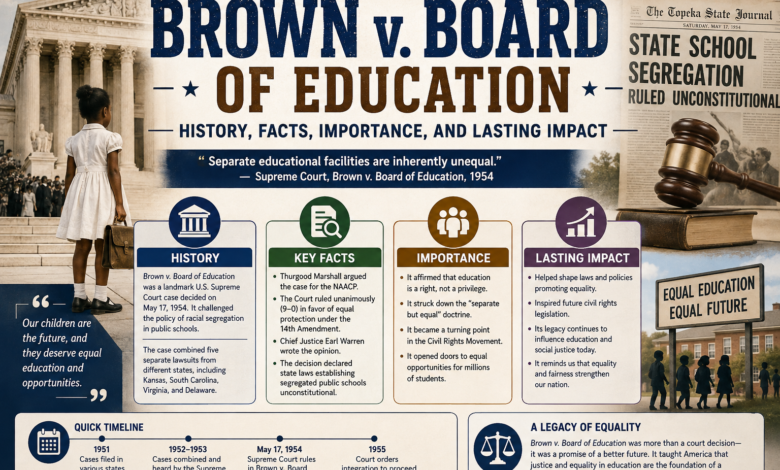
brown v board of education is one of the most important decisions in the history of the United States. The case changed the way the country understood racial segregation in public schools and became a major turning point in the struggle for civil rights. On May 17, 1954, the Supreme Court of the United States ruled that racial segregation in public schools was unconstitutional.
The decision rejected the idea that separate schools for Black and white children could be equal under the Constitution. In simple terms, the Court found that separating children by race in public education violated the Equal Protection Clause of the Fourteenth Amendment. This ruling did not instantly end segregation everywhere, but it gave the civil rights movement a powerful legal victory.

The story behind brown v board of education involves families, students, lawyers, teachers, activists, and communities that challenged an unfair system. Their efforts helped change American law and encouraged further action against racial discrimination. Even today, the case remains an important example of how the legal system can help bring about social change.
What Was brown v board of education?
brown v board of education was actually connected to several different school-segregation cases from different parts of the United States. The Supreme Court combined these cases because they raised similar constitutional questions about racial segregation in public education.
The main case came from Topeka, Kansas, and involved Oliver Brown, whose daughter Linda Brown had to travel across town to attend a segregated Black school even though a white school was much closer to her home. The case became known by the name Brown v. Board of Education of Topeka.
The Browns and other families argued that segregated schools were unfair and violated the constitutional rights of Black children. Their legal challenge eventually reached the Supreme Court.
The Court’s decision was unanimous. All nine justices agreed that racial segregation in public schools was unconstitutional. Chief Justice Earl Warren delivered the Court’s opinion, making the ruling a historic moment in American law.
The United States Before brown v board of education
To understand brown v board of education, it’s important to understand what American society looked like before the decision.
After the end of the Civil War, the United States adopted constitutional amendments that provided important legal protections for formerly enslaved people and their descendants. The Fourteenth Amendment, ratified in 1868, included the Equal Protection Clause. It stated that states couldn’t deny people equal protection under the law.
However, racial discrimination continued in many parts of the country. In the late nineteenth and early twentieth centuries, several states, especially in the South, created laws requiring racial segregation in public places.
These laws became known as Jim Crow laws.
Segregation affected many areas of life, including:
- Public schools
- Restaurants
- Transportation
- Parks
- Libraries
- Hospitals
- Public buildings
- Waiting rooms
- Other public facilities
Black Americans often faced unequal treatment, limited opportunities, and discriminatory laws.
Although segregation was legally required in some states, the facilities provided to Black communities were frequently worse than those available to white communities. School buildings, textbooks, transportation, and educational resources could all be unequal.
That reality became an important part of the legal argument against segregated education.
The Plessy v Ferguson Decision
Another important case in the history leading to brown v board of education was Plessy v. Ferguson.
In 1896, the Supreme Court ruled in Plessy v. Ferguson that racial segregation could be constitutional if the separate facilities were supposedly equal. This became known as the “separate but equal” doctrine.
The problem was that separate facilities were rarely equal in practice.
For decades, the doctrine allowed racial segregation to continue. Black Americans and civil rights organizations increasingly challenged the idea that separation could ever provide genuine equality.
The legal fight eventually moved toward public education. Lawyers began showing that segregated schools harmed Black children and denied them equal educational opportunities.
By the middle of the twentieth century, the legal foundation supporting school segregation was under serious pressure.
Who Was Linda Brown?
Linda Brown became one of the best-known figures associated with brown v board of education, even though she was a child when the legal case began.
Linda lived in Topeka, Kansas, with her family. Her father, Oliver Brown, wanted her to attend the nearby Sumner Elementary School, which was reserved for white children.
Instead, Linda had to attend Monroe Elementary School, a school for Black children located farther from her home.
The problem wasn’t simply the distance. The situation represented a larger system in which children were separated according to race.
Oliver Brown joined other parents in challenging the school system. Their case became part of the larger Supreme Court battle.
Linda Brown’s story helped Americans understand the real human impact of segregation. This wasn’t just a legal argument written in books. It affected children’s daily lives, education, opportunities, and sense of belonging.
The Role of the NAACP
The National Association for the Advancement of Colored People, commonly known as the NAACP, played a major role in the legal fight against school segregation.
NAACP lawyers had been challenging racial discrimination in courts for years. One of the most important lawyers involved was Thurgood Marshall, who later became the first Black justice on the United States Supreme Court.
Marshall and his legal team argued that segregated education violated the Constitution.
They presented evidence showing that segregation caused serious harm to Black children. The lawyers also argued that separating children based on race sent a message that Black children were less valued than white children.
The legal strategy was carefully developed over many years. Rather than treating each discriminatory practice as an isolated problem, the NAACP challenged the broader legal system that supported racial inequality.
This long legal campaign eventually helped create the conditions for the Supreme Court’s landmark ruling.
The Supreme Court’s Decision in brown v board of education
On May 17, 1954, the Supreme Court announced its decision in brown v board of education.
The Court ruled that racial segregation in public schools violated the Equal Protection Clause of the Fourteenth Amendment.
Chief Justice Earl Warren wrote the opinion for the unanimous Court.
The ruling directly challenged the constitutional basis of segregated public education. The Court rejected the idea that separate schools could provide equal educational opportunities simply because governments claimed that the facilities were equal.
One of the most important ideas in the decision was that segregation itself could create inequality.
The Court recognized that separating children by race could affect their feelings, education, and position in society. In other words, the harm wasn’t measured only by the number of books or the condition of a school building.
The decision represented a major shift in constitutional law.
Why the Fourteenth Amendment Mattered
The Fourteenth Amendment was central to brown v board of education.
The amendment was adopted after the Civil War and included several important protections. Among them was the Equal Protection Clause, which requires states to provide equal protection of the laws.
The Supreme Court had to determine whether state-supported racial segregation in public schools violated this constitutional protection.
The Court said it did.
This was significant because public schools were operated or supported by state and local governments. Therefore, racial separation in those schools wasn’t simply a private choice. It was a government-supported system.
The decision demonstrated how constitutional principles could be applied to real-life situations.
It also showed why constitutional amendments can remain important for generations. Although the Fourteenth Amendment had been written decades earlier, its meaning continued to shape major legal debates.
The Five Cases Behind the Decision
Although people commonly talk about brown v board of education as one case, the Supreme Court decision actually involved several related cases.
The cases came from different states and communities. They included challenges from:
- Kansas
- South Carolina
- Virginia
- Delaware
- Washington, D.C.
The Kansas case was the one that gave the Supreme Court decision its famous name.
The cases had different local circumstances, but they shared a central question: Could government-supported racial segregation in public schools be constitutional?
By bringing the cases together, the Supreme Court could address the broader constitutional issue.
This made the ruling more powerful than a decision involving only one school district.
The Decision Was Unanimous
One remarkable feature of brown v board of education was that the Supreme Court reached its decision unanimously.
All nine justices agreed that racial segregation in public schools was unconstitutional.
A unanimous decision sent a strong message to the country. It showed that the Court was united on the basic constitutional principle involved.
Chief Justice Earl Warren worked to build agreement among the justices. The final opinion clearly rejected state-sponsored segregation in public education.
A unanimous ruling didn’t mean that everyone in the country agreed with the decision. In fact, many communities strongly resisted it.
Still, the Court’s unity gave the ruling important legal and historical authority.
Brown II and the Challenge of Enforcement
The first brown v board of education decision declared school segregation unconstitutional, but another question remained: How quickly would schools actually become integrated?
In 1955, the Supreme Court issued a follow-up decision commonly called Brown II.
The Court instructed school authorities to move toward desegregation with what became known as “all deliberate speed.”
This phrase became controversial because many school districts resisted integration. Some officials delayed changes, while others openly opposed the Supreme Court’s authority.
As a result, the legal victory of 1954 didn’t immediately create integrated schools across the nation.
The difference between changing a law and changing society became very clear.
Resistance to the Supreme Court Ruling
The ruling in brown v board of education faced strong resistance in several states.
Some politicians and local officials argued against school integration. In certain areas, governments attempted to find ways to avoid following the decision.
The resistance could take many forms, including:
- Delaying integration
- Closing schools
- Creating new policies
- Using political pressure
- Supporting legal challenges
- Encouraging public opposition
One famous example occurred in Little Rock, Arkansas, in 1957. Nine Black students, later known as the Little Rock Nine, attempted to attend Central High School.
The crisis became a major national story and demonstrated how difficult enforcement could be.
The federal government eventually intervened to help enforce the students’ right to attend the school.
This episode showed that the Supreme Court’s decision required action from other parts of government before its principles could become a reality for many students.
The Impact on the Civil Rights Movement
brown v board of education became an important foundation for the wider civil rights movement.
The decision didn’t solve every problem involving racial discrimination. However, it demonstrated that segregation could be challenged successfully through the courts.
It also encouraged further legal and political action.
During the following years, civil rights activists challenged discrimination in:
- Public transportation
- Voting
- Housing
- Employment
- Public accommodations
- Higher education
The movement gained strength through protests, court cases, community organizing, and federal legislation.
The Supreme Court’s ruling helped establish an important principle: racial discrimination supported by government authority could be challenged under the Constitution.
The Importance of Education in the Case
Education was at the heart of brown v board of education because schools play a major role in children’s futures.
A good education can provide knowledge, skills, confidence, and opportunities. When children are denied equal access to education, the effects can last for years.
Segregation also shaped how children viewed themselves and other people.
The Supreme Court recognized that separating children by race could create feelings of inferiority and reinforce racial divisions.
This made the case about more than school buildings and textbooks. It was about equal citizenship and the promise that children should have a fair chance to learn.
That idea remains relevant today because equal educational opportunity continues to be an important goal.
How brown v board of education Changed American Law
The legal importance of brown v board of education goes beyond school segregation.
The ruling became a major part of the development of modern civil rights law. It strengthened the use of the Fourteenth Amendment to challenge government-supported racial discrimination.
Later court cases built upon the principles involved in Brown.
The decision also changed the role of the Supreme Court in debates about equality.
It showed that constitutional rights could be used to challenge deeply established systems, even when those systems had existed for generations.
Of course, courts aren’t the only institutions that create social change. Congress, presidents, state governments, local communities, schools, organizations, and ordinary citizens all played important roles.
Still, the Brown decision provided a powerful legal foundation.
Long-Term Effects of brown v board of education
The effects of brown v board of education can still be seen in American society.
The decision helped weaken the legal structure of racial segregation and encouraged further challenges to discriminatory practices.
Its influence can be understood through several major areas:
| Area | Impact of the Decision |
| Public education | Challenged legally enforced racial segregation |
| Constitutional law | Strengthened Equal Protection arguments |
| Civil rights | Encouraged further legal challenges |
| Federal authority | Demonstrated the government’s role in enforcing constitutional rights |
| Social change | Helped challenge ideas supporting racial separation |
| Education policy | Increased attention to equal educational opportunities |
| American history | Became a major milestone in the civil rights movement |
The process of achieving equality wasn’t immediate, and many challenges remained. Nevertheless, the decision marked a major change in the legal direction of the United States.
Important People Connected to the Case
Several people became closely associated with brown v board of education and the larger struggle against school segregation.
Oliver Brown
Oliver Brown was Linda Brown’s father and one of the parents who challenged Topeka’s segregated school system. His family’s experience became the central story behind the case’s name.
Linda Brown
Linda Brown was the child whose experience attending a distant segregated school helped bring national attention to the issue. She later became an important historical symbol of the fight for educational equality.
Thurgood Marshall
Thurgood Marshall was a leading NAACP lawyer who helped argue the school-segregation cases before the Supreme Court. He later became a Supreme Court justice.
Earl Warren
Earl Warren was Chief Justice of the United States when the Court decided Brown. He wrote the unanimous opinion that declared segregated public schools unconstitutional.
Civil Rights Activists and Families
The case wasn’t the work of only a few famous individuals. Many parents, children, teachers, lawyers, activists, and community members contributed to the broader campaign against segregation.
Their combined efforts mattered enormously.
Common Misunderstandings About brown v board of education
There are several misunderstandings about the case.
One common mistake is believing that the decision immediately ended all school segregation. It didn’t.
The ruling declared segregated public schools unconstitutional, but implementation took years and faced significant resistance.
Another misunderstanding is that Brown involved only Kansas. In reality, the Supreme Court combined several related cases from different locations.
Some people also believe the decision ended racial inequality in education. That isn’t accurate either. Brown addressed legally enforced segregation in public schools, but educational inequality continued in different forms.
Understanding these distinctions helps readers appreciate both the importance and the limitations of the ruling.
Why the Case Still Matters Today
More than seven decades after the decision, brown v board of education remains relevant.
Modern discussions about education often include questions about equal opportunity, school resources, access to quality instruction, and the effects of residential patterns on schools.
The country has changed significantly since 1954, but the basic idea behind Brown remains powerful: government-supported systems shouldn’t deny people equal protection because of race.
The case also teaches an important lesson about change.
A court decision can establish a legal principle, but putting that principle into practice can take time. It often requires cooperation, persistence, public education, and continued attention.
That lesson extends far beyond school policy.
Lessons Students Can Learn From the Case
Students studying brown v board of education can learn several important lessons.
First, laws can affect everyday life. A constitutional principle may seem abstract, but in this case it directly affected where children could attend school.
Second, ordinary families can become part of major historical events. Oliver and Linda Brown weren’t seeking fame. They were challenging an unfair situation in their community.
Third, change can take time. The Supreme Court issued a historic decision in 1954, but many schools remained segregated for years afterward.
Fourth, teamwork matters. Lawyers, families, activists, judges, teachers, and government officials all played different roles.
Finally, history shows that rights and equality often require people to speak up when systems are unfair.
Frequently Asked Questions About brown v board of education
What was the main purpose of brown v board of education?
The main purpose was to challenge racial segregation in public schools. The Supreme Court ultimately ruled that segregated public education violated the Equal Protection Clause of the Fourteenth Amendment.
When was brown v board of education decided?
The Supreme Court announced its decision on May 17, 1954.
Was the decision unanimous?
Yes. All nine Supreme Court justices agreed that racial segregation in public schools was unconstitutional.
Who was Linda Brown?
Linda Brown was a Black student from Topeka, Kansas, whose family challenged the city’s segregated public school system. Her experience became central to the case.
Who argued the case for the families?
Thurgood Marshall and other NAACP lawyers represented the families in the legal battle. Marshall later became a Supreme Court justice.
Did the decision immediately integrate every American school?
No. Although the ruling declared segregated public schools unconstitutional, many communities resisted or delayed integration. The process took many years.
Why is the Fourteenth Amendment important to the case?
The Court relied on the Equal Protection Clause of the Fourteenth Amendment. The Court concluded that government-supported racial segregation in public schools denied Black children equal protection under the law.
Why is the case important today?
The case remains an important symbol of equality, constitutional rights, and the fight against racial discrimination. It also demonstrates how legal challenges can contribute to major social change.
Conclusion: The Lasting Meaning of brown v board of education
brown v board of education stands as a landmark moment in American history. The Supreme Court’s 1954 decision rejected racial segregation in public schools and declared that separate educational systems based on race violated the Constitution.
The ruling was the result of years of work by families, students, lawyers, civil rights organizations, and communities. Although the decision didn’t instantly eliminate segregation or inequality, it changed American constitutional law and helped create momentum for the broader civil rights movement.
Its greatest lesson is that equality isn’t simply an idea written in a document. It must be protected through laws, institutions, education, and the actions of people who are willing to challenge unfair systems.
For students and readers today, brown v board of education offers a powerful reminder that history can change when people stand together for fairness, equal opportunity, and basic rights.