
Nionenad: A Complete Expert Guide to Understanding Its Meaning, Uses, and Future
Introduction to nionenad
The world of digital ideas and modern systems is always changing, and one term that has started gaining attention is nionenad. Even though it may sound unusual at first, nionenad represents a growing concept that blends innovation, structured thinking, and adaptable solutions for modern challenges.
In simple terms, nionenad can be understood as a flexible framework or idea used to organize processes, improve understanding, and support better decision-making in different fields. Whether you are a student, a researcher, or just someone curious about new concepts, learning about nionenad can help you see how structured systems make life easier and more efficient.


This article will walk you through everything about nionenad in a simple, clear, and human-like way. So, let’s dive in!
What is nionenad?
At its core, nionenad is a conceptual model that focuses on structured organization and adaptive learning. It is often described as a system that helps people or processes adjust to new conditions while keeping a stable foundation.
To make it even simpler, think of nionenad as a smart organizing tool. It helps:
- Break complex ideas into simpler parts
- Improve understanding of systems
- Support better communication between elements
- Allow flexibility when conditions change
Although nionenad is not tied to a single real-world object, it is widely used as a theoretical idea in learning systems, problem-solving frameworks, and analytical models.
So yes, while it might sound abstract, nionenad is actually very practical when applied correctly.
The Origin and Concept Behind nionenad
The concept of nionenad is believed to come from modern systems thinking. It was developed as a response to increasingly complex environments where traditional methods were no longer enough.
Back in earlier structured models, systems were often rigid. But as industries and technologies evolved, people needed something more flexible. That’s where nionenad steps in.
It combines three important ideas:
- Adaptability – The ability to adjust quickly
- Structure – A clear and organized system
- Integration – Connecting different parts smoothly
Over time, nionenad has become a symbolic way to describe systems that are both strong and flexible at the same time.
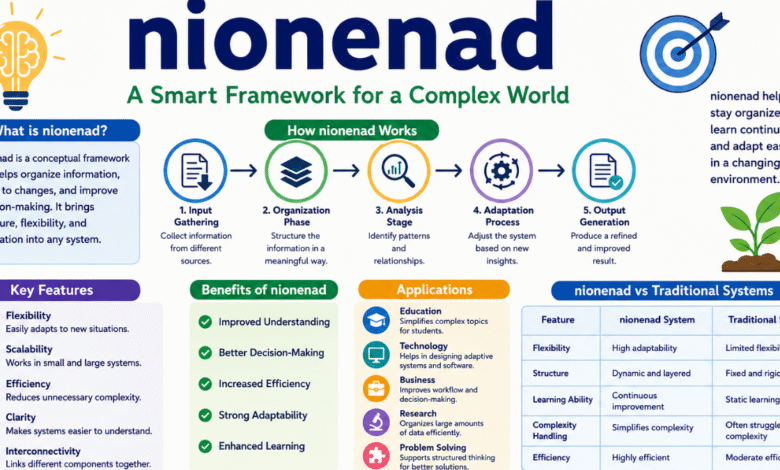
How nionenad Works in Practice
Even though nionenad is theoretical, it can still be explained in practical steps. Imagine a system that learns and adjusts continuously.
Here’s how nionenad typically works:
- Input Gathering
Information is collected from different sources. - Organization Phase
The collected data is structured in a meaningful way. - Analysis Stage
Patterns and relationships are identified. - Adaptation Process
The system adjusts based on new insights. - Output Generation
A refined and improved result is produced.
This cycle continues, making nionenad a dynamic and evolving framework.
Key Features of nionenad
The strength of nionenad lies in its unique features. These features make it useful in various conceptual and practical environments.
Some of the most important features include:
- Flexibility – Easily adapts to new situations
- Scalability – Works in small and large systems
- Efficiency – Reduces unnecessary complexity
- Clarity – Makes systems easier to understand
- Interconnectivity – Links different components together
Because of these features, nionenad is often seen as a modern solution for handling complexity.
Benefits of nionenad
The advantages of using or understanding nionenad are quite impressive. It offers value in both educational and professional environments.
Improved Understanding
It breaks down complex ideas into simpler parts.
Better Decision-Making
With structured data, decisions become more accurate.
Increased Efficiency
It reduces confusion and unnecessary steps.
Strong Adaptability
It adjusts to new challenges without breaking the system.
Enhanced Learning
Students and researchers can understand difficult topics more easily.
In short, nionenad makes complex systems feel a lot more manageable.
Challenges of nionenad
Of course, no system is perfect, and nionenad also comes with some challenges.
Some of these include:
- Difficulty in understanding at first
- Requires proper training or explanation
- May not be suitable for very simple tasks
- Can become confusing without proper structure
However, once understood, these challenges become much easier to handle. As the saying goes, “Every new idea feels tricky before it becomes familiar.”
Applications of nionenad in Real Life
Even though nionenad is a conceptual framework, it can still be applied in several areas.
Education
Teachers can use it to simplify complex topics for students.
Technology
It helps in designing adaptive systems and software models.
Business
Companies can use it to improve workflow and decision-making.
Research
Researchers can organize large amounts of data efficiently.
Problem Solving
It supports structured thinking when tackling difficult issues.
In all these areas, nionenad acts like a guiding structure that keeps things balanced and clear.
Comparison Table of nionenad and Traditional Systems
| Feature | nionenad System | Traditional System |
|---|---|---|
| Flexibility | High adaptability | Limited flexibility |
| Structure | Dynamic and layered | Fixed and rigid |
| Learning Ability | Continuous improvement | Static learning |
| Complexity Handling | Simplifies complexity | Often struggles with complexity |
| Efficiency | Highly efficient | Moderate efficiency |
This table shows how nionenad stands out when compared to older models.
Future Possibilities of nionenad
The future of nionenad looks very promising. As systems become more complex, the need for adaptive frameworks increases.
In the coming years, nionenad may evolve into:
- Smarter learning systems
- Advanced AI-based structures
- More efficient data organization tools
- Improved decision-making models
Experts believe that nionenad could become an important part of future digital and analytical systems.
Practical Tips for Understanding nionenad
If you are trying to understand nionenad, here are some helpful tips:
- Start with basic concepts first
- Break information into small parts
- Use real-life examples for clarity
- Practice applying the idea in simple situations
- Don’t rush—understanding comes with time
Remember, even experts once struggled with complex ideas before mastering them.
Common Misconceptions About nionenad
There are a few misunderstandings about nionenad that need to be cleared up.
It is not a physical tool
Some people think it is a machine or software, but it is actually a concept.
It is not overly complicated
While it may seem complex, it becomes simple with proper explanation.
It is not limited to one field
It can be applied in many areas, not just one industry.
By clearing these misconceptions, it becomes easier to appreciate the true value of nionenad.
Conclusion: The Growing Importance of nionenad
In today’s fast-changing world, systems need to be flexible, smart, and easy to understand. That is exactly where nionenad plays an important role. It brings structure to complexity and helps people think in a more organized and efficient way.
From education to business and beyond, nionenad continues to show its value as a powerful conceptual framework. Even though it may feel unfamiliar at first, once understood, it becomes a helpful tool for clearer thinking and better problem-solving.
As we move forward into a more advanced future, nionenad will likely become even more relevant and widely used in different fields. So, taking the time to understand it today can definitely give you an advantage tomorrow.
And finally, to wrap it up, nionenad is more than just a term—it is a growing idea that represents adaptability, clarity, and structured thinking in an increasingly complex world.