Pinstripes Bankruptcy Filing: What Happened, Why It Filed, and What Comes Next
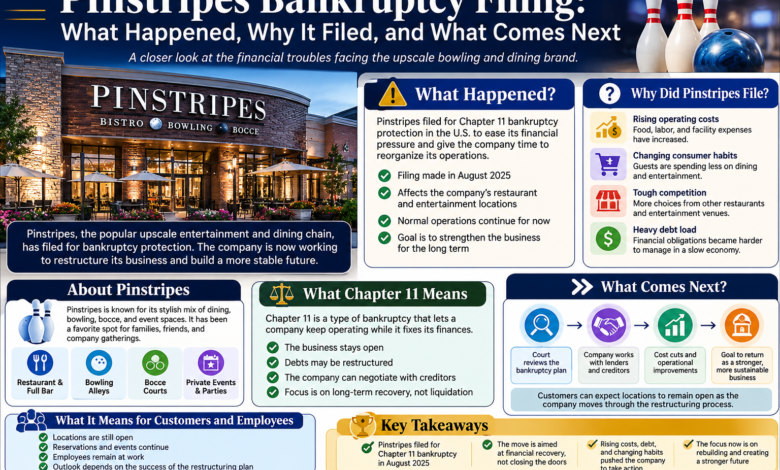
The pinstripes bankruptcy filing became a major development in the U.S. restaurant and entertainment industry in September 2025. Pinstripes, known for combining Italian-American dining with bowling, bocce, private events, and social entertainment, entered Chapter 11 bankruptcy protection after facing serious financial pressure. The filing was made in the U.S. Bankruptcy Court for the District of Delaware on September 8, 2025. Court records and industry reports placed the company’s assets and liabilities in broad ranges of $100 million to $500 million, while other reporting indicated that the company had more than $250 million in liabilities.
At first, the bankruptcy was designed as a restructuring effort rather than an immediate shutdown. Pinstripes hoped to protect its strongest locations, preserve jobs, reduce its financial burden, and find a path forward. However, the situation changed quickly. Several locations had already closed, the company struggled to attract outside buyers, and the bankruptcy case eventually moved from Chapter 11 toward liquidation under Chapter 7.


That doesn’t mean the Pinstripes brand simply disappeared overnight. A court-approved asset transaction allowed a buyer connected with Punch Bowl Social and Silverview Credit Partners to acquire certain assets and seven locations. The remaining bankruptcy estate then continued through a wind-down process. As of August 2026, the court record shows that the Chapter 7 case remains active, with later proceedings involving the trustee and New Punch Bowl Social.
Pinstripes Bankruptcy Filing: A Quick Overview
The pinstripes bankruptcy filing can be easier to understand when the major facts are placed side by side. The case wasn’t simply about a restaurant closing one or two underperforming locations. It involved a broader financial restructuring, the sale of business assets, location closures, and eventually a Chapter 7 wind-down.
| Key detail | Information |
| Company | Pinstripes Holdings, Inc. and related entities |
| Industry | Dining and entertainment |
| Founded | 2007 |
| Headquarters | Northbrook, Illinois |
| Original filing | Chapter 11 |
| Filing date | September 8, 2025 |
| Bankruptcy court | U.S. Bankruptcy Court for the District of Delaware |
| Original case | 25-11677 and related cases |
| Reported liabilities | More than $250 million in contemporary reporting |
| Locations before restructuring | About 18 |
| Locations closed before filing | About 10 |
| Locations continuing through the sale process | Seven |
| Later bankruptcy status | Chapter 7 wind-down |
| Asset buyer | New PBS Brand Co./Punch Bowl Social-related ownership |
| Major lender | Silverview Credit Partners |
The numbers are important, but they don’t tell the whole story. Pinstripes was an example of how a business can have a recognizable brand and popular customer concept while still experiencing significant financial difficulties.
What Is Pinstripes and Why Was It Popular?
Pinstripes was founded in Illinois in 2007 with an idea that was different from a traditional restaurant. Instead of asking customers to choose between eating out and entertainment, the company combined the two. Guests could enjoy Italian-American food while also bowling, playing bocce, attending events, or spending time with friends and family.
That business model became part of the larger “eatertainment” trend. The goal was to make a visit last longer and become more of an experience than an ordinary meal. For many customers, that made Pinstripes attractive for birthdays, corporate gatherings, family occasions, celebrations, and other group events.
The company eventually expanded to 18 locations across the United States. Its growth showed that there was demand for venues that mixed food, games, and social activities. However, rapid growth can also create challenges. Large venues generally carry significant rent, staffing, maintenance, food, equipment, and operating costs. When customer traffic falls, those fixed expenses can become difficult to manage.
Why Did the Pinstripes Bankruptcy Filing Happen?
The pinstripes bankruptcy filing was the result of several financial and operating pressures rather than one single problem. Industry reporting and court-related documents point to inflation, higher labor expenses, weaker consumer spending, debt obligations, and declining traffic as important factors.
The company had been under financial pressure for months before the bankruptcy became public. In June 2025, reports emerged that Pinstripes was considering bankruptcy protection and was negotiating with lenders. By September, the company had moved forward with the filing.
Some of the major pressures included:
- Rising food and operating costs
- Higher labor expenses
- Inflation affecting both businesses and customers
- Reduced consumer spending in certain markets
- Significant debt obligations
- Underperforming locations
- High fixed costs associated with large entertainment venues
- Difficulty attracting a third-party buyer
- Previous financing and ownership challenges
In other words, Pinstripes was caught in a difficult squeeze. Costs were rising while the company needed strong customer traffic to support its large venues.
The Impact of Inflation and Labor Costs
Inflation became an important issue for restaurants and entertainment businesses across the United States. Pinstripes was particularly exposed because its model required more than a conventional restaurant operation.
A large Pinstripes venue needed employees for food service, hospitality, event management, bowling operations, maintenance, and other functions. When wages and other operating costs increase, a company has to either raise prices, improve sales, reduce expenses, or find additional financing.
The problem is that customers also feel inflation. When household budgets become tighter, people may reduce the number of restaurant meals, entertainment outings, or large celebrations they purchase. So, a business can face higher costs at exactly the same time that demand becomes less predictable.
According to reporting around the bankruptcy, inflation and labor costs were among the factors that contributed to Pinstripes’ financial problems.
That combination can be especially challenging for a business built around discretionary spending. After all, bowling and restaurant outings are enjoyable purchases, but customers may postpone them when they need to prioritize essential expenses.
Pinstripes Bankruptcy Filing and the Location Closures
One of the clearest signs of trouble came through location closures.
Before the Chapter 11 filing, Pinstripes had operated approximately 18 venues. By the time the bankruptcy case began, about 10 locations had been closed, leaving roughly eight operating locations. Restaurant Dive reported that the chain had fallen from 18 units to eight by the time of the bankruptcy filing.
The closures were part of an effort to reduce losses and focus resources on locations that had a better chance of surviving.
Reported closures included venues in several major markets, including Texas, California, Connecticut, Florida, Illinois, Kansas, New Jersey, and other areas. For example, the Pinstripes location at The SoNo Collection in Norwalk, Connecticut, permanently closed after the bankruptcy filing.
Closing a location isn’t an easy decision. Businesses have to consider employees, landlords, customers, leases, equipment, inventory, and outstanding obligations. But when a location consistently loses money, keeping it open can make the financial situation worse.
What Chapter 11 Meant for Pinstripes
The initial pinstripes bankruptcy filing was made under Chapter 11 of the U.S. Bankruptcy Code.
Chapter 11 is generally intended to give a financially troubled business an opportunity to reorganize. Instead of immediately liquidating everything, a company may continue operating while it works with creditors, lenders, landlords, employees, and the bankruptcy court.
For Pinstripes, the initial plan involved preserving the business as a going concern. The company received debtor-in-possession financing, and Silverview Credit Partners became a major part of the proposed restructuring strategy. Reporting indicated that Silverview agreed to provide financing of up to $3.8 million and also proposed a $15 million credit bid as part of the sale process.
This approach gave Pinstripes a chance to sell assets while continuing operations at selected venues.
However, Chapter 11 isn’t a guarantee that a company will successfully reorganize. It provides a legal framework for restructuring, but the business still needs enough value, financing, and operational strength to support a future.
Why Pinstripes Eventually Moved Toward Chapter 7
The biggest change in the case came when Pinstripes determined that Chapter 11 restructuring was no longer producing the desired result.
In late October 2025, the company had pursued a sale process but did not receive enough outside interest to create a better alternative. Pinstripes then sought permission to convert the bankruptcy case to Chapter 7 liquidation. Bloomberg Law reported that the company said it had liquidated as many assets as possible and would have very limited funding after the asset sale.
The bankruptcy court ultimately approved the conversion. Court records show that the lead case, originally filed as Chapter 11, was converted to Chapter 7 on December 2, 2025.
This was a major turning point.
Chapter 7 generally focuses on liquidation rather than business reorganization. In a corporate Chapter 7 case, a trustee can oversee remaining assets and handle the administration of the estate, including claims and other outstanding matters.
So, while the original strategy was to restructure the company, the later strategy became more about winding down the old corporate entities and dealing with their remaining obligations.
The Role of Silverview Credit Partners
Silverview Credit Partners became one of the most important financial players in the pinstripes bankruptcy filing.
The lender had substantial secured debt connected to Pinstripes and supported the bankruptcy process through financing and a proposed credit bid. The court-supervised sale process was structured in a way that allowed the company to preserve value in selected parts of the business.
A credit bid is different from a traditional cash-only purchase. In simple terms, a secured creditor can sometimes use the amount it is owed as part of its bid for assets. This can allow a lender to acquire collateral without paying the entire purchase price in new cash.
In Pinstripes’ case, reporting around the sale described Silverview’s involvement in the stalking-horse bidding process. The court approved a transaction involving a credit bid and additional cash consideration.
This was important because the business needed a credible buyer and funding structure to preserve at least part of the operation.
Pinstripes and Punch Bowl Social
One of the most interesting parts of the bankruptcy story was the connection between Pinstripes and Punch Bowl Social.
Punch Bowl Social is another entertainment-focused hospitality company. Like Pinstripes, it combines food, social activities, and games. The two brands therefore operate in a similar part of the broader “eatertainment” market.
During the bankruptcy process, Punch Bowl Social was identified as a potential buyer, and a transaction involving New PBS Brand Co. ultimately resulted in the acquisition of certain Pinstripes assets and seven locations. The transaction was approved by the bankruptcy court on October 31, 2025, and was completed in November.
This distinction matters: the bankruptcy of the original Pinstripes corporate entities did not necessarily mean that every Pinstripes location or every part of the brand disappeared.
Instead, selected assets were transferred to a new ownership structure.
That is a common feature of bankruptcy proceedings. A financially troubled company may be unable to survive in its original form while parts of its business still have value.
What Happened to the Pinstripes Brand?
The pinstripes bankruptcy filing created a complicated situation for the brand.
The old corporate entities entered bankruptcy and later moved into Chapter 7 wind-down proceedings. At the same time, certain Pinstripes assets and locations were sold to a buyer associated with Punch Bowl Social and Silverview.
This means readers should be careful when saying simply that “Pinstripes went out of business.” That statement is too broad.
A more accurate description is that Pinstripes underwent bankruptcy, closed numerous locations, sold selected assets and locations, and entered a Chapter 7 wind-down of its former corporate structure.
Contemporary reports said the acquired locations could continue operating under the Pinstripes name.
That distinction is important for customers. A restaurant’s corporate bankruptcy does not always mean that every location closes permanently. Sometimes another company purchases the valuable pieces of the business and continues operating them.
What Happened to Employees?
Employees were among the people most directly affected by the restructuring.
When Pinstripes closed locations, workers at those venues were affected by the shutdowns. At the time of the original bankruptcy filing, reports indicated that the remaining eight locations supported nearly 900 jobs.
Bankruptcy can create uncertainty for employees because a business may change its operating schedule, close locations, sell assets, or transfer operations to another owner.
At the same time, preserving a business as a going concern can save jobs that might otherwise disappear entirely. That was one reason the Chapter 11 process initially focused on keeping selected Pinstripes venues open.
The later asset sale also created an opportunity for some operations to continue under new ownership. The outcome for individual workers, however, could vary by location and employment arrangement.
What Happened to Customers, Gift Cards, and Events?
Customers naturally had questions when the bankruptcy became public.
People who had already booked events, purchased gift cards, or made deposits wanted to know whether their money and reservations would still be honored. Pinstripes publicly told customers that gift cards and event deposits remained valid at continuing locations during the restructuring process.
However, bankruptcy-related policies can change depending on the specific location, date, contract, and ownership structure.
Customers should therefore avoid assuming that a reservation or gift card connected with a closed location automatically carries the same terms as one connected with a continuing venue.
The safest approach in any business restructuring is to verify the status of a specific booking or payment directly with the current operator.
How the Pinstripes Story Reflects a Bigger Restaurant Trend
The pinstripes bankruptcy filing also highlights broader changes taking place across the restaurant and entertainment industry.
The traditional restaurant business has become increasingly challenging because operators face several pressures at the same time. Food prices, wages, rent, insurance, utilities, technology costs, and borrowing expenses can all rise.
Meanwhile, customers have many choices.
Restaurants and entertainment companies must offer something memorable enough to encourage customers to spend their limited leisure budgets. Pinstripes attempted to solve this problem by creating a complete experience around food, bowling, and bocce.
That idea remains attractive, but the economics have to work.
A large entertainment venue can generate significant revenue when busy. Yet it can also have high fixed expenses when customer traffic falls. The Pinstripes experience demonstrates why growth must be balanced with sustainable unit-level profitability.
The Company’s Expansion Strategy and Financial Pressure
Pinstripes’ earlier growth was part of its appeal. The company demonstrated that its concept could work in different markets, and it expanded its footprint over time.
But expansion requires capital.
Opening a large entertainment venue can involve major construction expenses, equipment purchases, real estate costs, hiring, marketing, and pre-opening expenses. The company also has to build a local customer base after opening.
When expansion happens faster than cash flow can support, debt can become a significant burden.
According to reporting, Pinstripes had worked with advisers to explore strategic alternatives before the bankruptcy filing. The company reportedly contacted numerous potential parties during a sales process, but the initial effort did not produce a third-party offer that solved its financial problems.
That failure to attract a suitable buyer was an important part of the road toward bankruptcy.
Pinstripes and Its Public-Market History
Another important part of the story is Pinstripes’ experience as a public company.
Pinstripes went public in 2023, but its time as a publicly traded company did not provide the long-term financial stability the business needed. Restaurant Dive reported that the New York Stock Exchange issued a delisting notice in March 2025 and that the company did not appeal the determination.
Around the same period, Oaktree Capital Management took a significant ownership position in exchange for financing intended to keep the business operating.
These developments show how the company moved through several stages of financial support before reaching bankruptcy.
For readers, this is an important lesson: bankruptcy filings often represent the final stage of financial problems that have been developing for months or even years.
What the Bankruptcy Means for Creditors
Creditors are another major group affected by the pinstripes bankruptcy filing.
Pinstripes entered bankruptcy with substantial obligations. The bankruptcy process creates a formal system for identifying claims and determining how remaining assets can be distributed.
Not all creditors have the same legal position. Secured creditors, unsecured creditors, landlords, vendors, employees, and government agencies may have different rights depending on the nature and priority of their claims.
The case records show that claims administration became part of the Chapter 7 process, with deadlines established for filing claims.
For ordinary readers, the key point is simple: when a company doesn’t have enough assets to pay everyone in full, bankruptcy law establishes an order and process for handling those competing claims.
What the Chapter 7 Wind-Down Means Now
As of August 2026, the case is no longer simply an attempt to rescue the original Pinstripes corporation.
Court records identify the lead debtor as PS Holdings Wind Down, Inc., formerly Pinstripes Holdings, Inc. The case is listed as Chapter 7, following the conversion from Chapter 11.
The court docket also shows activity in 2026 involving Chapter 7 trustee David Carickhoff. In June 2026, the court approved an agreement involving the trustee, American Express Travel Related Services Company, and New Punch Bowl Social.
That development demonstrates that the bankruptcy case continued after the main operating assets had been sold.
A wind-down can take time because the trustee may need to address remaining assets, claims, contracts, disputes, taxes, professional fees, and other legal or financial matters.
What the Pinstripes Bankruptcy Filing Teaches Business Owners
There are useful lessons in the pinstripes bankruptcy filing for restaurant operators and entrepreneurs.
A strong concept is valuable, but a strong concept alone isn’t enough. Companies also need sustainable finances.
Several lessons stand out:
- Growth needs discipline. Expanding into new markets can create opportunities, but each location must eventually prove its ability to generate sustainable returns.
- Fixed costs matter. Large venues can become expensive very quickly when sales decline.
- Debt must be manageable. Borrowing can accelerate growth, but heavy debt can reduce flexibility when conditions change.
- Consumer behavior can shift quickly. Inflation and economic uncertainty can change how often customers spend on dining and entertainment.
- Location performance matters. A company may need to close weak venues to protect stronger ones.
- Early action can help. Businesses facing financial trouble often benefit from examining restructuring options before liquidity becomes critical.
- Brand value can survive corporate failure. A company may fail while parts of its brand and operating model remain attractive to another owner.
These lessons aren’t limited to restaurants. They apply to many businesses that operate physical locations and depend on steady consumer traffic.
Is Pinstripes Completely Gone?
No, that would be an oversimplification.
The original corporate structure entered bankruptcy, many locations closed, and the case eventually moved into Chapter 7. However, certain assets and seven locations were acquired through the bankruptcy sale, with the Pinstripes brand continuing as part of the transaction.
So, the best way to describe the situation is that Pinstripes as its former corporate organization underwent bankruptcy and liquidation, while parts of the Pinstripes business continued under new ownership.
That outcome is actually one of the more interesting aspects of the case. Bankruptcy isn’t always the absolute end of a recognizable consumer brand. Sometimes it becomes a transition point.
What Could Happen to the Remaining Brand?
The future of the surviving Pinstripes locations depends on how the new ownership manages them.
The biggest opportunity is to preserve what customers liked about the original concept while improving the economics behind the business.
That could mean focusing on:
- Stronger-performing locations
- Better cost management
- More efficient staffing
- Event and group bookings
- Food and beverage performance
- Customer loyalty
- Local marketing
- More disciplined expansion
- Careful management of leases and other fixed costs
The new owner also has the opportunity to learn from the problems that contributed to the original bankruptcy.
That’s where the story can become optimistic. A failed corporate structure doesn’t necessarily mean the underlying idea has no value.
Pinstripes Bankruptcy Filing: Key Timeline
The pinstripes bankruptcy filing developed over several important stages.
Early 2025: Pinstripes faced financial pressure and explored strategic alternatives. The company also experienced challenges related to financing and its public-market status.
June 2025: Reports emerged that the company was considering bankruptcy protection while negotiating with lenders.
Summer 2025: The company moved toward closing underperforming locations and preparing for a restructuring.
September 8, 2025: Pinstripes Holdings and related entities filed for Chapter 11 protection in Delaware.
September 2025: The company continued operating selected venues while pursuing a sale and restructuring strategy.
October 31, 2025: The bankruptcy court approved the sale of certain assets.
November 2025: The asset transaction involving seven locations was completed, according to transaction reporting.
November 21, 2025: The court entered an order converting the Chapter 11 cases to Chapter 7.
December 2, 2025: The conversion became reflected in the bankruptcy case records, with the former operating entities moving into the Chapter 7 wind-down.
June 2026: The bankruptcy docket showed further trustee activity, including a court-approved agreement involving New Punch Bowl Social.
August 2026: The bankruptcy estate remains subject to ongoing court administration even though the main operating assets were previously sold.
Frequently Asked Questions About the Pinstripes Bankruptcy Filing
Did Pinstripes file for bankruptcy?
Yes. Pinstripes Holdings and related entities filed for Chapter 11 bankruptcy protection in the U.S. Bankruptcy Court for the District of Delaware on September 8, 2025.
Why did Pinstripes file for bankruptcy?
The company faced a combination of rising operating costs, inflation, labor expenses, reduced customer spending, debt obligations, and underperforming locations. These pressures weakened its financial position and liquidity.
Did all Pinstripes locations close?
No. About 10 of the company’s approximately 18 locations had closed by the Chapter 11 filing, leaving about eight operating at that point. Later, certain assets and seven locations were acquired through a bankruptcy sale.
Was Pinstripes’ bankruptcy Chapter 11 or Chapter 7?
It was both, but at different stages. Pinstripes initially filed under Chapter 11 in September 2025. The cases were later converted to Chapter 7, with the conversion reflected in December 2025 court records.
Who acquired parts of Pinstripes?
New PBS Brand Co., associated with Punch Bowl Social and Silverview Credit Partners, acquired certain Pinstripes assets and seven locations through the bankruptcy sale process.
Does the Pinstripes brand still exist?
Parts of the brand continued after the bankruptcy sale. The transaction involved seven locations and certain assets, allowing the Pinstripes name and operating concept to continue under new ownership.
Is the bankruptcy case finished?
The operating business changed substantially, but the bankruptcy estate has continued through Chapter 7 administration. Court records show trustee activity as recently as June 2026.
Final Thoughts on the Pinstripes Bankruptcy Filing
The pinstripes bankruptcy filing is a useful example of how a well-known restaurant and entertainment concept can face serious financial challenges even when its customer experience remains distinctive. Pinstripes built its reputation around food, bowling, bocce, events, and social experiences, but inflation, labor costs, debt, changing consumer spending, and underperforming locations created pressure that the company could not overcome in its original structure.
The story, however, isn’t simply one of failure. The bankruptcy process helped preserve value in selected locations and assets. A transaction involving Punch Bowl Social and Silverview allowed seven locations and parts of the Pinstripes business to continue under new ownership, while the former corporate entities moved through Chapter 7 wind-down proceedings.
Ultimately, the pinstripes bankruptcy filing shows that business survival isn’t always about keeping every location open or maintaining the same corporate structure. Sometimes the most realistic path forward is to close weaker operations, sell valuable assets, reduce financial pressure, and give the strongest parts of a brand another chance. For Pinstripes, that process has already reshaped the company dramatically, but the continuing brand presence suggests that the original idea still has value when paired with a more sustainable business model.