
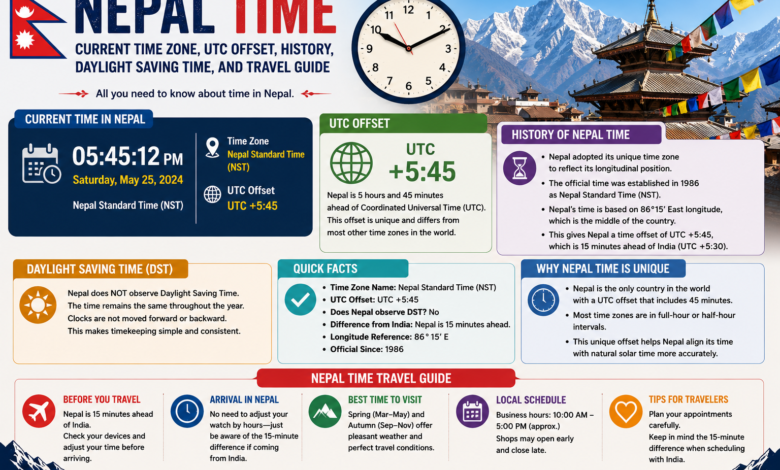
Nepal Time: Current Time Zone, UTC Offset, History, Daylight Saving Time, and Travel Guide
nepal time is the official time standard used throughout Nepal, a beautiful South Asian country known for Mount Everest, the Himalayas, ancient temples, diverse cultures, and busy cities such as Kathmandu. Understanding nepal time is useful for travelers, international businesses, students, families, and anyone communicating with people in Nepal.
Nepal follows Nepal Time, commonly abbreviated as NPT. The country’s standard time is UTC+5:45, which makes it unusual because the offset includes a forty-five-minute difference rather than a full hour. This small detail makes nepal time especially interesting when comparing it with neighboring countries and other parts of the world.


Unlike many countries, Nepal doesn’t currently change its clocks for daylight saving time. The same official time is generally observed throughout the year. So, if you’re planning a trip, scheduling an online meeting, calling someone in Kathmandu, or simply learning about Nepal’s geography, knowing nepal time can help you avoid confusion.
What Is Nepal Time?
nepal time is the standard time observed across Nepal. It is officially known as Nepal Standard Time and is abbreviated as NPT. The time zone has a UTC offset of UTC+5:45.
Coordinated Universal Time, or UTC, is the global reference system used to compare time around the world. When it is noon at UTC, the time in Nepal is five hours and forty-five minutes ahead.
For example, if UTC is 12:00 PM, nepal time is 5:45 PM.
This unusual offset makes Nepal stand out on the global time-zone map. Many countries use whole-hour differences, while others use half-hour or forty-five-minute offsets. Nepal is one of the world’s best-known examples of a forty-five-minute time zone.
The time applies throughout the country, meaning Kathmandu, Pokhara, Biratnagar, Lalitpur, Bhaktapur, and other areas generally follow the same official clock.
Nepal Time Zone and UTC Offset
The official time zone for nepal time is Nepal Time, with an offset of UTC+5:45.
Here’s a quick overview:
| Time Standard | Nepal |
| Official time zone | Nepal Time |
| Abbreviation | NPT |
| UTC offset | UTC+5:45 |
| Daylight saving time | Not observed |
| Country | Nepal |
| Main reference city | Kathmandu |
| Time-zone format | UTC+05:45 |
| Standard throughout country | Yes |
The forty-five-minute offset is the feature that most often surprises international visitors.
For instance, a person in a UTC+5 location would be forty-five minutes behind Nepal. Someone in a UTC+6 location would be fifteen minutes ahead of Nepal.
This unusual system can matter when arranging international calls, flights, online classes, work meetings, or virtual events.
Why Does Nepal Have a Forty-Five-Minute Time Difference?
The unusual nepal time offset is connected to Nepal’s geographical position and historical decision-making about its national standard time.
Time zones are broadly based on longitude. However, countries don’t always follow perfect fifteen-degree longitude divisions. Governments can select a national time standard that suits their geography, history, administration, and relationship with neighboring countries.
Nepal selected a time based on a longitude close to 86 degrees 15 minutes east. This helped create the forty-five-minute difference from UTC.
At first glance, the number may seem unusual. After all, why not simply choose an hour such as UTC+5 or UTC+6?
The answer lies in geography and historical national timekeeping decisions. Nepal’s official time was established to represent its position more closely than a simple whole-hour offset would.
As a result, nepal time became one of the world’s distinctive national time standards.
Nepal Time and Kathmandu
Kathmandu is Nepal’s capital and largest major urban center, making it one of the most useful reference points when discussing nepal time.
Kathmandu follows NPT throughout the year. Whether you’re checking the opening time of a business, planning a video call, arranging airport transportation, or following a local event, Kathmandu’s clock follows the national standard.
Kathmandu is also a major destination for international visitors. Travelers often arrive from countries with very different time zones, so understanding the local clock is important during the first few days of a trip.
The city combines modern neighborhoods with historic areas, temples, markets, and cultural landmarks. Because Kathmandu is Nepal’s political and economic center, many international organizations and businesses also coordinate activities according to nepal time.
Does Nepal Use Daylight Saving Time?
Nepal does not currently observe daylight saving time.
That means clocks generally remain on UTC+5:45 throughout the year. There isn’t a seasonal clock change in which residents move their clocks forward or backward.
This makes nepal time relatively straightforward to calculate.
For international travelers, this is helpful because you don’t have to worry about Nepal changing its clock at different points of the year.
However, the time difference between Nepal and another country can still change when that other country observes daylight saving time.
For example, a country might move its clocks forward during part of the year while Nepal keeps the same time. In that situation, the difference between the two countries changes even though Nepal itself hasn’t changed its clock.
Nepal Time Compared With India Time
One of the most common comparisons involving nepal time is India Standard Time.
India uses UTC+5:30, while Nepal uses UTC+5:45. Therefore, Nepal is fifteen minutes ahead of India.
For example:
| India Standard Time | Nepal Time |
| 8:00 AM | 8:15 AM |
| 10:00 AM | 10:15 AM |
| 12:00 PM | 12:15 PM |
| 3:00 PM | 3:15 PM |
| 6:00 PM | 6:15 PM |
| 9:00 PM | 9:15 PM |
This fifteen-minute difference is especially interesting because Nepal and India share a long border and have strong cultural, economic, and social connections.
Travelers crossing between the two countries need to remember that the official clocks aren’t exactly the same.
Nepal Time Compared With Pakistan Time
Pakistan Standard Time is UTC+5, while nepal time is UTC+5:45.
This means Nepal is forty-five minutes ahead of Pakistan.
For example, if it is 2:00 PM in Pakistan, it is 2:45 PM in Nepal.
| Pakistan Time | Nepal Time |
| 7:00 AM | 7:45 AM |
| 9:00 AM | 9:45 AM |
| 12:00 PM | 12:45 PM |
| 3:00 PM | 3:45 PM |
| 6:00 PM | 6:45 PM |
| 10:00 PM | 10:45 PM |
This comparison can be useful for students, remote workers, travelers, families, and businesses communicating across the two countries.
When scheduling a meeting, it’s a good idea to clearly state the time zone. A simple note such as “3:00 PM Nepal Time” can prevent misunderstandings.
Nepal Time Compared With Bangladesh Time
Bangladesh Standard Time is UTC+6, while Nepal uses UTC+5:45.
Therefore, Bangladesh is fifteen minutes ahead of Nepal.
This creates another interesting comparison because both countries use non-whole-hour relationships with some neighboring time standards.
For example, when it is 8:00 AM in Nepal, it is 8:15 AM in Bangladesh.
The small difference might seem insignificant, but it matters when people have appointments or online meetings scheduled close together.
For international communication, even a fifteen-minute difference can cause confusion if participants don’t specify their local time.
Nepal Time Compared With UTC
Understanding nepal time becomes simple once you know UTC.
Nepal is five hours and forty-five minutes ahead of UTC.
Here are some examples:
| UTC | Nepal Time |
| 12:00 AM | 5:45 AM |
| 3:00 AM | 8:45 AM |
| 6:00 AM | 11:45 AM |
| 9:00 AM | 2:45 PM |
| 12:00 PM | 5:45 PM |
| 3:00 PM | 8:45 PM |
| 6:00 PM | 11:45 PM |
| 9:00 PM | 2:45 AM next day |
The next-day difference is important when scheduling international events. A meeting that appears to take place in the evening in one location could occur after midnight in Nepal.
Using UTC as a common reference makes these calculations easier.
Nepal Time and International Business
Global communication has made nepal time increasingly relevant outside Nepal.
Businesses in Kathmandu and other Nepali cities may work with clients, partners, suppliers, and teams in Europe, North America, Asia, and other regions.
When arranging meetings, international teams should always specify the time zone.
For example, instead of writing:
“Let’s meet at 10 AM.”
It’s clearer to write:
“Let’s meet at 10 AM Nepal Time.”
This small habit can prevent scheduling errors.
Businesses can also use calendar applications that automatically convert meeting times for participants in different locations.
Remote workers should pay particular attention to time-zone differences when working with international teams. A regular meeting that is convenient for one team may take place very early in the morning or late at night for another.
Understanding nepal time makes international cooperation smoother and more professional.
Nepal Time for Travelers
Travelers visiting Nepal should understand the local time before arriving.
Most international visitors enter Nepal through Tribhuvan International Airport in Kathmandu. After a long journey, time-zone differences can be confusing, especially when comparing flight schedules and hotel bookings.
Before traveling, it’s helpful to:
- Check your phone’s automatic time-zone settings.
- Confirm the local arrival time on your flight ticket.
- Check hotel check-in and check-out times.
- Use local time when booking tours.
- Keep important appointment times written with the time zone.
- Remember that Nepal doesn’t use daylight saving time.
Once you’re in Nepal, phones and computers usually make the adjustment automatically if location-based time settings are enabled.
Still, understanding nepal time is useful because not every device or booking system handles time zones perfectly.
Nepal Time and Mount Everest
Mount Everest is one of Nepal’s most famous natural landmarks, and its location often makes people curious about nepal time.
Everest lies in the Himalayas along the Nepal-China border. Nepal’s official national time applies throughout the country, including areas close to the mountain.
However, sunrise and sunset aren’t identical everywhere in Nepal. Mountains, valleys, elevation, and longitude influence local daylight conditions.
This is an important distinction:
Official clock time is the national time standard, while solar time is based more directly on the position of the sun.
Two locations can share the same official clock but experience sunrise or sunset at slightly different local times.
For hikers and climbers, daylight conditions can be much more important than the clock itself. Mountain weather can also change quickly, so planning outdoor activities requires more than simply checking nepal time.
Nepal Time and Sunrise and Sunset
The country’s geography creates noticeable differences in daylight conditions.
Nepal stretches across a relatively large east-west distance for its size, while its landscape includes valleys, hills, and extremely high mountains.
As a result, sunrise and sunset can vary between locations.
The official clock remains the same, but the sun doesn’t rise and set at exactly the same moment everywhere.
This matters to travelers because a morning hike, photography trip, or sightseeing schedule should consider local daylight conditions.
For accurate sunrise and sunset information, travelers should check location-specific astronomical data rather than relying only on the official nepal time.
Nepal Time in Daily Life
For people living in Nepal, nepal time is simply part of everyday life.
Schools, offices, shops, transportation services, government institutions, banks, and other organizations use the national time standard.
Daily routines can vary depending on the city, occupation, season, and local customs.
Kathmandu tends to have a busy urban rhythm, while smaller towns and mountain communities can have different schedules.
Nepal’s diverse geography and cultures mean that daily life doesn’t look exactly the same everywhere.
Still, the official clock provides a common national reference.
Whether someone is attending school in Pokhara, working in Kathmandu, running a business in Biratnagar, or traveling through the Himalayan region, nepal time provides the same official time standard.
Nepal Time and Technology
Modern technology has made managing nepal time easier than ever.
Most smartphones automatically identify the local time zone using network or location information. Computers, calendars, and scheduling platforms can also convert between time zones.
The NPT time-zone identifier commonly used by computer systems is associated with the Kathmandu time zone.
This is especially useful for developers and international businesses because software can automatically calculate the appropriate local time.
Still, technology isn’t perfect. Incorrect device settings, outdated software, manual clock changes, or poorly configured applications can occasionally cause problems.
If you’re scheduling an important event, it’s smart to double-check the displayed time and time zone.
Common Mistakes When Calculating Nepal Time
Because of its forty-five-minute offset, nepal time can be easy to misunderstand.
Common mistakes include:
- Assuming Nepal is exactly five hours ahead of UTC.
- Assuming Nepal and India have the same time.
- Forgetting that Nepal doesn’t observe daylight saving time.
- Ignoring daylight-saving changes in another country.
- Looking at a flight time without checking the local time zone.
- Scheduling international meetings without specifying the time zone.
- Assuming sunrise occurs at the same clock time throughout the country.
The solution is simple: always identify the reference time zone before converting.
If you’re uncertain, use a reliable world clock or calendar application.
Why Nepal Time Is Unique
There are thousands of time-related systems and standards around the world, but nepal time is particularly memorable because of its forty-five-minute UTC offset.
This makes Nepal one of the countries where the official national time differs from the common whole-hour pattern.
The unusual offset also reflects an important fact about time zones: they aren’t purely mathematical lines drawn across a map. They are practical systems shaped by geography, government decisions, history, and national needs.
Nepal’s time standard has become an interesting part of the country’s identity for international observers.
For visitors, it may take a little getting used to. Once you understand the forty-five-minute difference, though, it’s easy enough to remember.
Frequently Asked Questions About Nepal Time
What time zone does Nepal use?
Nepal uses Nepal Time, abbreviated NPT, with a UTC offset of UTC+5:45.
Is Nepal ahead of India?
Yes. Nepal is fifteen minutes ahead of India because India uses UTC+5:30 while Nepal uses UTC+5:45.
Is Nepal ahead of Pakistan?
Yes. Nepal is forty-five minutes ahead of Pakistan, which uses UTC+5.
Does Nepal have daylight saving time?
No. Nepal currently uses the same official time throughout the year and doesn’t change its clocks for daylight saving time.
Is Kathmandu time the same as Nepal time?
Yes. Kathmandu follows the national Nepal Time standard.
Why is Nepal forty-five minutes ahead of UTC+5?
Nepal’s official time is based on a national standard corresponding to a longitude near 86 degrees 15 minutes east, resulting in the UTC+5:45 offset.
Does all of Nepal use the same time?
Yes. Nepal follows one national official time zone.
What does NPT mean?
NPT stands for Nepal Time, the official time standard used in Nepal.
Does Nepal change its clocks in winter?
No. Nepal does not currently use a seasonal daylight-saving clock change.
Why is Nepal time important for travelers?
Knowing the local time helps travelers manage flights, hotel bookings, tours, transportation, appointments, and communication with people in Nepal.
Final Thoughts on Nepal Time
nepal time is more than an unusual number on a world clock. It reflects Nepal’s geographic position and national approach to timekeeping. With its UTC+5:45 offset and no daylight-saving changes, Nepal offers a consistent time standard throughout the year.
For travelers, international businesses, students, remote workers, and anyone communicating with people in Nepal, understanding the local clock can prevent simple but frustrating scheduling mistakes. The most important thing to remember is straightforward: Nepal is five hours and forty-five minutes ahead of UTC.
Compared with India, Nepal is fifteen minutes ahead. Compared with Pakistan, it’s forty-five minutes ahead. Compared with Bangladesh, Nepal is fifteen minutes behind.
Once these differences become familiar, working with nepal time is surprisingly easy. Whether you’re planning a Himalayan adventure, arranging a video call with Kathmandu, studying Nepal’s culture, or simply checking the world clock, knowing nepal time gives you a clearer understanding of how this fascinating country fits into the global time system.