
Mastering the Methodology: Why UK Students Struggle with Research Paper Synthesis
The transition from standard essay writing to advanced research paper synthesis represents one of the most significant hurdles in higher education. For many undergraduates across the United Kingdom, the challenge isn’t necessarily finding information, but rather figuring out what to do with it once it’s found. Synthesis requires a student to move beyond mere summary, demanding they weave multiple perspectives into a singular, cohesive argument.
In the current academic climate, the pressure to maintain high marks while balancing personal commitments is immense. Many students find that the jump from A-levels to university-level expectations requires a radical shift in how they manage their schedule. It is during these high-pressure weeks that a student might look for a reliable expert to do my assignment for me as a way to understand the “gold standard” of academic formatting and logical flow. By observing how professionals structure a complex argument, students can often better grasp the nuances of academic tone and evidence integration.

The Core Challenges of Synthesis
Synthesis is often confused with a literature review. While a review lists what has been said, synthesis explains how those ideas interact. UK students often struggle here because British academic standards place a very high premium on critical analysis rather than just description.
1. The “Patchwork” Trap
Many students fall into the trap of writing “patchwork” papers. This happens when a writer moves from Author A to Author B to Author C without ever explaining the relationship between them. A successful paper should feel like a conversation at a dinner party where the author is the host, introducing guests to one another and highlighting where they agree or disagree.
2. Identifying the “Red Thread”
In any major research project, there must be a “red thread”—a consistent logical line that runs from the introduction to the conclusion. Students often lose this thread when they get bogged down in technical jargon or overly complex data sets. When the central argument is lost, the synthesis collapses into a collection of unrelated facts.
3. The Evidence-to-Analysis Ratio
A common mistake is providing 80% evidence and only 20% analysis. To rank well in the eyes of a UK marker, the ratio should ideally be flipped. The evidence is there to support your claim, but your voice—the analysis—should be the dominant force on the page.
Strategies for Effective Data Integration
To overcome these struggles, students need a systematic approach to handling their sources. This starts with organized note-taking. Instead of taking notes by book or article, try taking notes by theme. If three different authors discuss “digital literacy,” group their ideas together immediately. This makes the eventual writing process feel like filling in a puzzle rather than building a mountain from scratch.
| Feature | Standard Essay | Research Synthesis |
| Primary Goal | Answering a specific prompt. | Creating new knowledge from existing sources. |
| Source Usage | Support for a single viewpoint. | Comparison of multiple viewpoints. |
| Structure | Linear (Intro, Body, Conclusion). | Integrated (Thematic clusters). |
| Critical Thinking | Basic evaluation of facts. | High-level “Information Gain” and gap analysis. |
Moving Toward Advanced Research
As students progress into their second and third years, the complexity of these tasks increases exponentially. This is especially true for STEM and Law students in the UK, where the sheer volume of case law or lab data can be overwhelming. When a project reaches this level of complexity, seeking specialized academic guidance is a strategic move.
For those tackling final-year dissertations or complex technical reports, utilizing professional research paper writing services can be a game-changer. For instance, many top-performing students turn to MyAssignmentHelp to see how a professional researcher synthesizes high-level data into a peer-reviewed format. This isn’t about skipping the work; it is about utilizing a scholarly resource to understand how to bridge the gap between raw data and a polished, professional manuscript. Seeing a completed model of a methodology section can demystify the process of primary data collection and thematic coding.
The Role of Critical Reflection
In the UK, “Reflective Practice” is a major part of the curriculum. Students are often asked not just to report what they found, but to reflect on the limitations of their research. This is where many struggle, as it requires a level of humility and self-awareness in writing. You must be able to say, “While Author X provides a strong framework, it fails to account for the demographic shifts seen in modern urban environments.” This level of critique is what moves a paper from a 2:2 to a First Class mark.
Creating a Workflow for Success
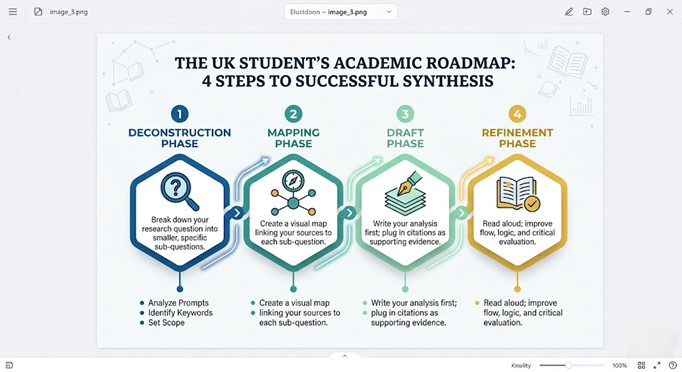
To avoid the “Red Flags” that search engines and markers alike look for—such as disjointed content or lack of depth—follow this workflow:
- The Deconstruction Phase: Break your research question into three smaller sub-questions.
- The Mapping Phase: Create a visual map of how your sources relate to those sub-questions.
- The Draft Phase: Write your analysis first, then “plug in” your citations to support your claims.
- The Refinement Phase: Read your paper aloud. If you find yourself saying “Author X says” too many times in a row, you need more synthesis and less summary.
Achieving First-Page Quality in Your Writing
Whether you are writing for a professor or a digital audience, “Information Gain” is the key. Google’s algorithms, much like university tutors, are looking for content that adds something new to the conversation. Don’t just repeat what is on Wikipedia. Use specific examples, cite recent UK-based studies, and provide actionable checklists that the reader can use immediately.
By focusing on the “Why” behind the research struggles, you create content that resonates on a human level. Students feel seen, and search engines recognize the topical authority of the piece.
Frequently Asked Questions
Q: What is the difference between quoting and synthesizing?
Ans: Quoting is using the exact words of an author to support a point. Synthesizing is taking the ideas from multiple authors, processing them, and explaining them in your own words to show a broader trend or conflict in the field.
Q: How many sources do I need for a good synthesis?
Ans: For a standard 2,000-word university paper, you should aim for at least 10–15 high-quality sources. However, quality matters more than quantity. One well-critiqued peer-reviewed journal article is worth more than five generic blog posts.
Q: Is it okay to use professional help for my research?
Ans: Absolutely. Using academic resources and consultancy services is a standard part of the modern learning process. It provides students with a roadmap and helps them understand the high standards required in professional and academic writing.
Q: How do I avoid “Red Flags” in my writing?
Ans: Avoid repetitive phrasing, ensure your headings are descriptive, and always provide a unique perspective. In the digital world, “Red Flags” often come from thin content that doesn’t help the user. In the academic world, they come from a lack of critical thinking.
About The Author
Hello! I’m Lucy Wilson, a Senior Academic Consultant at MyAssignmentHelp. With years of experience in digital marketing and SEO content strategy, I specialize in developing educational resources tailored for undergraduate students in the UK, US, Australia, and Canada.