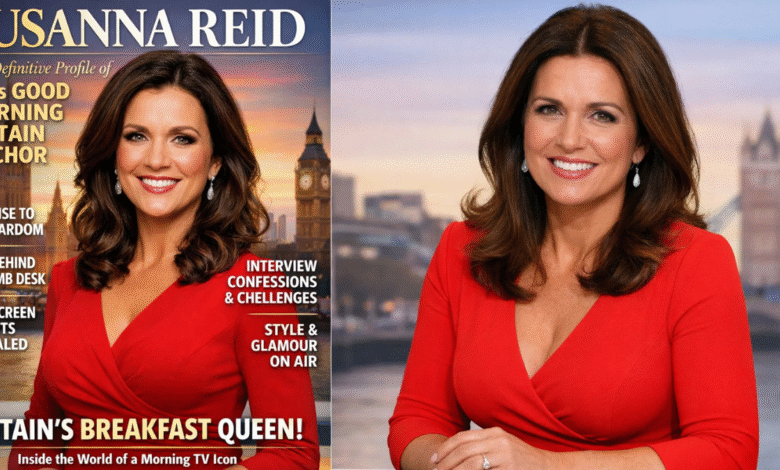
Susanna Reid: For millions of Britons, the day begins with a familiar, steadying presence. Susanna Reid is far more than just a television presenter; she is a cornerstone of the UK’s media landscape, a journalist of formidable intellect, and a broadcasting personality whose career arc mirrors the evolution of morning television itself. From her early days in local radio to anchoring the nation’s most talked-about breakfast show, her journey is one of resilience, sharp interviewing, and an unwavering commitment to public service broadcasting.
This deep-dive profile explores the multifaceted career of Susanna Reid, examining the professionalism, challenges, and defining moments that have cemented her status as one of the most authoritative and recognisable faces on British screens. Her story is not merely one of personal achievement but a lens through which to understand modern broadcast journalism.

Early Career and Formative Broadcasting Years
Long before the national spotlight found her, Susanna Reid was honing the skills that would define her career. Her foray into media began not on television, but in the more intimate arena of local radio, working for stations like BBC GLR and BBC Southern Counties Radio. This foundational period was crucial, instilling in her the disciplines of live broadcasting, quick thinking, and direct audience connection a training ground that television studios cannot fully replicate. It was here she learned to listen as much as she spoke, a trait that would later become a hallmark of her interviewing style on major political and cultural figures.
The natural progression led her to the BBC’s flagship newsroom, where she served as a producer and reporter for BBC News 24. This behind-the-scenes experience proved invaluable, granting her a masterclass in newsgathering, editorial judgment, and the technical complexities of a rolling news operation. When she transitioned to on-screen reporting, it was with a producer’s mind, understanding the architecture of a story. Her big break came with presenting the early-morning bulletins on BBC Breakfast, a gruelling shift that tests any broadcaster’s mettle. Reid not only endured but excelled, demonstrating the warmth, clarity, and pre-dawn stamina that would make her a perfect fit for the demanding world of morning TV.
The BBC Breakfast Era and Rise to Prominence
Her tenure on BBC Breakfast alongside Bill Turnbull marked the period where Susanna Reid became a household name in the truest sense. The sofa of BBC Breakfast is a unique national institution, requiring a delicate balance of hard news, human interest, and congeniality. Reid mastered this alchemy, bringing a genuine empathy to human stories and a razor-sharp focus to political interviews. Her chemistry with Turnbull was palpable, offering viewers a comforting and reliable start to their day. This era solidified her reputation as a presenter of both substance and accessibility, someone who could discuss complex economic policy and the latest celebrity saga with equal professionalism and grace.
It was during this time that her profile skyrocketed, leading to opportunities that extended beyond the news studio. Her participation in Strictly Come Dancing in 2013, where she was a surprise finalist, showcased a different dimension of her character to the public one of determination, grace under pressure, and a relatable willingness to step far outside her comfort zone. While some questioned a news journalist joining an entertainment show, it ultimately broadened her appeal and demonstrated her versatility. The experience, as she often noted, was less about dance and more about resilience, a quality that would be rigorously tested in the next, seismic shift of her career.
The Pivotal Move to Good Morning Britain
In 2014, Susanna Reid made a career-defining decision that sent shockwaves through the industry: leaving the established comfort of BBC Breakfast for the then-struggling ITV rival, Good Morning Britain. The move was seen as a high-risk gamble. GMB was languishing in the ratings, struggling to find its identity against the dominant BBC offering. Reid’s defection was not just a job change; it was a statement of intent from ITV to revitalise its morning flagship. She was joined by a new co-host, the combative Piers Morgan, a pairing that seemed, on paper, to be an unlikely and potentially volatile experiment. The challenge was monumental: to carve out a distinct, impactful niche in a crowded market.
The early days were tough, with critics quick to pounce and ratings slow to budge. However, the strategic vision behind the Reid-Morgan partnership began to crystallise. It was designed as a conscious counterpoint to the BBC’s often calmer tone. Where the BBC offered a reflective cup of tea, GMB aimed to be a double espresso provocative, opinionated, and news-driving. Reid’s role within this dynamic became her most critically acclaimed work. She evolved into the show’s moral and journalistic anchor, the rigorous interviewer who could challenge power with forensic preparation, and the essential counterbalance to Morgan’s more theatrical provocations. This period marked the true emergence of Susanna Reid not just as a presenter, but as a formidable journalistic force in her own right.
Defining the Role of the Anchor and Interviewer
At the heart of Susanna Reid’s success on Good Morning Britain is her mastery of the live political interview. In an era of slick media training and evasive soundbites, she has become renowned for her meticulous preparation and tenacious yet fair questioning. Her interviews with successive Prime Ministers, from Theresa May to Rishi Sunak, are textbook examples of holding power to account. She combines a clear command of complex detail be it Brexit negotiations, pandemic data, or economic policy with an ability to frame questions from the viewer’s perspective. This dual approach disarms guests who might be prepared for partisan attacks but are less equipped for persistent, fact-based scrutiny delivered with calm authority.
Her interviewing style is characterised by a strategic use of silence, a respectful but unwavering follow-up, and a focus on accountability. She avoids grandstanding in favour of substance, making her interviews must-watch television for those interested in policy, not just personality. This journalistic rigour has elevated the stature of the entire programme, forcing political heavyweights to take the show seriously as a platform for national conversation. As one media commentator noted, “Reid has redefined what a morning TV host can be. She is neither a passive conduit for politicians nor a shouting pundit, but a forensic examiner of public life.” This reputation for fairness and depth has been instrumental in building trust with the GMB audience.
The On-Screen Partnership and Dynamic Chemistry
The professional relationship between Susanna Reid and Piers Morgan became the engine of Good Morning Britain’s resurgence, a study in contrasting styles that created compelling television. Morgan’s brash, confrontational, and often controversial persona was the lightning rod, generating headlines and heated debate. Reid’s role was multifaceted: often the voice of reason, the empathetic interviewer on human interest stories, and, when necessary, a formidable challenger to Morgan’s own assertions on the sofa. Their debates, whether on Brexit, Meghan Markle, or COVID policies, were unscripted and authentic, giving viewers a genuine sense of live television where the outcome was unknown.
This dynamic required immense skill and professional confidence from Reid. She had to maintain her own journalistic integrity while engaging with a co-host whose methods were fundamentally different. The chemistry was built on a foundation of mutual professional respect, even when they disagreed profoundly. Her ability to stand her ground, to articulate a counter-argument with clarity and conviction, and to occasionally act as the audience’s surrogate in questioning Morgan’s stance, made her relatable and respected. When Morgan departed the show abruptly in 2021, many questioned whether GMB could survive the loss. However, the stability and authority provided by Susanna Reid proved to be the show’s consistent bedrock, allowing it to navigate a transition that could have been destabilising.
Navigating High-Profile Moments and Public Scrutiny
A broadcaster of Susanna Reid’s profile operates under an intense and unrelenting spotlight, where professional and personal boundaries frequently blur. Her career has been punctuated by moments that spilled from the studio into national headlines, requiring immense personal composure. From conducting emotionally charged interviews with grieving families to confronting politicians during national crises like the pandemic, she has consistently demonstrated a balance of strength and sensitivity. These high-stakes situations are a test of a presenter’s core character, and Reid’s ability to navigate them with grace has fortified her authority. She understands the weight of the platform and wields it with a sense of responsibility, particularly when dealing with vulnerable contributors.
This public role inevitably extends to scrutiny of her personal life, from her relationships to her parenting choices and even her fashion. Reid has managed this aspect of fame with a dignified reserve, selectively sharing parts of her life to foster connection with viewers while firmly maintaining private boundaries. She has also used her platform to discuss issues of relevance to her demographic, such as the challenges faced by working mothers and the realities of ageing in a youth-obsessed industry. By addressing these topics with honesty, she has forged a deeper, more authentic bond with her audience, transforming from a distant TV figure into a relatable professional woman navigating many of the same pressures as those watching her.

Advocacy, Off-Screen Influence, and Modern Role
Beyond the daily headlines, Susanna Reid has leveraged her influence to advocate for issues close to her heart, evolving into a modern broadcaster with a clear sense of social purpose. She has been a vocal supporter of campaigns related to mental health awareness, domestic violence charities, and better support for family carers. This advocacy is rarely performative; it is woven into the fabric of her interviews and reporting, ensuring these subjects receive serious, thoughtful coverage. Her approach demonstrates how a mainstream broadcaster can use their platform for public service without compromising journalistic objectivity, instead enriching it with sustained attention on under-reported societal challenges.
Her influence also reflects the changing role of the television anchor in the digital age. While the daily broadcast remains her primary pulpit, her presence extends across social media and podcast platforms, where she engages with audience feedback and promotes show segments. This multi-platform existence allows her to shape the news cycle beyond the three-hour morning window. In this sense, Susanna Reid represents a hybrid model: the authoritative voice of traditional broadcast journalism, seamlessly integrated into the conversational, immediate world of digital media. She maintains the standards of the former while understanding the demands and engagement styles of the latter.
The Business of Broadcasting and Market Impact
The success of a programme like Good Morning Britain, with Susanna Reid at its helm, is not merely a cultural talking point; it is a significant commercial and strategic enterprise for ITV. The breakfast television market is fiercely competitive, with advertising revenue and brand prestige resting on the ability to capture and retain a loyal audience. Reid’s presence has been central to GMB’s commercial turnaround. Her journalistic credibility attracts A-list political and cultural guests, which in turn drives viewership and media coverage, creating a virtuous cycle that boosts the show’s commercial appeal. Advertisers covet the engaged, often opinion-leading demographic that the show, and Reid in particular, commands.
Her contract negotiations and career moves are thus analysed not just by showbiz columnists, but by media analysts assessing ITV’s stock performance and competitive strategy. The table below breaks down the key pillars of her professional value and market impact within the UK broadcasting landscape:
| Pillar of Influence | Description | Tangible Impact |
|---|---|---|
| Journalistic Authority | Renowned for forensic political interviews and balanced reporting. | Elevates show’s prestige, attracts high-calibre guests, wins industry awards. |
| Audience Trust & Loyalty | Builds deep connection through consistency, empathy, and perceived authenticity. | Drives stable ratings, high audience engagement, and strong demographic appeal. |
| Brand Alignment | Embodies GMB’s shift to news-driven, provocative yet substantive breakfast TV. | Central to programme identity and successful differentiation from BBC Breakfast. |
| Commercial Appeal | Credibility translates to a desirable environment for major advertisers. | Supports premium advertising rates and lucrative sponsorship deals for ITV. |
| Leadership & Stability | Provides continuity through co-host changes and production evolutions. | Reduces volatility, ensures smooth operational transition, and retains core viewers. |
Style, Persona, and the Art of Relatability
In the visually conscious medium of television, presentation matters, and Susanna Reid has cultivated a style that is both professionally impeccable and subtly relatable. Her on-screen wardrobe is a frequent topic of discussion, carefully curated to be stylish yet approachable power dressing tailored for the morning sofa. This attention to detail is not mere vanity; it is a strategic element of her broadcast persona, signalling professionalism while avoiding any barrier that might distance her from the viewer at home. Similarly, her demeanor composed, witty when appropriate, and unfailingly polite even during tough interviews creates an aura of capable calm that is the show’s steadying centre.
This crafted persona is underpinned by a clear understanding of her audience. She speaks to them as intelligent equals, whether explaining a complex news story or discussing a lighter feature. Her relatability stems from this absence of condescension and her willingness to reveal flashes of her life outside the studio the challenges of the school run, the realities of a pre-4 a.m. alarm without making it the story itself. As she once reflected, “The job is to connect, not to perform. Viewers can spot inauthenticity a mile away.” This philosophy ensures that her professional polish never feels alienating, but rather aspirational in an achievable way, making Susanna Reid a trusted guide to the day’s events.
Critical Reception and Industry Recognition
The trajectory of Susanna Reid’s career has been mirrored in her critical reception, which has evolved from viewing her as a capable presenter to acknowledging her as a leading journalist. Early reviews often focused on her presentation skills and chemistry with co-hosts. However, as her tenure on GMB progressed and her interview prowess became undeniable, the tone of critical commentary shifted.
Major broadsheets now frequently analyse her interviewing technique, praising her preparedness and persistence. This shift is significant, marking her transition within industry perception from a ‘TV host’ to a ‘broadcast journalist’ of the first rank a distinction earned through consistent, high-calibre work.
This professional respect has been formalised through numerous industry awards and nominations. She has been recognised at the Tric Awards, the Broadcasting Press Guild Awards, and the National Television Awards, where Good Morning Britain finally broke BBC Breakfast’s long-standing winning streak a victory in which her role was universally acknowledged as pivotal.
These accolades serve as external validation of her impact, not just on ratings but on the quality of broadcast journalism itself. They cement her legacy as a key figure who helped redefine the competitive landscape and expectations of morning television in the UK.
Legacy and Future Trajectory
As she continues her tenure on one of British television’s most prominent platforms, the legacy of Susanna Reid is already being written. She has proven that intelligence, rigorous journalism, and a steadfast commitment to fairness can be the driving force of a hugely popular mainstream show. In an era of fragmented media and often polarised debate, she has maintained a crucial centre ground, a space where issues are examined rather than merely shouted about. Her career stands as a powerful case study in professional evolution, demonstrating how a broadcaster can adapt to changing formats, co-hosts, and the news cycle while strengthening their core authority.
Looking forward, the future trajectory for a broadcaster of her stature is rich with possibility. While anchoring GMB remains her primary focus, her skills are transferable to longer-form documentary work, current affairs specials, or even leadership roles within broadcasting. Whatever path she chooses, her fundamental contribution is clear: Susanna Reid has elevated the craft of the morning television anchor, blending the warmth required for the day’s first hello with the steely resolve needed to interrogate the powerful. She has not just reported on the news of the day; she has become a consistent and influential part of the national conversation, defining what it means to inform a nation over its morning coffee.
Conclusion
Susanna Reid’s journey from local radio to the heart of Britain’s morning routine is a testament to skill, strategic courage, and substantive talent. She navigated a risky career move and helped forge a television programme into a national institution, all while developing a distinctive interview style that commands respect from viewers and powerbrokers alike. Her story underscores that in modern media, authenticity and authority are not opposing forces but complementary strengths. As broadcasting continues to evolve, Susanna Reid remains a gold standard a reminder that trust is built daily through preparation, empathy, and an unwavering dedication to the simple, vital task of telling the truth clearly. Her presence on our screens is more than just familiar; it is a grounding force in an increasingly noisy world.
Frequently Asked Questions
What is Susanna Reid’s professional background before television?
Before becoming a household name, Susanna Reid built a solid foundation in broadcast journalism. She started in local radio at BBC GLR and BBC Southern Counties Radio, learning the essentials of live broadcasting. She then moved behind the camera as a producer for BBC News 24, gaining crucial editorial experience, before stepping in front of it as a reporter and eventually a presenter on BBC Breakfast.
How did Susanna Reid become famous?
Susanna Reid rose to national prominence as a co-presenter on BBC Breakfast alongside Bill Turnbull, where her warm yet professional style resonated with millions. Her profile expanded significantly with a standout run on Strictly Come Dancing in 2013. However, her move to ITV’s Good Morning Britain in 2014, and her subsequent development into a formidable political interviewer, cemented her status as a leading figure in British broadcasting.
What is Susanna Reid’s salary for Good Morning Britain?
While her exact salary is confidential, it is widely reported in the media that Susanna Reid’s contract with ITV for Good Morning Britain places her among the highest-paid female presenters in UK television. Her compensation reflects her central role in the show’s success, her journalistic stature, and her significant contribution to ITV’s daytime programming strategy and revenue.
Who does Susanna Reid currently co-host with?
Following the departure of Piers Morgan in 2021, Susanna Reid has been the consistent anchor of Good Morning Britain. She now primarily co-hosts with a rotating team of presenters including Ed Balls, Richard Madeley, Kate Garraway, and Ben Shephard. This format allows her to act as the programme’s steadying core, adapting her dynamic to different co-presenters while maintaining the show’s editorial tone.
What are some of Susanna Reid’s most notable interviews?
Susanna Reid is renowned for her tough, fair, and meticulously researched political interviews. Some of her most notable include repeated, forensic grillings of Prime Ministers like Rishi Sunak and Boris Johnson on pandemic policy and Partygate, as well as a landmark interview with former Health Secretary Matt Hancock. Her ability to hold leaders to account with calm persistence has defined her journalistic reputation on Good Morning Britain.
You may also read
Ayden Heaven: The Definitive Guide to the Digital Icon’s Rise, Art, and Authenticity