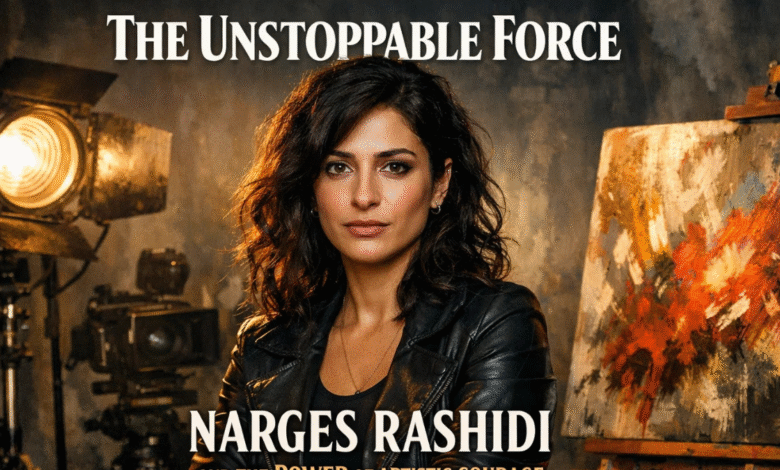
The Unstoppable Force: Narges Rashidi and the Power of Artistic Courage
Narges Rashidi: In the vast and often glittering landscape of global cinema, some artists shine not just for their talent but for the profound weight of their choices and the cultural bridges they build with their craft. Narges Rashidi stands as one such luminous figure—an actress whose journey from the vibrant theatre scenes of Tehran to the forefront of international genre cinema is a masterclass in resilience, versatility, and bold artistic vision.
Her name has become synonymous with powerful, often haunting performances that linger long after the credits roll, challenging stereotypes and captivating audiences worldwide. More than just a performer, Narges Rashidi represents a new wave of transnational artists who carry the depth of their heritage into global narratives, creating a unique and compelling dialogue between worlds. This article delves deep into the life, career, and undeniable impact of this remarkable actress, exploring the roles that defined her, the challenges she transcended, and the indelible mark she continues to leave on the fabric of contemporary film.


Early Life and Theatrical Roots in Iran
To understand the artist that Narges Rashidi is today, one must begin in Tehran, where her passion for performance was first ignited. Born into a culture with a rich and complex relationship with the arts, Rashidi’s early environment was steeped in narrative and expression. From a young age, she was drawn to the immediacy and raw power of live theatre, a medium that thrives in Iran despite, and perhaps because of, various social constraints. The theatre became her first classroom, a space where she could explore human emotion, political subtext, and the sheer physicality of storytelling.
Her formative years on the Persian stage were not merely an acting apprenticeship; they were a crucial education in conveying meaning through nuance and metaphor. Iranian theatre, known for its poetic depth and intellectual rigor, demands a high level of commitment and intelligence from its performers. Narges Rashidi immersed herself in this world, honing a craft that relied on subtle gesture, potent silence, and a deep connection to text.
This foundation provided her with an actor’s toolkit that was both technically precise and emotionally expansive. It instilled in her a discipline and a seriousness of purpose that would later become the bedrock of her screen presence, allowing her to navigate vastly different filmmaking cultures with unwavering authenticity and skill.
A Bold Leap: Relocation and Career Transition to Germany
The path of an artist is often one of courageous upheaval, and for Narges Rashidi, a significant turning point came with her decision to leave Iran and establish herself in Germany. This move was far more than a simple change of address; it was a profound cultural and professional leap into the unknown. Relocating meant starting anew, facing the daunting challenges of learning a new language, understanding a different cinematic landscape, and building a reputation from the ground up. For many, such a transition could have meant obscurity, but for Rashidi, it became a catalyst for a remarkable reinvention.
This period of transition was undoubtedly fraught with difficulty. The German film and television industry, while robust, presented its own barriers to an actress with a foreign background. Yet, Narges Rashidi approached this phase with characteristic determination. She began to take on roles in German television series and films, steadily building a portfolio that showcased her adaptability.
These early German roles, often in crime procedurals or dramatic series, were essential stepping stones. They allowed her to demonstrate her range to European directors and casting agents, proving that her talent was not confined by language or locale. This chapter of her career is a testament to her resilience, highlighting her ability to absorb new influences while retaining the powerful core of her theatrical training, ultimately setting the stage for the international breakthroughs that would soon follow.
Breakthrough Role: “Under the Shadow” and International Acclaim
While Narges Rashidi had been steadily working for years, it was the 2016 supernatural horror film Under the Shadow that catapulted her onto the world stage and redefined her career. Directed by Babak Anvari, the film is set in post-revolutionary Tehran during the Iran-Iraq War, following a mother, Shideh, grappling with a haunting political and literal supernatural force. Landing the lead role was a pivotal moment for Narges Rashidi, requiring her to channel her personal history and immense skill into a performance of staggering depth and vulnerability.
The film was a critical sensation, praised for its intelligent weaving of political allegory with genuine genre terror. At the heart of its success was Rashidi’s mesmerizing portrayal of Shideh. She brought to life a character who was fiercely intelligent, emotionally strained, and profoundly relatable—a woman fighting external oppression and internal doubt.
The performance was a masterclass in nuanced horror, where the fear in her eyes spoke volumes about societal pressures as much as about the eerie djinn haunting her apartment. Under the Shadow won numerous awards and was the UK’s official submission for the Academy Awards, making Narges Rashidi a globally recognized name. The role cemented her status not just as a talented actress, but as a compelling lead capable of anchoring a high-concept film with emotional truth and raw power.
Quote from Babak Anvari on casting Rashidi: “I needed an actress who could carry the weight of the film’s metaphor without ever losing the character’s humanity. From the first audition, Narges was Shideh. She understood the subtleties, the unspoken tensions, and brought an essential gravity.”
Artistic Range and Versatility Across Genres
One of the most striking aspects of Narges Rashidi’s career is her defiant resistance to being pigeonholed. Following the intense drama-horror of Under the Shadow, she could have easily been offered a string of similar roles. Instead, she consciously embarked on a path that showcased a breathtaking range, moving seamlessly between genres and formats. This versatility is the hallmark of a true character actress, one who prioritizes the story and the role over predictable career moves. From indie dramas to big-budget action and dark comedy, Rashidi has demonstrated an uncanny ability to transform and adapt.
She delivered a sharp, controlled performance in the German thriller The Other Side of the Wall, and then pivoted to the gritty, dystopian world of Siberia, starring alongside Willem Dafoe. She showcased comedic timing and dramatic heft in the Austrian film Corsage, and ventured into epic science fiction with the Apple TV+ series Foundation, portraying a complex politician in a universe-spanning narrative. Each role is approached with the same integrity and preparation,
yet the results are distinctly different. This chameleonic quality ensures that audiences are never watching “Narges Rashidi the star,” but rather the fully realized character she has embodied. It is a career built on curiosity and challenge, proving that an actor’s most potent tool is not a recognizable persona, but the depth of their transformative ability.
Navigating Identity: Iranian Heritage in a Global Context
The work of Narges Rashidi cannot be separated from the context of her Iranian heritage, a thread that weaves through her filmography in both explicit and subtle ways. She belongs to a generation of diaspora artists who navigate a complex space—honoring their roots while engaging freely with global art forms. Her choices reflect a conscious engagement with this duality, often selecting projects that allow her to explore themes of displacement, identity, and cultural memory. This is not a passive background detail but an active, creative wellspring from which she draws profound insight.
In films like Under the Shadow, her intimate understanding of the setting’s social fabric was irreplaceable. In other projects, her heritage informs a deeper understanding of characters who exist between worlds or under systems of control. However, it is crucial to note that Narges Rashidi has never allowed her identity to be reduced to a single narrative. She insists on the universality of human experience while acknowledging the specificities of her own.
By doing so, she challenges simplistic Western perceptions of Iranian women and expands the palette of roles available to Middle Eastern actors internationally. She represents a new archetype: the global performer whose strength lies in her layered identity, using it to bring unique authenticity to every story she tells, whether it is specifically about Iran or not.

Collaboration with Acclaimed Directors
A significant marker of an actor’s respect within the industry is the caliber of directors they attract, and Narges Rashidi’s roster of collaborators is impressively diverse and esteemed. Working with visionary filmmakers has not only elevated her profile but has also pushed her artistic boundaries, resulting in some of her most memorable work. Each collaboration represents a unique creative dialogue, showcasing her ability to understand and execute a director’s vision while imprinting it with her own distinctive energy.
Her partnership with Babak Anvari on Under the Shadow was clearly transformative. She later worked with Abel Ferrara on the psychological drama Siberia, a demanding experience that required tapping into abstract, subconscious realms. Joining the cast of David Cronenberg’s Crimes of the Future placed her in the realm of body-horror iconography, a testament to her willingness to engage with challenging, avant-garde material. Furthermore,
her role in the sweeping saga of Foundation, under the direction of showrunner David S. Goyer, demonstrates her capability in large-scale, effects-driven storytelling. The trust these directorial heavyweights place in her speaks volumes. It indicates a shared recognition of her professional rigor, her intellectual engagement with material, and her fearless commitment to going wherever the role demands.
Table: Selected Filmography of Narges Rashidi
| Year | Title | Role | Genre / Notes |
|---|---|---|---|
| 2016 | Under the Shadow | Shideh | Supernatural Horror / Breakthrough |
| 2018 | The Other Side of the Wall | Narin | Thriller |
| 2020 | Siberia | Woman at Counter | Psychological Drama |
| 2022 | Corsage | Countess Festetics | Historical Drama |
| 2022 | Crimes of the Future | Berst | Sci-Fi Body Horror |
| 2021-2023 | Foundation (Series) | Zephyr Halima | Epic Sci-Fi |
| 2023 | The G | Miriam | Drama |

The Craft: Approach to Acting and Character Building
Behind every compelling performance by Narges Rashidi lies a meticulous and deeply thoughtful process. Her approach to acting is a fusion of the rigorous theatrical discipline from her early career and a more intuitive, research-driven method for screen work.
She is known for her intensive preparation, which often involves extensive research into a character’s historical, social, and psychological context. For a role like Shideh, this meant understanding the specific anxieties of a woman in 1980s Tehran; for a character in Foundation, it might involve constructing the political worldview of a future spiritual leader.
Rashidi often speaks about finding the “inner logic” of a character—the core motivations that make their actions, no matter how unusual, feel truthful and inevitable. She builds her performances from the inside out, focusing on the character’s thought process and emotional history before layering in physicality and voice. This process is collaborative but deeply internal;
she comes to set fully prepared, with a rich inner life for the character, which allows her to react spontaneously and authentically within a scene. This dedication to craft ensures that even in fantastical settings, her characters feel grounded, complex, and deeply human. It is this unwavering commitment to truth in performance that makes her work so consistently resonant and powerful.
Impact on Representation in Cinema
The rise of Narges Rashidi carries a significance that extends beyond individual film credits. In a global film industry that has historically offered limited, often stereotypical roles to actors of Middle Eastern descent, her career trajectory is quietly revolutionary. She has consistently broken molds, refusing roles that portray Iranian or Middle Eastern women as mere victims, ornaments, or threats. Instead, she has chosen characters who are agents of their own stories—complex, intelligent, flawed, and powerful. By doing so, she actively rewrites the narrative possibilities for an entire community of actors.
Her success paves the way for others, demonstrating to international casting directors and producers that audiences are ready for and eager to see Middle Eastern actors in layered, leading roles across all genres. The presence of Narges Rashidi in a major sci-fi series like Foundation or an auteur horror project like Crimes of the Future normalizes the inclusion of diverse faces in stories not explicitly about their ethnicity. This is a profound form of representation: it asserts that an actor’s background can be a part of their richness without being the sole definition of their on-screen existence. She represents a shift towards a more inclusive and interesting cinematic world, where talent is the primary passport.
Beyond Acting: Advocacy and Personal Philosophy
While her filmography is the most public facet of her life, Narges Rashidi’s influence and personality extend beyond the camera. She is an artist with a clearly articulated philosophy about her work and its place in the world. In interviews, she emerges as thoughtful, articulate, and driven by a sense of purpose that transcends fame. She views her platform as a responsibility, often speaking with eloquence about the power of storytelling to foster empathy and bridge cultural divides. Her journey from Iran to Europe has given her a unique perspective on freedom of expression, the role of art in society, and the challenges faced by immigrant artists.
Though not a loud political figure in the traditional sense, her advocacy is embedded in her choices. By portraying strong, nuanced women and collaborating on films that challenge societal norms, she advocates for a more thoughtful and complex view of the world. Her personal philosophy seems to be one of quiet perseverance, artistic integrity, and the belief in cinema as a universal language. She champions the idea that stories from specific cultures, like the Iranian ghost story in Under the Shadow, can reveal universal truths about fear, motherhood, and resilience, connecting with people from all backgrounds on a fundamental human level.
The Future: Upcoming Projects and Evolving Legacy
As of today, the career of Narges Rashidi shows no signs of slowing down or becoming predictable. She continues to seek out challenging projects that pique her curiosity and push her into new artistic territories. With several projects in various stages of development, her future seems poised to further blend international arthouse cinema with more accessible genre and mainstream work. Each new role adds another facet to her growing legacy, ensuring that she remains one of the most interesting and unpredictable actors to watch on the global stage.
The evolving legacy of Narges Rashidi is already taking shape. She is becoming known as a fearless artist whose career is a map of intelligent choices, a bridge between cinematic cultures, and a testament to the power of transformative performance. Future film scholars may look back at her filmography as a key example of early 21st-century transnational cinema.
For aspiring actors, particularly those from underrepresented backgrounds, her journey offers a powerful blueprint: one built on unwavering craft, strategic courage, and the profound belief that an actor’s most powerful instrument is their own multifaceted humanity. The next chapter for Narges Rashidi is eagerly awaited, but one thing is certain—it will be pursued with the same intention and brilliance that has defined her path so far.
Conclusion
Narges Rashidi’s journey from the stages of Tehran to the pinnacle of international cinema is more than a success story; it is a narrative of artistic conviction and cultural synthesis. Through her fearless choices, masterful performances, and unwavering dedication to her craft, she has shattered stereotypes and carved a unique space for herself in a competitive industry. Rashidi has demonstrated that true artistry knows no borders and that depth of experience can become an actor’s greatest asset.
She stands not only as a celebrated actress but as a symbol of a new global creative spirit—one that carries the weight of heritage into universal storytelling, enriching both. As audiences and critics alike continue to follow her compelling path, the work of Narges Rashidi promises to inspire, challenge, and captivate for many years to come, solidifying her place as an indispensable voice in contemporary film.
Frequently Asked Questions About Narges Rashidi
What is Narges Rashidi best known for?
Narges Rashidi is best known internationally for her lead role as Shideh in the critically acclaimed horror film Under the Shadow (2016). Her powerful performance as a mother grappling with supernatural and political terror in post-revolutionary Tehran earned her widespread recognition and acclaim. This role showcased her ability to anchor a high-concept genre film with deep emotional resonance and is often considered her breakthrough to a global audience.
How did Narges Rashidi start her acting career?
Narges Rashidi began her acting career in the theatre scene in her hometown of Tehran, Iran. She immersed herself in Persian theatre, which provided a rigorous foundation in performance, subtext, and physical storytelling. Seeking new challenges and artistic freedom, she later relocated to Germany, where she patiently rebuilt her career. She started with roles in German television and film, gradually building a reputation for her versatility and skill before landing the international breakout role in Under the Shadow.
What languages does Narges Rashidi speak, and how does this affect her roles?
Narges Rashidi is fluent in Persian (Farsi), German, and English. This linguistic versatility has been a significant asset in her transnational career, allowing her to work seamlessly in a variety of film industries. She has performed leading roles in all three languages, from Persian in Under the Shadow to German in The Other Side of the Wall and English in Foundation and Crimes of the Future. This trilingual ability greatly expands her range and makes her a highly adaptable collaborator for international productions.
Why is Narges Rashidi considered an important figure for representation in film?
Narges Rashidi is considered an important figure for representation because she consistently chooses complex, multi-dimensional roles that defy reductive stereotypes of Middle Eastern women. She portrays characters who are agents of their own narratives—intelligent, strong, flawed, and central to the plot—across genres from horror to sci-fi to historical drama. Her presence in major international projects normalizes the inclusion of Iranian and Middle Eastern actors in stories where their ethnicity is not the sole defining plot point, paving the way for greater diversity and nuance in global cinema.
What are some of the key characteristics of Narges Rashidi’s acting style?
Narges Rashidi’s acting style is characterized by intense preparation, emotional authenticity, and a powerful, often subtle, screen presence. She employs a methodical approach, deeply researching her characters’ backgrounds and motivations to build their inner logic. Her theatrical training is evident in her command of physicality and silence, often conveying volumes with a look or gesture. She excels at portraying interior conflict and resilience, bringing a palpable gravity and intelligence to every role, whether in quiet dramas or high-pressure genre films.
You may also read
The Visionary Legacy of Oliver Tress: Defining an Era of Eyewear Elegance