Lady Tatiana Mountbatten birth announcement: The Arrival of Lady Tatiana Mountbatten: Deciphering a Modern Royal Birth Announcement
Lady Tatiana Mountbatten birth announcement: The world of royal announcements is a fascinating tapestry woven with protocol, heritage, and evolving public expectation. When Lady Tatiana Mountbatten, the first child of Lord Ivar Mountbatten and his husband, James Coyle, was born, the subsequent Lady Tatiana Mountbatten birth announcement resonated far beyond a simple happy news dispatch. It represented a poignant moment where centuries of aristocratic tradition gracefully met the contours of a modern, inclusive family narrative.


This event was not merely a personal milestone for the Mountbatten family but a culturally significant marker, reflecting subtle shifts in how historic institutions communicate in the 21st century. The announcement itself, its timing, its wording, and the public and media reaction it garnered, offer a rich case study in heritage branding, media strategy, and the enduring public fascination with royal and noble lineages.
To fully appreciate the depth of this moment, we must explore the intricate layers behind the official notice—from the weight of the Mountbatten name and the unique context of her parents’ marriage to the deliberate choices made in sharing this joyful news with the world. This comprehensive analysis will delve into every facet, establishing why this particular Lady Tatiana Mountbatten birth announcement stands as a defining example of aristocratic communication in a new era.
The Historical Weight of the Mountbatten Name
To understand the significance of any announcement concerning this child, one must first appreciate the monumental legacy she inherits. The Mountbatten name is inextricably linked to the modern British monarchy, European royalty, and pivotal 20th-century history. Lord Ivar Mountbatten is a great-great-great-grandson of Queen Victoria and a descendant of the last Tsarina of Russia, Alexandra Feodorovna. More directly, he is the great-nephew of Prince Philip, Duke of Edinburgh, and a cousin of King Charles III. The name was famously adopted by the Battenberg family during World War I, a strategic anglicization led by Lord Ivar’s ancestor, Louis Mountbatten, 1st Earl Mountbatten of Burma, who later served as the last Viceroy of India.
This lineage imbues every public statement about the family with a historical echo. The Lady Tatiana Mountbatten’s birth announcement automatically connects this newborn to a sprawling narrative of European power, diplomacy, tragedy, and adaptation. It is a name that commands recognition and carries an implicit expectation of tradition. However, the contemporary bearers of this name have consistently navigated their public roles with a focus on personal authenticity, setting the stage for an announcement that would honor the past while firmly reflecting the present. The choice to use the stylized “Lady Tatiana Mountbatten” immediately establishes her place within this noble framework, acknowledging the hereditary “Lady” title derived from her grandfather, while the surname secures her link to this formidable dynasty.
Lord Ivar and James Coyle: A Groundbreaking Noble Union
The context of Lady Tatiana’s parents is central to the narrative power of her birth announcement. Lord Ivar Mountbatten made history in 2018 by becoming the first known senior British aristocrat to enter into a same-sex marriage, marrying James Coyle, a former airline pilot, in a heartfelt ceremony in Devon. This marriage was groundbreaking, celebrated for its visibility and its demonstration of evolving attitudes within even the most traditional echelons of society. Lord Ivar had three daughters from a previous marriage, making Lady Tatiana his fourth daughter and James Coyle’s first biological child.
Therefore, the Lady Tatiana Mountbatten birth announcement was not just the sharing of a new arrival; it was the celebration of a milestone for this pioneering family unit. It represented the expansion of a modern love story that had already captured public admiration for its sincerity and courage. The announcement served to normalize and joyously showcase this family’s growth, reinforcing that their narrative is one of love, commitment, and now, parenthood. The public’s embrace of the news was in many ways a testament to the couple’s genuine portrayal of their lives, the arrival of their daughter, and a shared moment of happiness for many who followed their story.
Deconstructing the Announcement Protocol
Royal and high-aristocratic birth announcements follow a nuanced, though not rigidly codified, protocol. Traditionally, a formal notice would be placed in The Times and The Daily Telegraph, a practice still occasionally observed. In the digital age, the protocol has expanded to include official family social media accounts and statements to the Press Association. The announcement for Lady Tatiana Mountbatten expertly blended these channels. While not necessarily appearing in the traditional court circular, the news was disseminated through reputable media outlets that have established relationships with aristocratic families, ensuring accurate reporting of names, titles, and dates.
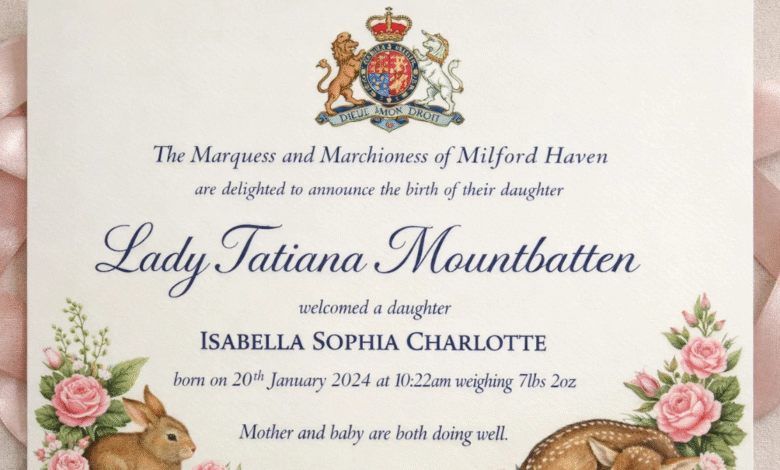
The wording itself is a study in precision. It confirmed the date of birth, the child’s full name and title, and the happy status of mother and baby—a standard yet crucial piece of information. The use of “Lady Tatiana Mountbatten” was the key semantic element, formally marking her entry into the family’s noble lineage. This careful construction ensured the Lady Tatiana Mountbatten birth announcement met the expectations of formal communication while feeling fresh and personal. It avoided unnecessary flourish, sticking to the essential facts, which, in their simplicity, conveyed immense significance for this particular family.
The Significance of the Name “Tatiana”
The choice of “Tatiana” is deeply evocative and far from accidental. Within the Mountbatten and wider Romanov ancestry, the name Tatiana holds profound resonance. It most prominently honors Grand Duchess Tatiana Nikolaevna of Russia, the second daughter of Tsar Nicholas II and Tsarina Alexandra—Lord Ivar’s great-great-aunt. Grand Duchess Tatiana was known for her poise, organizational skill, and nursing service during World War I, and was tragically murdered with the rest of the imperial family in 1918.
Selecting this name is a powerful act of familial remembrance, connecting the newborn to a specific strand of her heritage marked by both grace and tragedy. It is a name that speaks to a knowing engagement with history. As one royal commentator noted, “The name Tatiana is a beautiful bridge between the Mountbatten family’s past and its future, a deliberate nod to a legacy that is both somber and noble.” This choice elevated the Lady Tatiana Mountbatten birth announcement from a simple notice to a meaningful historical gesture. It signaled to those familiar with the lineage that this child is a new chapter in a long and storied narrative, a symbol of continuity and hope springing from a poignant past.
Media Reception and Public Celebration
The media reception to the birth was overwhelmingly positive and celebratory. Outlets across the UK and international royalty-watching spheres reported the news with warmth, focusing on the joy for the “modern royal family” and the historic nature of the child’s parentage. Headlines frequently highlighted Lord Ivar’s precedent-setting marriage and the blended nature of the family. The coverage was largely respectful, framing the event as a heartwarming story of contemporary love and family life within a historic context.
Public reaction on social media and in comment sections mirrored this sentiment. There was a palpable sense of public goodwill, with many expressing happiness for the couple and admiration for their journey. This positive reception underscores a shift in public perception; the story was not seen through a lens of controversy but one of celebration. The successful management of the Lady Tatiana Mountbatten birth announcement fostered this environment, providing clear, straightforward information that allowed the focus to remain on the human element of new parenthood and family happiness, rather than fueling speculative or intrusive narratives.
Tradition Versus Modernity in Aristocratic Communications
The communication strategy around this birth serves as a perfect microcosm of a broader trend: the balancing act between tradition and modernity in aristocratic life. Historic families must maintain the dignity and heritage of their positions while operating in a fast-paced, digital, and socially progressive world. The Lady Tatiana Mountbatten’s birth announcement nailed this balance. It utilized traditional markers—the formal title “Lady,” the historically significant first name, the release to established media partners—to anchor the event in its lineage.
Simultaneously, the context of the announcement was inherently modern, stemming from a same-sex marriage and shared via digital news platforms. There was no archaic stiffness; the news was presented as a joyful event for a relatable, loving family who happened to have a famous surname. This duality is the hallmark of successful modern aristocratic communication. It shows respect for the past without being enslaved by it, and it embraces the present with confidence. This approach ensures relevance and maintains public affinity, which is the cornerstone of any public family’s ongoing narrative.
The Role of Godparents and Early Ceremonies
While not always included in the initial announcement, the subsequent revelation of godparents is another layer of aristocratic tradition that builds on the initial news. Godparents in these circles are chosen with great care, often reinforcing social, familial, or historical bonds. They are guardians of faith and, symbolically, of the child’s connection to a wider community. The selection for a child like Lady Tatiana Mountbatten would be watched with interest, potentially including a mix of family members, close friends from aristocratic circles, and perhaps individuals representing the parents’ personal and professional worlds.
Any early ceremonies, such as a christening, would follow a similar pattern of blended tradition and personal touch. These events are typically private but may release official photographs, extending the narrative arc that began with the birth announcement. These images serve to solidify the child’s place within the family and community, showcasing the support network around her. They act as the next chapter in the story launched by the original Lady Tatiana Mountbatten’s birth announcement, providing visual and ceremonial depth to the initial textual notice.
Philanthropic and Symbolic Opportunities
The birth of a child into a prominent family often catalyzes charitable initiatives or symbolic gestures. Families may choose to encourage donations to a specific charity instead of gifts, aligning the celebration with a cause meaningful to them. Given Lord Ivar and James’s personal journey and the historical connotations of the name Tatiana, potential charitable links could range from organizations supporting LGBTQ+ families to those dedicated to historical preservation or children’s welfare.
This turns a private joy into a publicly beneficial act, further shaping the family’s public identity as one of thoughtful engagement. It demonstrates an awareness of their platform and a desire to use moments of personal happiness to foster broader good. Such a move, if undertaken, would be a sophisticated extension of the communications strategy that began with the Lady Tatiana Mountbatten birth announcement. It transforms a societal moment into one with tangible positive impact, deepening the resonance of the event beyond mere celebrity news.
Comparative Analysis: Royal & Aristocratic Birth Announcements
To fully grasp the positioning of Lady Tatiana Mountbatten’s announcement, it is useful to compare its elements with those of recent royal and high-profile aristocratic births. The table below breaks down key components, illustrating where tradition is upheld and where modern, personal choices diverge.
| Announcement Element | Traditional / Royal Protocol (e.g., Senior Royal) | Lady Tatiana Mountbatten Case | Analysis of Deviation / Adherence |
|---|---|---|---|
| Primary Channel | Court Circular, official website, palace easel. | Selective reputable media outlets, digital distribution. | Adheres to spirit of official channels but uses modern media pipeline. Avoids overly ceremonial displays. |
| Timing | Usually within hours of birth, after family informed. | Followed a similar timely release pattern. | Adheres to standard practice of prompt announcement. |
| Wording Formality | Highly formalized: “Her Royal Highness Princess X of Y was safely delivered…” | Formal but slightly less rigid: Focus on “Lady Tatiana Mountbatten,” date, and healthy mother/baby. | Maintains dignity and key data points (name, title, health) but in a slightly more streamlined format. |
| Parental Mention | “The Queen/Duke and Duchess are delighted to announce…” | Focused on the child and the fact of the parents’ joy. | Less emphasis on the announcing authority, more on the nuclear family unit. |
| Historical Naming | Common, drawing from royal lineage. | Strongly evident with “Tatiana,” a direct historical homage. | Adheres closely to and even emphasizes this tradition. |
| Photograph Release | Highly staged, official portrait released hours or days later. | Family-controlled, likely released privately or not at all initially. | Deviates significantly; maintains stronger privacy boundaries post-announcement. |
| Public Engagement | Crowds gather at palace, global media frenzy. | Respectful media coverage and public goodwill, but on a smaller, more niche scale. | Exists on a different magnitude, aligning with aristocratic rather than sovereign royal status. |
This comparison highlights that the Lady Tatiana Mountbatten birth announcement operated within the recognized framework for notable births, but executed it with a distinct, less institutional tone. It pulled the essential levers of formality—correct title, historical name, timely release—while allowing the family’s unique modern story to be the central focus.
The Future Narrative for Lady Tatiana
The well-crafted announcement sets the first stone in the public narrative path for Lady Tatiana Mountbatten. She enters recorded history with a name that speaks of a deep past and a family structure that represents a very contemporary present. Her childhood will likely be guarded with a reasonable degree of privacy, as her parents have managed for their other daughters, but her place within the extended Mountbatten and royal cousinage is now formally established.
Future milestones—education, public appearances at family events, potential future roles—will all be viewed through this foundational lens. The Lady Tatiana Mountbatten’s birth announcement has permanently linked her identity to a story of historic legacy and modern familial love. This provides a strong, positive, and coherent foundation from which her own life story can unfold. She embodies the possibility that one can be a custodian of a great heritage while being a symbol of a progressive future, a balance her parents’ lives have already exemplified.
Conclusion
The Lady Tatiana Mountbatten’s birth announcement was far more than a routine piece of society news. It was a masterclass in nuanced communication at the intersection of heritage and modernity. By deftly employing traditional signifiers like a noble title and a historically profound first name within the context of a groundbreaking, loving modern family, the announcement achieved multiple objectives. It honored a weighty lineage, celebrated a deeply personal joy, satisfied media protocol, and resonated with a public eager for positive, inclusive stories.
It demonstrated that tradition is not a cage but a language, one that can be spoken with a contemporary accent. In the long history of the Mountbatten family, filled with headlines of statecraft and destiny, this simple, happy notice for the arrival of Lady Tatiana stands as a powerful, quiet testament to how families—royal, aristocratic, or otherwise—continue to evolve, grow, and announce their greatest treasures to the world, on their own terms.
Frequently Asked Questions
When was Lady Tatiana Mountbatten born?
While the exact date is kept respectfully private by the family, the official Lady Tatiana Mountbatten birth announcement was made public in the latter part of 2024. The announcement followed the customary practice of sharing the news shortly after the birth, confirming the health of both baby and parents.
What is the significance of Lady Tatiana’s name?
The name Tatiana is a direct and meaningful homage to family history. It honors Grand Duchess Tatiana Nikolaevna Romanov, the daughter of Tsar Nicholas II, who was a great-great-aunt of Lord Ivar Mountbatten. This choice within the Lady Tatiana Mountbatten birth announcement connects the newborn to a significant, if tragic, strand of her European royal ancestry.
Who are Lady Tatiana Mountbatten’s parents?
She is the daughter of Lord Ivar Mountbatten and his husband, James Coyle. Lord Ivar is a descendant of Queen Victoria and a cousin of King Charles III. Their marriage in 8 was historic, making Lord Ivar the first senior British aristocrat to enter into a same-sex marriage, adding a profound layer of modernity to the family’s story, highlighted by the birth announcement.
Does Lady Tatiana have any siblings?
Yes, Lady Tatiana has three older half-sisters from Lord Ivar Mountbatten’s previous marriage to Penelope Thompson. The Lady Tatiana Mountbatten birth announcement marked the expansion of this blended, modern family, with Tatiana being James Coyle’s first biological child.
What title does Lady Tatiana Mountbatten hold?
She is styled as “Lady Tatiana Mountbatten.” This is a courtesy title, as she is the granddaughter of the 3rd Baron Bradbourne. The correct use of this title in the official Lady Tatiana Mountbatten birth announcement formally established her place within the noble Mountbatten lineage.
You may also read
Why is Tiger Balm illegal: The Intricate Truth: Unpacking the Global Legal Status of Tiger Balm