
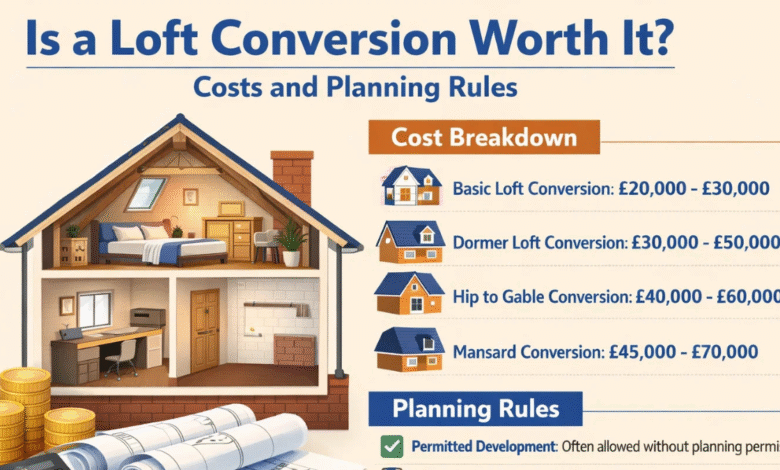
Is a Loft Conversion Worth It? Costs and Planning Rules
A loft conversion is one of the few moves that can add meaningful space without touching the footprint. In London, that matters. Gardens are protected, party walls are close, and planning decisions often come down to massing and neighbour impact. The real question is not “is it worth it?” in the abstract – it is whether your roof volume can deliver a room that feels intentional, with enough head height, light, storage, and a stair that does not steal the floor below.
The quickest way to sanity-check a loft
Before you spend time on layouts, confirm the fundamentals with loft conversion services that start with feasibility, not assumptions. A quick review can tell you whether the roof form supports the space you want, where the stair could land, and how likely the proposal is to raise planning or neighbour concerns. That early clarity is what keeps budgets realistic and prevents late redesign.
What “worth it” actually means in London
Value is only one part of the equation. A good loft conversion improves daily life: a calmer main bedroom, a better work zone, a guest room that is not an afterthought. If the new level solves a real problem (space, privacy, family growth), the return is both practical and financial.
Where lofts fail is also predictable. You gain square metres but lose flow. The stair lands awkwardly. Ceiling lines feel compromised. Bathrooms are squeezed into the wrong place. Storage is forgotten, so the room never feels settled. If you treat the loft as a design project rather than a “room in the roof”, it becomes a coherent part of the home, with sensible thresholds, usable corners, and joinery that supports how you actually live.
Cost drivers you should understand early
Loft conversion costs vary because the roof is not just a shell, it is structure, access, fire safety, and services. The biggest drivers are usually:
- roof form and volume (dormer, hip-to-gable, mansard)
- structural complexity (steelwork, floor strengthening)
- stair position and how much it disrupts existing layouts
- bathrooms and drainage runs
- window strategy (light, privacy, planning risk)
- specification level (joinery, finishes, insulation performance)
A common mistake is pricing a loft as a single line item. The smarter approach is to set the brief, test feasibility, and align the design with a realistic specification. That is where costs become controllable, rather than reactive. It also avoids the classic trap of “saving” on design, then paying later through changes, delays, and compromised detailing on site.
Planning rules and when you may need permission
Some lofts can fall within permitted development, but London conditions often complicate the picture. Conservation areas, Article 4 directions, and design expectations around roof form can trigger planning even when the volume looks modest. Flats are also a different category, and many do not benefit from the same rights as houses.
Even where planning permission is not required, building regulations still shape the design. Fire strategy, stair geometry, insulation build-up, structure, and escape routes need to be resolved as part of the concept, not bolted on at the end. If you are in a terrace or semi, party wall considerations and construction sequencing matter too – not just legally, but practically, because access and temporary works influence programme and cost.
What good design looks like in a roof space
The difference between “extra space” and a genuinely valuable new level usually comes down to three decisions. First, where the stair lands – it should feel natural, not like a ladder to a separate zone. Second, how you handle daylight – rooflights and dormer windows need to be placed for usable light, privacy, and balanced proportions. Third, how you control head height – pushing the usable volume to the places you actually stand and move, while using lower zones for storage, joinery, or baths. When these are solved together, the loft stops feeling like a compromise.
The decision that makes the rest easier
A loft conversion is worth it when it delivers usable space with good proportions, calm daylight, and a layout that improves the whole home. Cost and planning outcomes depend on early decisions: stair strategy, roof form, structure, and how the design sits in its context. Get those right, and the rest becomes delivery – not a debate.