
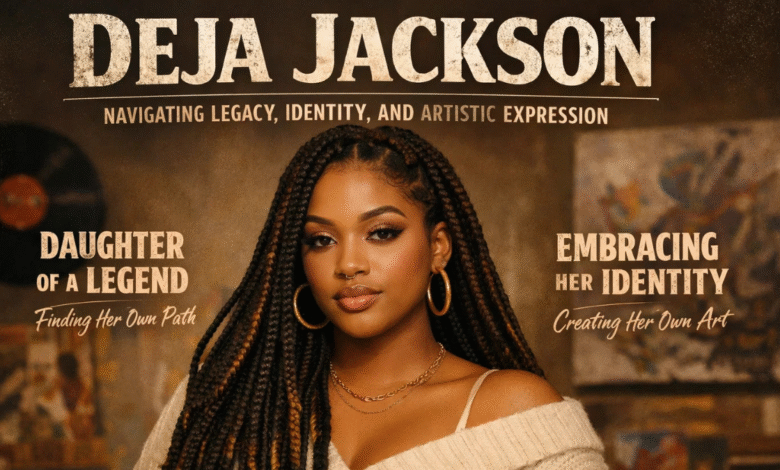
Deja Jackson: Navigating Legacy, Identity, and Artistic Expression
Deja Jackson: In a world saturated with celebrity offspring and instant fame, the story of Deja Jackson stands apart. It is a narrative not of scandal or relentless self-promotion, but of deliberate intention, quiet creativity, and the complex navigation of a legacy that is both a privilege and a profound personal journey. Daughter of the iconic Janet Jackson and the late music executive René Elizondo Jr., Deja Jackson exists at the intersection of immense cultural heritage and an individual’s right to a self-defined path.

While public curiosity about her is immense, fueled by her famous family, understanding her significance requires looking beyond mere genealogy. This exploration delves into the multifaceted identity of Deja Jackson as a private individual, an emerging artistic voice, and a symbol of how a new generation interprets and evolves a legendary family’s legacy in the modern age. Her life offers a compelling case study in balancing public expectation with private authenticity, making her a figure of quiet fascination and respect.
The Jackson Family Legacy and Its Weight
Growing up as a member of the Jackson family is an experience unlike any other. It means being born into a narrative of groundbreaking musical achievement, global adoration, and intense public scrutiny that spans decades. For Deja Jackson, this legacy is both her inheritance and her context. It provides a world of unparalleled artistic resources and exposure, but it also casts a long shadow, setting a towering benchmark against which any personal creative endeavor might be measured. The Jackson name carries a weight of expectation that is historical, cultural, and deeply personal, creating a unique environment for self-discovery.
Navigating this legacy requires a nuanced understanding of family, history, and self. Deja Jackson has been raised within a tradition of excellence and resilience, learning from generations who transformed the entertainment industry. However, the modern challenge differs. It involves honoring that past while forging an identity that feels authentically her own, outside of comparative frameworks.
This delicate balance—between reverence for a monumental family history and the need for individual expression—is central to her journey. It’s a testament to her upbringing that she approaches this balance with such apparent poise and intentionality, choosing her steps carefully in a world eager to define her.
The Artistic Path of Deja Jackson
While many assume a predetermined entry into music or performance, the artistic inclinations of Deja Jackson have manifested in nuanced and visually oriented ways. Early glimpses and family insights suggest a strong pull toward the visual arts and creative design, realms where she can build a language of expression that is distinctly her own.
This choice is significant; it represents a branching of the Jackson creative tree into new mediums, allowing her to engage with her innate creativity while establishing a separate, complementary lane to the family’s famed auditory legacy. Art becomes her personal dialect, a way to communicate her perspective without the immediate echo of a musical surname.
This path is not a rejection of heritage but an evolution of it. The Jackson family’s genius has always been rooted in performance, rhythm, and visual storytelling—from Michael’s revolutionary videos to Janet’s cinematic albums. Deja Jackson’s exploration of visual arts can be seen as a contemporary extension of this same narrative impulse.
It allows her to contribute to the family’s story of creativity on her own terms, using canvas, design, or digital media as her stage. Her artistic journey, though kept private, underscores a modern truth: legacy is not a blueprint to be followed, but a foundation of creative confidence upon which to build something new and personally meaningful.
Privacy and Personhood in the Digital Spotlight
In an era where oversharing is currency and privacy is often sacrificed for clout, Deja Jackson’s choice to maintain a guarded personal life is a powerful statement. This decision is a conscious strategy for self-preservation and healthy identity formation. By controlling her narrative and limiting her digital footprint, she asserts that her personhood is not public property, despite her famous lineage. This approach protects her space to grow, make mistakes, and evolve without the distorting lens of constant public commentary, a challenge her parents and relatives knew all too well.
This commitment to privacy also reframes her public appearances and rare acknowledgments. When Deja Jackson does step into the spotlight, whether alongside her mother at an event or through a shared family post, the moment carries greater weight precisely because it is curated and intentional. It shifts the dynamic from one of entitled access to one of granted glimpse, fostering a relationship with the public built on respect rather than consumption. In doing so, she masters a difficult modern art: maintaining relevance and connection while fiercely protecting the sanctity of her private self, a lesson in digital-age boundaries many are still learning.
The Role of Motherhood and Family Influence
The influence of Janet Jackson on Deja Jackson’s life is, understandably, profound. However, it extends far beyond fame into the realms of values, resilience, and artistic integrity. Janet has famously shielded her son from the media, and this protective instinct extends to her approach to motherhood with Deja. Reports and rare insights suggest a close, nurturing bond where Deja has been encouraged to explore her interests in a supportive environment. Janet’s own career, marked by artistic reinvention and personal strength, provides a blueprint not for fame but for navigating life with grace under pressure and maintaining control over one’s creative output.
Furthermore, the broader Jackson family network offers Deja a unique ecosystem. It is a family that has experienced the highest peaks of fame and its most punishing valleys. This collective history provides a deep well of wisdom about the realities of public life, the importance of family unity, and the necessity of spiritual and emotional grounding. For Deja Jackson,
this means being part of a tribe that understands her context innately. Their influence likely emphasizes the importance of character over celebrity, of personal happiness over public perception, and of finding one’s own version of success—lessons that are invaluable for anyone, but essential for someone in her position.
Public Perception Versus Personal Reality
The public narrative around figures like Deja Jackson is often constructed from fragments: a photographed outing, a family tribute, or historical data. This inevitably leads to a gap between perception and reality. Public curiosity often projects fantasies or assumptions onto her—about her career ambitions, her relationship with wealth, or her personality—based solely on her family name.
This manufactured persona, built without her direct input, is the “Deja Jackson” of tabloid headlines and online forums, a simplified character in a story she did not write.The personal reality is, by design, less accessible and far more complex. It is the lived experience of a young woman navigating education, personal relationships, creative development, and self-discovery. The real Deja Jackson is not a public figure in the traditional sense but a private individual who happens to have an inescapably public context.
This dichotomy is her central challenge: to live her authentic life while the world whispers a version of it. Her success lies in her ability to ignore the noise and focus on building a genuine existence, choosing to let her future actions, should she choose to share them, define her rather than the public’s preconceived notions.
The Future and Forging an Independent Identity
What does the future hold for Deja Jackson? The most compelling answer is that it remains wonderfully unwritten and entirely in her hands. The options are vast. She may choose to step more fully into the public sphere as a visual artist, a designer, or an advocate for causes close to her heart. She may build a career that leverages her unique perspective from within the entertainment industry, perhaps in a behind-the-scenes creative role.
Or, she may continue to prioritize a private life, finding fulfillment away from the glare of cameras entirely. The power of her position is that the choice is authentically hers, a luxury earned by the family’s legacy that provides security and options.
Forging an independent identity is the ultimate act of self-definition for any child of famous parents. For Deja Jackson, this doesn’t mean erasing her heritage—that would be impossible and likely undesired. Instead, it means integrating it into a larger, more personal whole. It means the name “Jackson” becomes one part of her story, not the entirety of it.
Her independent identity will be a synthesis of her family’s history, her mother’s direct influence, her own talents and passions, and her personal values. As one industry insider familiar with the family’s dynamics once noted, “The greatest legacy isn’t forcing the next generation to repeat your steps, but giving them the foundation and confidence to chart their own path. That’s where true evolution happens.” This is the journey Deja Jackson is on, and it is arguably more interesting than any predetermined path.
Comparative Context: Navigating Fame in the Next Generation
The experience of Deja Jackson is part of a broader phenomenon of “legacy kids” in entertainment dynasties. How her path compares to others highlights different strategies for navigating inherited fame. The table below contrasts key approaches, showcasing where Deja Jackson’s choices position her within this landscape.
| Navigational Strategy | Common Characteristics | Example Figures | Deja Jackson’s Alignment |
|---|---|---|---|
| The Direct Successor | Embraces the family’s exact profession; pursues a public-facing career in the same field (music, acting). Often faces direct comparison. | Zoe Kravitz (acting/music), Miley Cyrus (music/acting) | Low Alignment. Has not pursued mainstream music or performance publicly. |
| The Adjacent Creative | Leverages family insight and access but operates in a complementary, often behind-the-scenes or adjacent creative field (directing, producing, design). | Sofia Coppola (directing), Jason Schwartzman (acting/music) | High Alignment. Indications point toward visual arts/design, a creative field adjacent to performance. |
| The Private Citizen | Actively rejects public life; pursues a completely separate, private professional path (law, medicine, business) with minimal media engagement. | Nicky Hilton Rothschild (business/fashion), Sean Lennon (selective music/private life) | Medium-to-High Alignment. Prioritizes privacy, but any future public creative work would shift this balance. |
| The Brand & Media Personality | Builds a public persona heavily reliant on family name but applied to media, branding, influencing, or reality television. | Kylie Jenner (business/influencing), Brooklinn Khoury (advocacy/influencing) | Low Alignment. No evidence of cultivating a public personal brand or media presence for its own sake. |
This comparative view clarifies that Deja Jackson’s path most closely resembles that of “The Adjacent Creative” with strong tendencies toward “The Private Citizen.” This strategy allows for creative expression and connection to the family’s world while maintaining significant control and distance from the most intense forms of celebrity. It is a sophisticated, sustainable approach for the long term.
The Cultural Significance of Her Journey
On a broader cultural level, the public fascination with Deja Jackson speaks to our collective curiosity about lineage, legacy, and the human desire to see stories continue. We are drawn to narratives of “the next generation” in royal families, political dynasties, and entertainment empires. Her story taps into timeless questions about nature versus nurture,
the burden of expectation, and the possibility of self-invention. In watching her journey, the public is indirectly exploring universal themes of identity formation, all projected onto a figure who operates with notable silence.Furthermore, her approach offers a quiet critique of contemporary fame culture. In a world that often rewards the loudest voice in the room, Deja Jackson’s choice of privacy and purposeful action presents an alternative model.
It suggests that influence can be cultivated through presence rather than promotion, through the quality of one’s work rather than the quantity of one’s posts. For a public weary of curated inauthenticity, her genuine reticence becomes intriguing and even refreshing. She represents the idea that in the 21st century, perhaps the most radical act for someone in her position is to simply live a life that feels real and true to oneself, regardless of the narrative others wish to impose.
Conclusion
The story of Deja Jackson is, ultimately, a story in progress—one defined more by potential and poised intention than by a catalog of public achievements. It is a narrative that compellingly intertwines the epic scale of the Jackson family legacy with the intimate, universal human quest for self. While the world knows her as Janet Jackson’s daughter, her significance lies in how she is navigating the space beyond that defining fact. Through a commitment to privacy, a pursuit of personal artistic expression, and the clear support of a family that understands the costs of fame, Deja Jackson is authoring a life on her own terms.
Her journey teaches us about the power of quiet determination in a noisy world. It reminds us that the most impressive legacy one can build is not always the one that shouts from the headlines, but the one that resonates in the quality of a private life well-lived and the integrity of choices made away from the spotlight. As we observe from a distance, the enduring intrigue around Deja Jackson is not just about who she is related to, but about the person she is quietly, assuredly becoming. Her path reaffirms that true identity is not given by a surname or public perception, but is built piece by piece through personal choice, creativity, and the courage to define success for oneself.
Frequently Asked Questions (FAQs)
Who is Deja Jackson’s mother?
Deja Jackson is the daughter of global music icon and cultural legend Janet Jackson. Her father is Janet’s ex-husband, music executive and songwriter René Elizondo Jr. Janet has been famously protective of her children’s privacy, a principle that has extended to shaping the private upbringing of Deja Jackson.
What does Deja Jackson do for a living?
Specific details about the career of Deja Jackson are kept private, aligning with her overall approach to life outside the public eye. Based on family comments and rare insights, she has shown a strong interest and likely pursuit in the visual arts and creative design fields, suggesting she is forging a path as an artist or creative professional in an adjacent space to her family’s musical legacy.
How has the Jackson family legacy influenced Deja Jackson?
The Jackson family legacy provides Deja Jackson with an unparalleled context of artistic excellence and resilience. It offers both inspiration and a formidable standard. The influence appears to be less about pressure to perform and more about providing a foundation of creative confidence, family solidarity, and hard-earned wisdom about navigating public interest, allowing her to explore her own identity from a position of strength and support.
Why is Deja Jackson so private?
Deja Jackson maintains a high degree of privacy as a deliberate and healthy choice for personal development. Growing up in one of the world’s most famous families, she has likely witnessed the intense pressures of public life firsthand. Choosing privacy allows her to grow, learn, and define herself without the distortion of media narratives or public expectations, asserting her right to a normal personal development process.
Will Deja Jackson ever go into music like her family?
There is no public indication that Deja Jackson plans to pursue a career in music as a performer. Her creative energies seem directed toward the visual arts. However, the future remains entirely her choice. Whether she enters music, continues in the visual fields, or does something completely different, any decision will be noteworthy precisely because it will be a clear expression of her personal will, not an expectation fulfilled.
You may also read
The Regalbuzz Ecosystem: Decoding the New Currency of Strategic Influence