
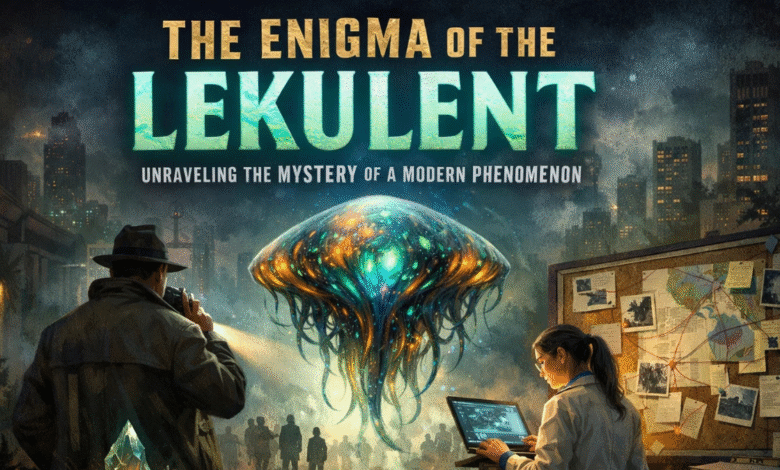
The Enigma of the Lekulent: Unraveling the Mystery of a Modern Phenomenon
Lekulent We live in a world filled with wonders, both explained and unexplained. Some emerge from the depths of ancient forests, others from the frontiers of science, and a few seem to spring, fully formed, from the collective imagination of the internet age. The lekulent sits intriguingly at the intersection of all these realms. You may have stumbled upon the term in an obscure forum, heard it whispered in a documentary about strange natural phenomena, or seen it tagged on a surreal piece of digital art.
But what, precisely, is a lekulent? Is it a newly discovered biological entity, a forgotten piece of folklore, a psychological concept, or something else entirely? The very ambiguity is central to its allure. This article is a comprehensive journey into the heart of this mystery. We will trace the murky origins of the word, explore its various interpretations across different fields, examine its cultural footprint, and delve into the scientific principles that might make the idea of a lekulent not just possible, but plausible.


The story of the lekulent is less about finding a single, fixed definition and more about understanding how we categorize the unknown and why certain concepts capture our curiosity with such tenacity. Prepare to explore a concept that defies easy labeling, a true lekulent of the informational age.
Origins and Etymological Shadows
The first challenge in understanding the lekulent is pinning down where the word itself came from. Unlike scientific terms with clear Latinate roots or folkloric creatures with centuries-old linguistic trails, “lekulent” appears almost phantasmagorically in modern lexicons. Some linguists and amateur etymologists have proposed a fusion of roots. One compelling theory suggests a blend of the Greek “lekos,” meaning dish or receptacle, and the Latin “lentus,” meaning slow, viscous, or tenacious.
This combination poetically hints at an entity that is a “container of slowness” or something that holds a persistent, thickening quality. Another school of thought traces it to a possible corruption of “luculent,” an archaic English word meaning clear or lucid, which would create an ironic twist for such an obscure subject. Yet others hear echoes of Slavic words for “shadow” or “patch.”However, the most captivating origin story is not linguistic, but anecdotal. It springs from early-20th-century accounts, perhaps apocryphal, of naturalists and explorers in remote temperate rainforests.
They spoke of encountering areas where the environment felt profoundly different—where sound dampened, light seemed to filter through a thicker medium, and time itself felt viscous. They reportedly used the term lekulent to describe these zones, possibly borrowing from a local dialect now lost. This narrative, whether fact or folklore, provides a powerful foundational myth: the lekulent as a place, a localized atmospheric anomaly. The lack of concrete documentation only fuels further speculation and investigation, making the quest for the origin of the lekulent a core part of its enduring mystery.
This etymological murkiness is, in many ways, the lekulent’s greatest strength. Without a fixed point of origin, it becomes a conceptual blank slate. It can be adapted, molded, and reinterpreted across disciplines and stories. The search for its roots mirrors the human desire to find the source of any mystery, to trace the river of an idea back to its spring. As we will see, this flexibility has allowed the lekulent to evolve from a possible piece of forgotten explorer jargon into a multifaceted symbol in contemporary culture. The ambiguity of its beginnings invites us to project our own understandings of the strange and unexplained onto it, ensuring that the lekulent remains perpetually relevant and intriguing.
The Lekulent in Cultural Consciousness
While it may lack the household recognition of Bigfoot or the Loch Ness Monster, the lekulent has carved out a unique and growing niche in modern culture. Its presence is subtle, often lurking in the subtext rather than starring on the poster. In contemporary weird fiction and speculative literature, authors have adopted the term to describe entities or phenomena that are not merely monstrous but environmentally transformative.
A lekulent in these stories might be a creeping patch of forest that assimilates everything into its slow, dreamlike logic, or a psychic stain on a location that warps perception. It’s less a creature you encounter and more a zone you inadvertently step into. This usage directly echoes those early explorer tales, translating them into potent narrative fuel.Beyond literature, the concept of the lekulent thrives in digital art and online communities. On platforms like Tumblr, Reddit, and dedicated art forums, tag searches for #lekulent reveal a stunning array of visual interpretations.
Common motifs include bioluminescent, viscous ecosystems; impossible, non-Euclidean botanical forms; and landscapes where gravity, light, and texture operate by unfamiliar rules. As one digital artist noted, “The lekulent isn’t something you draw; it’s the atmosphere you try to render. It’s the feeling of the air being soup and the light being syrup.” This artistic movement treats the lekulent not as a defined object, but as an aesthetic and emotional experience—one of profound, beautiful unease.
The lekulent has also made intriguing, if cryptic, appearances in other media. Independent video games use it as the name for mysterious power-ups or corrupted zones within their worlds. In the realm of music, ambient and drone artists have titled tracks or albums after it, using soundscapes to evoke that same sensation of temporal thickness and environmental absorption.
This cross-media presence demonstrates the concept’s versatility. It functions as a convenient shorthand for a very specific kind of mystery—one that is passive, pervasive, and ecological rather than aggressive and individual. The cultural journey of the lekulent shows how an obscure term can be collectively refined into a sophisticated tool for expressing complex ideas about nature, perception, and the unknown.
Scientific Perspectives and Ecological Intrigue
If we move from culture to science, does the idea of a lekulent hold any water, or is it purely a fictional construct? Interestingly, several scientific phenomena echo the descriptions associated with the lekulent, providing a scaffold of plausibility. Let’s consider it through an ecological lens. Imagine a localized area within a forest where a unique confluence of factors exists. The table below outlines how observable natural phenomena could create a lekulent-like environment:
| Perceived Lekulent Trait | Possible Scientific Explanation |
|---|---|
| Dampened, muffled sound | Exceptionally thick, spongy moss and peat layers absorbing acoustic vibrations. Dense, moisture-laden air in a microclimate. |
| Thick, viscous air/light | High concentrations of aerial algae (e.g., Trentepohlia) or pollen creating a visible, particulate-heavy haze. Temperature inversions causing light to bend unusually. |
| Slowed perception of time | Sensory deprivation caused by uniform visual noise (e.g., repetitive fungal growths), reduced auditory input, and potentially low-level natural narcotics from certain fungi or plants affecting cognition. |
| Unique, clustered biology | A “terrestrial reef” effect: a fallen “nurse log” or mineral seep creating a hyper-concentrated niche for symbiotic fungi, mosses, insects, and plants rarely found together elsewhere. |
From a mycological (fungal) perspective, the lekulent finds even more fascinating parallels. The vast, underground networks of mycelium—the “wood wide web”—exhibit behaviors that seem almost intelligent and are crucial to forest ecosystems. A particularly dense and old network, communicating through chemical and electrical signals, could theoretically influence the local environment in subtle ways. Could a lekulent be a visible manifestation of an exceptionally active and dominant mycorrhizal hub?
Furthermore, the phenomenon of “fairy rings”—where fungi grow in a circle—is a simple, real-world example of a fungus visibly and geometrically altering its environment, a miniaturized model of a boundary-defined ecological zone.Physics, too, offers intriguing angles. Research into localized magnetic anomalies or areas with unusual electromagnetic fields shows they can sometimes cause disorientation in animals and humans. Places with high concentrations of certain metals or unique geological formations could create such fields.
While not producing visible “thickness,” these zones could certainly alter perception and create a sense of stepping into a different “space,” a key characteristic of the legendary lekulent. The scientific takeaway is not that lekulents exist as described in stories, but that the natural world is full of complex, interconnected phenomena that can collectively produce experiences so strange they feel supernatural. The lekulent, therefore, serves as a useful conceptual basket for these intertwined ecological, sensory, and psychological effects.
Psychological and Perceptual Dimensions
The experience of a lekulent is, ultimately, a human experience. This leads us to the crucial psychological component. How does our own mind contribute to the perception of such a phenomenon? The answer lies at the intersection of environmental psychology and neuroscience. When we enter an environment with reduced sensory cues—like a foggy forest, a soundless snowy landscape, or a deeply shaded grove—our brain struggles to calibrate.
This can lead to a state of mild dissociation or altered time perception. The brain, hungry for pattern and input, may begin to project meaning or see patterns where none exist (a phenomenon called apophenia). A strangely shaped log, an odd cluster of mushrooms, and a sudden drop in wind can be woven by a suggestible mind into a narrative of a conscious place.This is deeply connected to the concept of “genius loci,” or the spirit of a place. Many cultures inherently believe that certain locations have a tangible presence or personality. The lekulent can be seen as a modern, secular-scientific attempt to name and understand this ancient feeling.
It externalizes the internal awe and unease we feel in profoundly ancient or ecologically dense places. It’s not that the place is alive in a fairy-tale sense, but that its complex, ancient, and massively interconnected biosphere projects a “presence” that our evolved instincts recognize as significant and potentially threatening. We are sensing the sheer weight of life and process, and our consciousness interprets it as an entity.
Furthermore, the idea of the lekulent taps into our cognitive biases regarding ambiguity. We have a lower tolerance for ambiguous threats than for clear ones. A strange, quiet patch of woods where something feels off is more psychologically taxing than a clearing with a visible predator. The lekulent embodies this ambiguous threat perfectly. It doesn’t chase you; it simply is, and its intentions,
if any, are utterly inscrutable. This makes it a potent symbol for our relationship with the natural world—not as a garden to be tended, nor a resource to be extracted, but as a vast, complex, and indifferent system whose inner workings we barely comprehend. The psychological power of the lekulent is that it gives form to this sublime indifference.
Philosophical and Metaphorical Interpretations
Beyond the sensory and psychological, the lekulent serves as a rich metaphor with profound philosophical implications. It challenges our basic categories of existence. Is it an object? A process? An event? A relationship? It seems to be all or none of these. In this sense, the lekulent aligns with object-oriented ontology and ecological philosophy, which seek to de-center the human and view all objects—rocks, rivers, fungi, concepts—as having their own rich, mysterious existence independent of human perception. The lekulent becomes a figure for the absolute “otherness” of nature, a thing-in-itself that we can only ever partially perceive and never fully understand.
It also serves as a powerful metaphor for mental states and social phenomena. One can speak of a “psychological lekulent“—a period of life or a state of mind where time feels viscous, progress seems impossible, and one is trapped in a kind of cognitive syrup. Similarly, sociologists have playfully used the term to describe bureaucratic systems or institutional cultures that are so dense with procedure and precedent they absorb energy and momentum, slowing all progress within them. These metaphorical uses are telling; they show that the core qualities of the lekulent—density, absorption, perceptual alteration—are recognizable in many aspects of human experience.
On a grander scale, the lekulent can be seen as a metaphor for the Anthropocene epoch itself. We live in a world increasingly shaped by human action, where the distinction between natural and artificial is blurred. Climate change, microplastics, and radioactive isotopes are creating new, hybrid environments.
Could a lekulent be a manifestation of nature responding, adapting, and mutating under these pressures? A zone where the ecosystem has reconfigured itself in a novel, unexpected, and perhaps unsettling way? This interpretation transforms the lekulent from a relic of wild places into a potential harbinger of our planet’s future—a symbol of nature’s resilient, alien, and non-human creativity in the face of disruption. It forces us to ask: as we change the world, what strange new “places” are we bringing into being?
The Lekulent in Comparative Mythology
While the term is modern, the concept of the lekulent has deep roots in global mythology and folklore. We can find its spiritual ancestors in countless traditions. The Slavic leshy is a forest spirit that can distort space and time, making travelers lose themselves in woods that feel endlessly vast. The Japanese kachina fuchi are certain forbidden or sacred valleys and mountains where time flows differently, and those who enter may emerge to find decades have passed. Celtic lore is filled with “thin places,” where the veil between the mundane world and the Otherworld is permeable; these locations often have a distinct, charged atmosphere.
In these myths, the entity and the environment are one. The forest is the leshy. The valley is the spirit. This is a crucial parallel to the lekulent, which is consistently described as a zone or an environmental condition rather than a discrete being with agency. Furthermore, many traditions have taboos about disturbing certain places—taking a stone from a fairy hill, cutting a specific tree.
To do so is to invite misfortune, as if one has violated the integrity of a living system. This mirrors the modern ecological understanding of fragile, interconnected ecosystems, where removing one element can collapse the whole. The lekulent, in a modern context, repackages this ancient wisdom in a new vocabulary.What sets the lekulent apart from these traditional entities is its lack of explicit personification or moral agenda. A leshy can be tricked or appeased; a fairy can be benevolent or vengeful. The lekulent, as commonly conceived, is amoral and impersonal. It does not act with intention; it simply exists with consequences. This reflects a more modern, materialist worldview.
It’s not a spirit with a will, but a natural system with properties. This shift is significant. It shows how our myths evolve with our understanding of the universe. We’ve moved from animistic spirits to complex systems, but the underlying experience—the awe and unease in the face of a powerful, incomprehensible natural presence—remains unchanged. The legend is the myth for a scientific, yet still wonder-filled, age.
Conclusion: The Enduring Allure of the Unnamed
Our long exploration of the lekulent reveals that it is far more than a quirky internet meme or a piece of fictional jargon. It is a multifaceted conceptual tool, a Rorschach test for our relationship with mystery. From its shadowy etymological beginnings to its vibrant life in digital art, from its echoes in real-world ecology to its profound philosophical implications, the lekulent proves to be a remarkably resilient and adaptable idea.
Its power lies precisely in its refusal to be pinned down. It is a placeholder for the unexplained, a narrative vessel for our sense of wonder, and a metaphor for the dense, interconnected, and often alien reality of the natural world.The quest to define the lekulent is ultimately a fool’s errand, and that is its greatest strength. In a world where information is instantly available and mysteries are often quickly debunked, the lekulent persists precisely because it is undefinable.
It invites participation. It asks the scientist to look closer at fungal networks, the artist to render a new vision of atmosphere, the hiker to ponder the feeling of a particular grove, and the philosopher to question the boundaries of objects and beings. It is a collaborative myth, built not by a single culture over centuries, but by a globally connected community sharing a sense of awe.Perhaps, then, the true lekulent is not an external phenomenon at all, but an internal capacity—the human capacity to perceive depth, pattern, and presence in the world around us, and to feel a shiver of connection to something vast and old.
It is the moment we step into a quiet forest and feel time slow, the air grow heavy, and the sense that we are not just in nature, but being perceived by it. By giving that feeling a name—however vague, however modern—we honor it. We acknowledge that the world is still full of pockets of profound mystery, waiting not for monsters to be discovered, but for a deeper, more humble understanding to be earned. The lekulent is a reminder that not everything needs, or should have, a simple explanation.
Frequently Asked Questions About the Lekulent
What is the most accurate definition of a lekulent?
There is no single accurate definition, and that’s central to the concept. In its broadest sense, a lekulent refers to a localized area or phenomenon where the normal rules of the environment seem subtly altered—where sound, light, time, and biology feel different, often described as “thick,” “viscous,” or “dreamlike.” It can be interpreted as a mythical place, a psychological experience, a metaphor for complex systems, or a hypothetical ecological anomaly. Think of it less as a specific thing and more as a category of experience for something that feels profoundly other and environmentally integrated.
Could a lekulent actually exist in reality?
While no scientifically documented entity called a “lekulent” exists, many real-world phenomena can combine to create a lekulent-like experience. Dense fungal networks, unique microclimates with heavy particulates in the air, areas with strong magnetic anomalies, and specific ecological niches can all alter human perception in ways that match descriptions of a lekulent. So, the literal monster or magical zone probably doesn’t exist, but the sensory and psychological experience of encountering a deeply strange, interconnected natural place is very real and forms the basis for the legend.
How is the lekulent different from other cryptids or mythical creatures?
The key difference is agency and form. Most cryptids (like Bigfoot) are discrete creatures—animals that behave in animal-like ways, even if they are elusive. The lekulent is typically not a creature. It is often described as a condition of a place or a diffuse entity that is coextensive with its environment. It doesn’t hunt or hide; it simply is. Its threat or allure is passive, emerging from its mere existence and its effect on the surrounding space and those within it. It’s closer to a haunted locale than a hidden animal.
Why has the concept of the lekulent become popular online?
The lekulent resonates online because it is highly visualizable yet open to infinite interpretation. It provides a creative prompt for digital artists, writers, and world-builders. Its ambiguity allows it to function as a shared meme within niche communities, fostering collaboration and in-jokes. Furthermore, in an age of ecological awareness, it taps into a growing fascination with non-human intelligence and the eerie, interconnected “otherness” of natural systems like mycelial networks, making it a perfect symbol for an internet-savvy, environmentally-conscious generation.
Can I visit or find a lekulent?
You cannot find a location officially designated as a lekulent. However, you can seek out places that evoke the feeling often associated with one. Ancient, undisturbed forests (like temperate rainforests), deep fern gullies, peat bogs at dusk, or caves with unique mineral formations can all produce the sensory dampening, altered time perception, and awe that inspire stories of the lekulent. The search, therefore, is less about discovery and more about cultivating a mindful, perceptive state when in wild places. The “lekulent” is in the perception as much as in the place.
You may also read
The Denika Kisty: Unbuckling the History and Craft of the Kabardian Belt