
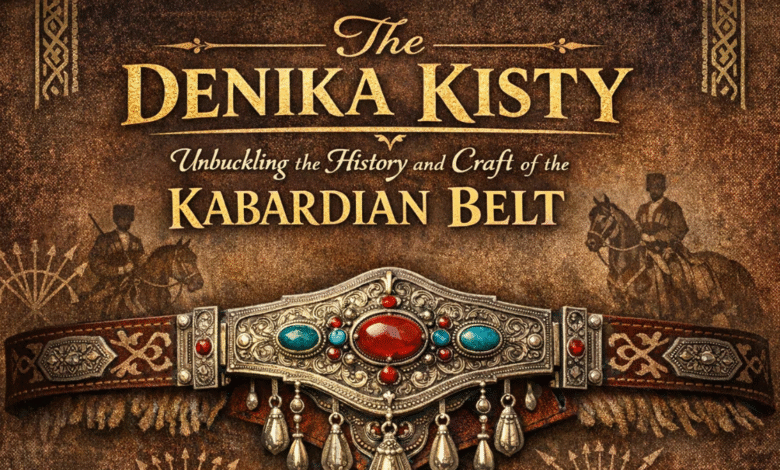
The Denika Kisty: Unbuckling the History and Craft of the Kabardian Belt
Denika Kisty Imagine a piece of clothing so central to an identity that its absence is unthinkable. For the Kabardian and broader Circassian (Adyghe) peoples, the denika kisty is precisely that. More than a mere accessory to hold up trousers, this traditional belt is a masterpiece of metalwork, a historical record, a symbol of status and honor, and a vibrant thread in the fabric of a resilient culture. It is the indispensable finishing touch to the iconic Circassian coat, the cherkeska. To see a man in full traditional attire without his denika kisty would be like seeing a knight without his sword belt—incomplete and fundamentally off.
The story of Denika Kisty is not just a tale of fashion or function; it is a narrative woven through centuries of Caucasian history, reflecting social structures, aesthetic ideals, and the unparalleled skill of master armorers-turned-jewelers. From the workshops of ancient Kubachi to the ceremonial gatherings of the modern diaspora, the belt has endured. This article will take you on a deep journey into the world of Denika Kisty, exploring its origins, deconstructing its complex craftsmanship, deciphering its symbolic language, and understanding its powerful resurgence today. We will unbuckle its layers, one ornate plate at a time.


The Historical Roots and Evolution of the Denika Kisty
To understand Denika Kisty, one must first understand the world that forged it. The Caucasus Mountains have long been a crossroads of empires, a land of fierce independence and intricate codes of honor, like the famous Adyghe Xabze. The Circassian peoples, renowned as warriors and horsemen, developed a material culture that perfectly blended martial necessity with profound artistry. The Denika Kisty finds its earliest ancestors in the practical belts of warriors, designed to carry the tools of war: the dagger (qama), the pistol, and later, cartridge tubes for rifles.
Originally, these belts were likely made of leather, reinforced with simple metal plaques. However, as blacksmithing and metalworking flourished in Caucasian centers like Kubachi (in modern-day Dagestan), Lak villages, and among the Adyghe themselves, the belt transformed. It evolved from a purely functional item into a key indicator of social standing, wealth, and taste.
The mastery once reserved for chainmail and sword hilts was channeled into creating increasingly elaborate belt sets. By the 18th and 19th centuries, during the peak of Circassian cultural flowering and the tragic Caucasus War, the denika kisty had become a canonical element of national dress, its design codified and rich with meaning.The tumultuous events of the 19th century, including the forced exile of most Circassians from their homeland, could have spelled the end for such a specialized artifact. Yet, Denika Kisty survived.
In diaspora communities across the Ottoman Empire and later the Middle East, it became a powerful tangible link to the lost homeland. Craftsmanship continued, often adapting to new materials and influences while preserving core principles. In the Soviet North Caucasus, though traditional life was suppressed, the belt persisted as part of folk ensembles. Today, this historical journey from battlefield to cultural beacon makes Denika Kisty a potent symbol of endurance.
Deconstructing the Craftsmanship: Anatomy of a Masterpiece
A casual observer sees a shimmering, clinking band of metal. A closer look reveals a complex architectural feat. The classic Denika Kisty is an assembly of individual, meticulously crafted components, each with a name and purpose. Understanding its anatomy is key to appreciating the art.
The foundation is the leather belt strap itself, traditionally made of robust, blackened leather. Attached to this strap are the metal elements, which are never sewn on but are fastened using loops or rings on their reverse, allowing them to sit securely while maintaining flexibility. The most prominent features are the large, often rectangular or arched buckle (zhyyn) and the matching tip or end-piece (zhyyn shyt). These are the anchors of the design and are typically the most decorated, featuring the finest engraving and sometimes central gemstones.
Linking the buckle to the tip are the belt plaques (tkhyepl’e). These are individual decorated plates, often square or rectangular, that create the belt’s continuous gleaming surface. Their number can vary, but a complete belt usually features an odd number, following traditional aesthetic rules. Interspersed between these plaques are often connecting elements or smaller decorative links. The back of the belt, which would be against the cherkeska, is far plainer, demonstrating that the artistry is meant for the world to see—a public declaration of identity and skill.
The Metals and Methods of the Masters
The traditional Denika Kisty is primarily forged from silver. Silver was abundant in the Caucasus and was believed to have purifying, protective properties. Gilding (covering with a thin layer of gold) was common for the wealthiest nobles, creating a stunning two-tone effect. The core manufacturing techniques are a legacy of ancient artisanry.
Niello work (tuthe) is the signature technique most associated with high-quality Caucasian metalwork, and thus with the finest denika kisty belts. This process involves engraving an intricate design into the silver, then filling the grooves with a black alloy of sulfur, copper, silver, and lead. When polished, the result is a stark, beautiful contrast between the shiny silver and the velvety black lines of the niello, creating detailed pictorial or geometric scenes. Filigree—using delicate threads of silver soldered together into lacy patterns—and granulation—decorating with tiny silver balls—are also used, often in combination. Engraving (gur) without niello is another common method, producing fine, shimmering lines that catch the light.
As one renowned modern craftsman from Nalchik notes, “The hand must remember the pattern before the tool touches the silver. We are not just making a belt; we are etching a memory that will be worn for generations.” This quote underscores the deep intentionality behind each stroke. The tools may have evolved from simple chisels to more precise modern gravers, but the eye and the steady hand of the master remain irreplaceable. The following table breaks down the primary components and their characteristics:
| Component (Adyghe Name) | Primary Function | Key Characteristics & Decoration |
|---|---|---|
| Buckle (Zhyyn) | Secures the belt, central focal point. | Largest plate; often arched; features central motif (tree of life, astral symbol, animal); may have a functional prong or decorative clasp. |
| Belt Plaques (Tkhyepl’e) | Forms the main body of the belt’s front. | Multiple rectangular/square plates; designs often symmetrical and repeating; connected via leather loops. |
| Tip/End-Piece (Zhyyn Shyt) | Finishes the belt’s end, balances the buckle. | Matches buckle in size and ornamentation style; often has a dangling pendant or chapon. |
| Connecting Links/Chains | Joins plaques and adds movement/sound. | Smaller elements; can be chains, rings, or small plaques; enhances auditory “clink.” |
| Leather Strap | Structural foundation. | High-quality black or dark brown leather; hidden at front, visible at sides/back. |

The Language of Ornament: Symbols and Social Codes
Every curve, dot, and etched figure on a Denika Kisty is a word in a visual language. The ornamentation is never arbitrary; it carries meanings tied to mythology, spirituality, and social hierarchy. Reading a belt is like reading a biography of its wearer’s family and aspirations.
Geometric patterns are the most ancient layer of this language. Meanders, spirals, zigzags, and rosettes speak to concepts of eternity, the sun, movement, and protection. Floral motifs, especially the highly stylized “tree of life,” symbolize growth, lineage, and the connection between heaven and earth. Zoomorphic (animal) figures are powerfully evocative. The ram’s horn is a ubiquitous symbol of strength, fertility, and leadership. Stylized birds, often doves or falcons, represent the soul, messenger functions, or nobility. Less common but highly significant are anthropomorphic (human) figures, sometimes depicting epic heroes or ritual scenes.
The composition and richness of these symbols directly communicated social status. A young man’s first denika kisty might be simpler, with basic geometric niello. A mature, respected man of means would wear a belt with dense, intricate narratives—perhaps scenes of hunting or battle, complex floral arrays, and abundant use of niello and filigree. The belt of a princely lineage might incorporate gold gilding and precious stones like carnelian or turquoise. It was a bankable asset, a store of wealth worn on the body, and a key part of a bridegroom’s dowry presentation. In a society with a strong oral and visual culture, the denika kisty silently announced who a man was and what he represented.
The Belt in the Ensemble: Completing the Cherkeska
The Denika Kisty cannot be divorced from its context: the traditional male Circassian costume. Its relationship with the cherkeska is symbiotic. The cherkeska—the long, fitted coat with the distinctive breast cartridge pockets (gazyrs)—is designed to be worn belted. The Denika Kisty sits at the natural waist, cinching the elegant silhouette and causing the skirt of the coat to flare slightly, emphasizing the wearer’s posture and poise.
Functionally, the belt served as a harness. From it would hang the indispensable arms: the kindjal dagger at the front and the sword at the side. The weight of these weapons required a strong, broad belt like the denika kisty to distribute the load comfortably during long hours on horseback or on foot. The auditory element is also crucial. The gentle, metallic clink of the belt plaques, combined with the sound of the weapon fittings, created a distinctive soundscape that announced a man’s movement—a sound of readiness and presence.
Aesthetically, the belt provides a central horizontal axis that breaks the vertical lines of the cherkeska and the gazyrs. It draws the eye and serves as a glittering centerpiece, harmonizing with other silver elements like the gazyr tips, the chest ornaments (brestmeydal), and the weapon hilts. Together, they form a cohesive system of adornment that is both breathtakingly handsome and deeply purposeful. Without Denika Kisty, the cherkeska feels unfinished, like a sentence without a verb.
The Modern Revival and Cultural Renaissance
For a time in the 20th century, the use of the denika kisty was largely confined to folk dance troupes, museum displays, and rare family heirlooms brought out for weddings. However, the past few decades have witnessed a powerful and passionate revival. This renaissance is driven by a global Circassian reawakening to cultural identity, a growing diaspora seeking connection, and a proud reclamation of heritage in the North Caucasus homeland.
The demand for authentic, high-quality Denika Kisty belts has surged. A new generation of jewelers and silversmiths, both in the Caucasus (in cities like Nalchik, Maikop, and Cherkessk) and in diaspora hubs like Jordan, Turkey, and the United States, are dedicating themselves to this craft. They study old belts in museums and private collections, apprentice with aging masters, and painstakingly relearn the techniques of niello, filigree, and traditional engraving. Their workshops now produce belts that are indistinguishable from antique masterpieces in technique, while sometimes incorporating contemporary stylistic subtleties.
This revival is most visible at life-cycle celebrations. At a modern Circassian wedding, the groom’s denika kisty is a central focus. It is often a new piece, commissioned for the occasion, symbolizing his new role as a family patriarch. Similarly, the belt is a mandatory element for men performing in or attending cultural festivals, national holidays, and community gatherings. It has transcended folklore to become an active, living symbol of pride. Furthermore, the aesthetic of Denika Kisty has influenced modern fashion designers within the community, who might abstract its patterns onto ties, cufflinks, or women’s jewelry, creating a bridge between ancestral craft and contemporary style.
Preservation and Challenges for the Future
Despite this positive trend, the craft faces significant challenges. The skills required are extraordinarily difficult to master and are not learned overnight. A true master craftsman needs the hands of a surgeon, the eye of an artist, and the historical knowledge of a scholar. There is a risk that commercialization could lead to a dilution of quality, with machine-stamped, plated imitations being passed off as authentic work, which undermines both the cultural value and the economic viability of true artisans.
Preservation efforts are therefore multifaceted. Cultural organizations are documenting patterns and techniques, creating digital archives of historic belts. Some NGOs offer grants or workshops to support young artisans. Perhaps most importantly, educated consumers within the community are learning to distinguish mass-produced souvenirs from hand-forged denika kisty belts, and are willing to invest in the latter, understanding they are funding both a living and a legacy. As one cultural activist puts it: “Every time a young man chooses to wear a real, handcrafted denika kisty, he is not just accessorizing. He is becoming a patron of our culture and a walking testament to its future.”
The Denika Kisty in a Global Context
In a world of homogenized global fashion, the Denika Kisty stands out as a powerful statement of specific identity. Its significance resonates with broader movements of intangible cultural heritage preservation recognized by UNESCO. While not inscribed individually, the craftsmanship and symbolism of the belt are part of the larger tapestry of Circassian cultural practices that communities are fighting to safeguard.
For the global diaspora, the belt is a particularly potent object. For generations born far from the Caucasus mountains, wearing a denika kisty at a wedding or festival is a profound act of connection. It is a tactile link to an ancestral homeland many have never seen, a way to embody a history that was almost erased. It transforms an abstract identity into a physical, weighted reality. In this sense, the Denika Kisty performs a function similar to other diasporic sartorial symbols, like the Scottish kilt or the Armenian taraz, but with its own unique martial elegance and Caucasian complexity.
Furthermore, the sheer beauty of Denika Kisty gives it a universal aesthetic appeal. Museums of world art and design are increasingly including Caucasian silverwork in their collections, introducing the belt to audiences with no prior knowledge of Circassian history. This external appreciation validates the craft’s artistic merit and introduces it into global conversations about decorative arts, metalwork, and the stories that objects carry.
How to Recognize and Appreciate an Authentic Denika Kisty
For an enthusiast or someone looking to acquire a belt, knowing what to look for is crucial. An authentic, traditionally made Denika Kisty will have certain hallmarks. First, examine the workmanship. Hand-engraving and niello will have slight, human imperfections—the lines may have minute variations in depth, and the niello might not be perfectly flush in every microscopic area. Machine-made pieces are uniformly sterile.
Look at the construction. The plaques should be individually attached, allowing slight independent movement. A single, rigid metal plate is a sign of modern, cheap production. Check the metal. Solid silver will tarnish to a dull grey or black if untreated, and will be heavy. Plated or alloy belts are noticeably lighter. The leather should be thick and sturdy. Finally, study the pattern. Authentic designs draw from the traditional symbolic lexicon mentioned earlier. Random, non-symmetrical, or overly “modern” patterns are likely not from a craftsman steeped in the tradition.
Appreciating a Denika Kisty, however, goes beyond connoisseurship. It is about understanding the narrative it holds. When you see one, consider the hundreds of hours of skilled labor, the generations of knowledge transmitted from master to apprentice, and the cultural pride it represents. It is not just a belt; it is a worn heirloom, a piece of history on the hip, and a continuing testament to a people’s artistic spirit and unbroken will.
Conclusion
The journey of Denika Kisty is a remarkable story of cultural tenacity. From its practical origins on the waist of Caucasian warriors to its role as a glittering centerpiece of national dress, this belt has carried the weight of history, identity, and artistry. We have seen how its intricate anatomy of buckle, plaques, and tip is forged through master techniques like niello and filigree, each symbol etched into the silver speaking an ancient language of protection, lineage, and status. We have observed its symbiotic relationship with the cherkeska, completing a martial yet elegant silhouette.
Today, Denika Kisty is experiencing a vibrant revival, powered by a global Circassian cultural renaissance. New generations of craftsmen and wearers are ensuring that this is not a relic of the past, but a living, evolving tradition. The challenges of preserving such a high-art craft are real, but the growing appreciation for authenticity is a hopeful sign. More than just an object, the Denika Kisty is a statement—a declaration of pride, a wearable archive, and a stunning work of art. It reminds us that some threads of tradition, like a well-forged silver plaque on strong leather, are designed to hold fast against the tides of time, clinking softly with the resilient music of a people’s heritage.
Frequently Asked Questions About Denika Kisty
What is the primary purpose of a Denika Kisty?
The Denika Kisty serves multiple interconnected purposes. Primarily, it is a functional belt designed to cinch the traditional Circassian cherkeska coat at the waist. This functionality extends to being a harness from which a man would historically hang his dagger and sword. Beyond utility, its core purpose is cultural and symbolic. It acts as a key marker of male identity and social status within Circassian (Adyghe) culture, displaying wealth, lineage, and personal taste through its quality and ornamentation.
How can I tell if a Denika Kisty is handmade and authentic?
Authenticating a Denika Kisty involves examining several factors. First, look at the engraving and niello work. Hand-done pieces will have slight, natural irregularities in the depth and flow of the lines, whereas machine-made patterns are perfectly uniform and often shallower. Check the attachment of the plaques; they should be individually fixed and have slight movement. The weight is a good indicator—authentic belts are made of solid silver and feel substantial. Finally, the design should reflect traditional Caucasian motifs (ram’s horns, geometric patterns, tree of life). A reputable seller should be transparent about the craftsman’s origins and methods.
Why is the Denika Kisty always worn with a specific outfit?
The Denika Kisty is intrinsically linked to the male Circassian national costume, most notably the cherkeska. The cherkeska is tailored to be worn belted; the denika kisty creates the proper fitted silhouette, causing the skirt of the coat to flare. Aesthetically, it provides a central, horizontal axis of adornment that harmonizes with the other silver elements of the outfit, like the gazyr tips. Functionally, the broad, strong leather and metal construction of the Denika Kisty is necessary to support the weight of traditional weapons hung from it. Wearing it with modern clothing would divorce it from its historical and sartorial context.
What do the symbols on a Denika Kisty mean?
The symbols on a Denika Kisty form a rich visual language. Geometric patterns like meanders and spirals often symbolize eternity, the sun, or movement. The stylized “tree of life” represents growth, family lineage, and the connection between worlds. Animal motifs are very common: the ram’s horn signifies strength, fertility, and leadership, while birds can represent the soul or nobility. The density, complexity, and choice of symbols historically communicated the wearer’s age, social standing, and regional origins. Each belt tells a story through this metal-and-niello vocabulary.
Is the Denika Kisty only for special occasions today?
While historically worn daily as part of traditional dress, in the modern context, the denika kisty is indeed primarily worn for special and cultural occasions. This includes weddings, where it is essential for the groom, as well as national holidays, cultural festivals, dance performances, and community gatherings. However, its use for these “special occasions” is precisely what marks their continued vitality. It is not locked away in a museum but is actively used in the most significant moments of personal and community life, which is a powerful sign of a living tradition. Some men in the homeland may also wear simpler versions more regularly as an expression of cultural pride.
You may also read
The Enigma of Selena Green-Vargas: Unraveling the Story Behind the Name