
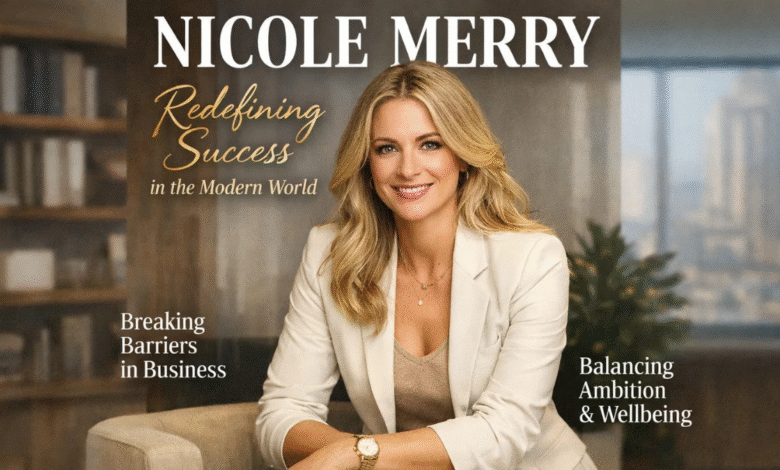
Nicole Merry: In an era saturated with influencers and self-proclaimed thought leaders, the name Nicole Merry stands apart. It resonates not as a fleeting brand but as a symbol of substantive achievement, intellectual depth, and a profoundly human-centric approach to innovation. To understand Nicole Merry is to explore a multidimensional journey that weaves through the high-stakes corridors of technology, the compassionate world of strategic philanthropy, and the nuanced art of personal and professional fulfillment.


This article is not a simple biography; it is a deep dive into the philosophy, strategies, and legacy of a figure who has consistently operated ahead of the curve. We will unpack the core principles that have defined her path, offering not just a portrait of an individual, but a blueprint for impactful living in the 21st century. The story of Nicle Merry is a compelling case study in how to wield influence responsibly, build with integrity, and leave a mark that extends far beyond balance sheets or public accolades.
Early Foundations and Formative Influences
The trajectory of any significant career is often traced back to its foundational moments. For Nicole Merry, this period was defined not by a singular passion for technology in isolation, but by a dual fascination with systems and stories. Her academic pursuits bridged what many considered disparate worlds: the logical rigor of computer science and the empathetic, contextual study of anthropology.
This unique lens allowed a young Nicle Merry to see technology not as an end in itself, but as a tool embedded within human culture, with the power to reshape behaviors, relationships, and societies. This interdisciplinary grounding became her secret weapon, fostering a systems-thinking approach that considered the human consequence of every line of code.
This perspective was solidified during her early professional experiences at the intersection of finance and social impact. Working on platforms designed for micro-lending in emerging economies, Nicole Merry witnessed firsthand both the transformative potential of well-designed technology and the pitfalls of solutions built without deep cultural understanding.
These projects were not abstract assignments; they were masterclasses in stakeholder alignment, ethical deployment, and measuring success beyond mere adoption rates. It was here that her core belief crystallized: true innovation is not about the “what,” but the “why” and “for whom.” This human-first conviction would become the north star for all her future endeavors, distinguishing her approach in an industry often obsessed with disruption for its own sake.
The Breakthrough: Pioneering Human-Centric AI
The mainstream conversation around artificial intelligence is often dominated by either utopian hype or dystopian fear. Nicole Merry entered this space with a different, more pragmatic question: How can we build AI that amplifies human potential without eroding human agency? Her pioneering work at the helm of her first major venture, Axiom Logic, was a direct answer.
Moving away from the “black box” models prevalent at the time, she championed a framework she termed “Explainable by Design.” This mandated that transparency and interpretability were not optional add-ons, but fundamental architectural requirements. Her teams focused on creating AI assistants that could not only complete tasks but also articulate their reasoning, building a bridge of trust between human and machine.
This philosophy was put to the ultimate test in high-stakes sectors like healthcare diagnostics and judicial risk assessment. While competitors raced for pure algorithmic accuracy, Nicle Merry insisted on a tripartite success metric: accuracy, explainability, and bias auditability. This often meant sacrificing marginal gains in performance for massive gains in trust and safety. The result was a suite of tools adopted not because they were the most “intelligent” in a narrow sense, but because they were the most responsible and collaborative. Her 2018 keynote, “The Partner Algorithm,” became a seminal talk, shifting industry dialogue from replacement to partnership. This focus cemented her reputation not just as a skilled technologist, but as an essential ethical compass for the field.
Building a Culture of Conscious Creation
A visionary’s ideas are only as powerful as the ecosystem that brings them to life. Recognizing this, Nicole Merry dedicated immense energy to cultivating an organizational culture that was itself an innovation. At the core of her leadership philosophy was the dismantling of the traditional silos between “creatives,” “engineers,” and “business.” She instituted mandatory rotational programs and project “collision spaces,” physically and procedurally designed to foster serendipitous collaboration. The goal was to create what she called “T-shaped innovators” people with deep expertise in one area (the vertical stem of the T) but a broad capacity for empathy and communication across disciplines (the horizontal top).
This cultural blueprint extended to performance and recognition. Moving beyond pure output metrics, her companies evaluated contributions based on a matrix of impact, collaboration, and ethical stewardship. Bonuses were tied not only to individual milestones but to team-wide knowledge-sharing and successful cross-departmental handoffs. This created an environment where helping a colleague was not a distraction from one’s work, but a core part of the work itself. The outcome was a notable decrease in attrition and a surge in patentable ideas born from interdisciplinary teams. This people-first operational model proved that a conscious culture is not a cost center or a perk; it is the ultimate engine of sustainable innovation and resilience.
The Strategic Philanthropy Engine
For many high-profile figures, philanthropy is a separate, often reactive chapter of life. For Nicole Merry, it has always been an integrated, proactive strand of her professional DNA. Her approach moves decisively away from the classic “checkbook charity” model toward what she terms “Venture Philanthropy.” This framework applies the rigor of a tech startup clear objectives, key results (OKRs), iterative testing, and scalability assessments to philanthropic giving. Each initiative under the Nicole Merry Foundation is treated like a portfolio company, requiring a theory of change, measurable milestones, and a plan for eventual sustainability or graceful conclusion.
This method is most evident in her flagship “Code for Access” initiative. Rather than simply donating computers to schools, the program takes a systems-level view. It funds the development of open-source, low-bandwidth educational software tailored to regional curricula, trains local educators to become tech stewards, and partners with municipalities to advocate for infrastructure improvements.
The investment is multi-layered, targeting immediate need, capacity building, and policy change simultaneously. This creates a multiplicative effect, ensuring that the impact of the donation outlives the initial fanfare. For Nicle Merry, this is where technology and philanthropy find their highest-purpose intersection: not in giving people tools they can use, but in building ecosystems where they can learn to build tools for themselves.
Navigating Public Life and Private Integrity
With significant achievement comes a level of public scrutiny that can be both a platform and a prison. Nicole Merry has navigated this terrain with a deliberate strategy that balances profound engagement with protected solitude. Her public communications are consistent in their focus on ideas, projects, and collective progress, rather than personal spectacle. She leverages her platform to amplify the work of her teams, highlight under-recognized innovators in her field, and engage in substantive policy debates. This consistency has built a reputation for reliability and substance, attracting opportunities aligned with her core mission rather than fleeting trends.
However, the more critical component of her strategy is the fiercely guarded private sphere. She maintains what her close associates describe as “zones of non-negotiable disconnect” periods of deep work and family time entirely insulated from the demands of public life. This is not a luxury but a strategic discipline. She views this protected cognitive space as the incubator for her most original thinking and the foundation for her emotional resilience. By creating this clear boundary, Nicole Merry avoids the burnout and reactivity that plague many public figures. She models that true influence is not measured by constant availability, but by the quality and impact of one’s contributions when one chooses to engage.
The Evolution into a Thought Leader
Thought leadership, in the hands of Nicole Merry, transcends the typical cycle of opinion pieces and conference speeches. It is a disciplined practice of synthesis, foresight, and actionable guidance. Her process begins with what she calls “horizon scanning,” a dedicated practice of consuming research far outside her immediate field from cognitive neuroscience to urban planning to philosophy. This wide-angle view allows her to identify connective threads and emerging patterns long before they reach industry trade publications. Her role is to translate these signals into frameworks that practitioners can use.
Her seminal framework, “The Ethical Deployment Canvas,” exemplifies this. Born from observing repeated failures in tech rollouts, the canvas is a practical, one-page tool that forces product teams to answer nine critical questions before development begins, covering areas like unintended bias, data provenance, failure states, and reversibility.
It didn’t just critique the industry; it gave it a practical tool to improve. This shift from commentator to solution-provider is the hallmark of her thought leadership. She doesn’t just predict the future of work or the ethical challenges of AI; she builds the playbooks that help organizations navigate them. This generosity of insight is what has cemented her authority, making the name Nicole Merry synonymous with not just foresight, but usable wisdom.

Overcoming Adversity and Industry Skepticism
The path of an innovator challenging entrenched norms is rarely smooth. Early in her crusade for explainable AI, Nicole Merry faced significant skepticism. The prevailing Silicon Valley ethos prioritized speed and scale, often dismissing her focus on ethics and transparency as naive or a competitive handicap. Critics argued that her “Explainable by Design” mandate would slow development to a crawl and cede market advantage to less scrupulous competitors. This period required immense conviction, as she had to defend her philosophy not only in boardrooms but also in retaining top talent who were tempted by the faster-paced, “move fast and break things” environment elsewhere.
Her response to this adversity was not dogmatic insistence, but data-driven persuasion. She authorized parallel “shadow” projects: one team building with her ethical constraints, and another building without them, on the same problem. The results were telling. While the unconstrained model sometimes achieved marginally better results on initial testing, the explainable model proved far superior in real-world deployment, user adoption, and long-term stability.
It generated fewer costly errors, faced less regulatory pushback, and built deeper user trust. By turning a philosophical debate into an empirical one, Nicle Merry didn’t just win the argument she provided a replicable blueprint for proving that ethical rigor and commercial success are not antagonists, but partners. This experience taught her that resilience is not just about persistence, but about the smart, evidence-based articulation of your vision.
The Personal Philosophy of Integrated Success
Beyond the boardrooms and keynote stages, the most asked questions about Nicole Merry often revolve around how she “does it all.” Her answer consistently challenges the very premise of the question. She is a vocal critic of the “work-life balance” metaphor, which she argues pits two essential parts of a whole against each other in a zero-sum game. Instead,
she advocates for a philosophy of “Integrated Success,” a concept where professional ambitions, personal well-being, intellectual growth, and communal contribution are not competing priorities but interrelated components of a single, fulfilling life system. For her, a breakthrough idea might emerge during a quiet hike, and family time provides the emotional fuel for professional challenges.
This philosophy is operationalized through ruthless prioritization based on her core values, not external expectations. She employs a dynamic quarterly planning system, identifying one focal theme for each domain of her life be it a family goal, a learning objective, or a professional milestone. These themes act as filters for decision-making; an opportunity that doesn’t serve a current theme, no matter how prestigious, is declined. This creates coherence and prevents fragmentation. As she famously stated in a rare personal interview:
“We wear so many hats founder, parent, partner, citizen. The goal isn’t to juggle them until we drop. It’s to weave a single, strong fabric from all those threads. That fabric is your legacy, and it’s far more durable than any list of titles.”
This mindset is perhaps her most influential contribution, offering a sustainable model of achievement that rejects burnout as a badge of honor.
Future Ventures and Lasting Legacy
Today, the gaze of Nicole Merry is fixed on the horizon of what she calls “The Second Wave of Digital Humanism.” Having laid groundwork in ethical AI and venture philanthropy, her current initiatives are even more ambitious in their scope. She is deeply invested in the concept of “Digital Public Infrastructure” advocating for and investing in the creation of open-source, non-profit digital utilities for identity, data exchange, and payments that can serve as a foundation for equitable societies, much like physical public roads or the electrical grid. This work positions her at the complex intersection of technology, governance, and civic society, aiming to prevent the digital future from being carved into exclusive, privately-owned fiefdoms.
The legacy she is consciously building, therefore, is not tied to any single company or product. It is a legacy of methodology and mindset. She aims to be remembered not as the founder of X or the creator of Y, but as a key architect of a more thoughtful, inclusive, and human-centric technology era. The ultimate testament to the Nicole Merry approach will be if the principles she championed explainability, ethical deployment, integrated success, and strategic philanthropy become so normalized that they are simply considered “good practice.” Her focus is on making her own specific advocacy less necessary over time, by baking its core tenets into the very DNA of how we build and interact with the tools that shape our world.
Comparative Analysis: The Nicole Merry Approach vs. Conventional Tech Leadership
The impact of Nicole Merry is best understood through direct contrast. Her philosophy represents a paradigm shift away from several entrenched norms in technology and business leadership. The table below distills the key differentiators that define her unique approach and explain the distinct outcomes it generates.
| Leadership Dimension | Conventional Tech Leadership (Common Paradigm) | The Nicole Merry Approach (Human-Centric Paradigm) | Resulting Outcome Difference |
|---|---|---|---|
| Core Driver | Disruption, market capture, shareholder value. | Human potential, ethical consequence, stakeholder value (includes employees, users, society). | Builds loyalty and trust vs. transient market share. Creates sustainable vs. exploitive models. |
| View of Technology | An end in itself; a product to be shipped and sold. | A contextual tool; a force embedded in and shaping human systems. | Solutions are more adopted and resilient because they fit real human contexts, not just solve technical problems. |
| Innovation Culture | Competitive, siloed, “rock star” genius model. High burnout. | Collaborative, interdisciplinary, “orchestra” model. Focus on sustainable creativity. | Higher team retention, more diverse idea generation, lower cost of talent churn. |
| Metrics of Success | Pure business metrics: revenue, growth, adoption. | Hybrid metrics: ethical audit results, team well-being, long-term user trust, social impact. | Balances profit with purpose; avoids long-term brand and regulatory risks associated with ethical shortcuts. |
| Philanthropy & Social Role | Often separate, reactive, public relations-focused. | Integrated, proactive, strategy-focused (Venture Philanthropy). Treats giving like an investment. | Philanthropic efforts have measurable, systemic impact and create self-sustaining change, not dependency. |
| Personal/Professional Model | “Work-Life Balance” as separate, competing spheres. Sacrifice for success. | “Integrated Success” as a unified life system. Synergy between spheres. | Models sustainable achievement, attracts talent seeking holistic careers, reduces leader burnout. |
Conclusion
The journey through the life and work of Nicole Merry reveals more than an impressive career chronology. It unveils a coherent, powerful, and urgently needed alternative blueprint for impact in the modern age. Her story demonstrates that the highest form of innovation is not technological, but philosophical it’s about the “why” that precedes the “what.”
From her foundational interdisciplinary thinking to her pioneering of explainable AI, from her cultivation of conscious corporate cultures to her strategic, systemic philanthropy, Nicole Merry has consistently chosen the path of depth over speed, integration over fragmentation, and humanity over mere utility.
In a world often dominated by short-term optimization and transactional relationships, her legacy-in-progress stands as a testament to a different possibility. It proves that ethical rigor can be a competitive advantage, that compassion can scale, and that a life of profound professional achievement can be built not on the ashes of personal well-being, but in concert with it.
To engage with the ideas of Nicle Merry is to be invited into a more thoughtful, deliberate, and hopeful way of building our collective future one responsible algorithm, one empowered community, and one integrated life at a time.
Frequently Asked Questions
What is Nicole Merry best known for professionally?
Nicole Merry is best known as a pioneering technology executive and ethical AI advocate who championed the “Explainable by Design” framework. She founded and led Axiom Logic, a company that built transparent and interpretable AI systems for high-stakes industries, shifting the industry conversation from pure automation to human-machine partnership. Her work established key precedents for responsible innovation.
How does Nicole Merry approach philanthropy differently?
Nicole Merry approaches philanthropy through a “Venture Philanthropy” model, applying startup principles like clear objectives, iterative testing, and scalability to her giving. Her Nicole Merry Foundation focuses on systemic change by funding multi-layered initiatives like her “Code for Access” program that combine tool development, local capacity building, and policy advocacy to create self-sustaining impact rather than temporary aid.
What is the core philosophy behind Nicole Merry’s concept of “Integrated Success”?
The core philosophy of “Integrated Success,” as developed by Nicole Merry, rejects the traditional “work-life balance” metaphor. Instead, it proposes that professional, personal, intellectual, and communal goals are interwoven threads of a single life system. The aim is to create synergy between these domains, using values-based prioritization to build a coherent and fulfilling legacy, rather than juggling competing priorities until burnout occurs.
What are some key leadership principles practiced by Nicole Merry?
Key leadership principles from Nicole Merry include fostering interdisciplinary “T-shaped” innovation by breaking down silos, evaluating team performance on collaboration and ethical stewardship alongside output, and protecting “zones of disconnect” for deep work. She believes a conscious, people-first culture is the ultimate engine for sustainable innovation and resilience, not a corporate perk.
Where is Nicole Merry focusing her efforts today?
Today, Nicole Merry is focusing her efforts on advocating for and investing in “Digital Public Infrastructure.” This involves promoting the development of open-source, non-profit digital utilities (e.g., for secure identity or data exchange) that can serve as a foundational layer for equitable societies. She is working to ensure the digital future is built on public-interest principles, preventing it from being controlled by private monopolies.
You may also read
Is Sally Nugent in a Relationship? Unveiling the Private Life of the BBC Breakfast Star