
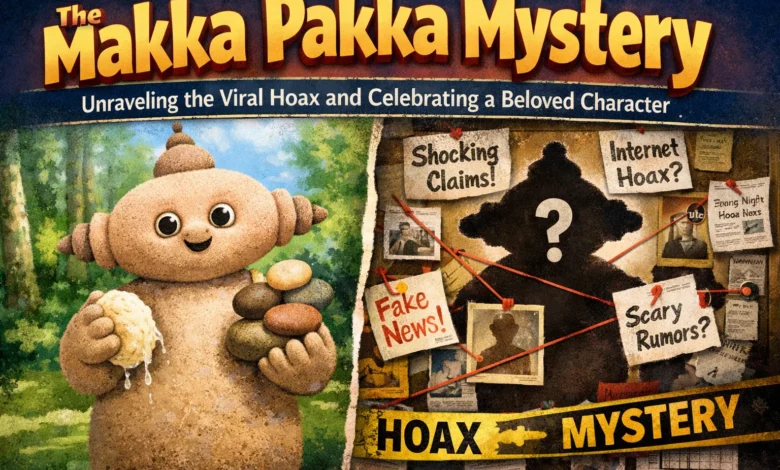
The Makka Pakka Mystery: Unraveling the Viral Hoax and Celebrating a Beloved Character
Makka Pakka: If you’ve spent any time on the internet, particularly in the darker corners of social media or on meme-heavy forums, you might have stumbled upon a shocking and deeply unsettling question: “How did Makka Pakka die?” For millions of parents and fans of the beloved BBC children’s show In the Night Garden…, this query is not just confusing; it’s a visceral punch to the gut. The very idea seems unthinkable. Makka Pakka, the gentle, round-bodied creature who loves washing stones and riding his Og-Pog, is an icon of toddler tranquility. So, where did this macabre rumor come from, and why has it persisted?


This article is your definitive deep dive into the peculiar online phenomenon surrounding Makka Pakka’s supposed demise. We will meticulously trace the origins of this viral hoax, explore the psychological and cultural reasons it gained traction, and firmly separate disturbing internet fiction from the joyful television reality. More than just debunking a myth, we’ll celebrate what Makka Pakka truly represents: a symbol of routine, comfort, and innocent wonder for an entire generation of children.
The story of “how did Makka Pakka die” is not a tale of tragedy, but a fascinating case study in how the internet can warp and reshape even the most innocent content, creating narratives that are compelling in their sheer absurdity. So, let’s wash away the rumors like Makka Pakka washes his stones and uncover the truth.
The Origin Story of a Viral Hoax
The rumor questioning how Makka Pakka died didn’t emerge from a single, traceable source like a news article or official statement. Instead, it blossomed in the fertile, often chaotic soil of internet culture, particularly on platforms like 4chan, Reddit, and later, TikTok and Twitter. The hoax appears to have roots in the late 2000s and early 2010s, coinciding with the peak popularity of In the Night Garden… and the rise of “creepypasta” – user-generated horror stories shared online. These narratives often take innocent childhood symbols and twist them into something dark and sinister.
One prevailing theory suggests the rumor began as a combination of meme culture and psychological projection. The show’s unique, dreamlike aesthetic—with its floating beds, surreal landscapes, and hypnotic pacing—while calming for toddlers, could be interpreted as slightly uncanny or even eerie through an adult lens. This “weird kid’s show” trope became a popular topic of discussion online. From there, it was a short leap for internet trolls and creative storytellers to invent dark backstories for the characters.
The query about how Makka Pakka died likely started as an edgy joke or a piece of fictional creepypasta, designed to provoke a reaction by juxtaposing extreme darkness against extreme innocence. The lack of any official narrative for the characters outside the show created a vacuum, and the internet, as it often does, filled it with its own bizarre lore.
Another potential origin point is the common online trend of “sad theory” or “dark theory” videos and listicles. Content creators, seeking clicks and engagement, would craft elaborate and tragic histories for children’s characters, asking questions like “What really happened to Caillou?” or “The dark truth behind Teletubbies.” The speculation about how Makka Pakka dies fits perfectly into this genre.
A fictional, tragic end for the character—be it a mishap with the Og-Pog, a terrible washing accident, or something more grim—was fabricated for shock value. These stories were then shared, remixed, and amplified across social media, losing their context as fiction for many who encountered them. The question morphed from a known joke into a genuine query for those unfamiliar with the hoax’s origins, thus perpetuating the cycle.
Understanding Makka Pakka: The Character, Not the Myth
To fully grasp why the question of how Makka Pakka dies is so jarring, one must understand who Makka Pakka truly is within the universe of In the Night Garden…. Created by Andrew Davenport and produced by Ragdoll Productions for the BBC, Makka Pakka is a foundational character in the show’s gentle ecosystem. He is a small, diminutive being with a rounded body, large eyes, and a moss-like covering. He lives in a little cave-like dwelling and has one great passion: washing things. His three favorite possessions are his sponge, his bar of soap, and his beloved stone-washing tool, the “Uff-Uff.”
His daily routine is a cornerstone of the show’s comforting structure. He travels around the Night Garden on his trusty orange vehicle, the Og-Pog, stopping to meticulously wash and polish stones, the faces of his friends (like Igglepiggle and Upsy Daisy), and even his own belongings. This obsession with cleanliness and order is not presented as compulsive, but as a joyful, purposeful activity.
He sings his simple, repetitive song (“Makka Pakka akka yakka mikka makka moo…”) as he works, embodying a state of focused contentment. He is a creature of harmless habit, and his interactions are always helpful and kind. He represents the toddler’s own world of small rituals—washing hands, arranging toys—and the profound satisfaction found in repetition and predictable outcomes.
Psychologists and child development experts often praise In the Night Garden… for its deliberate pacing and lack of conflict, which is ideal for winding down before bedtime. Makka Pakka is a key component of this therapeutic design. His sequences are slow, methodical, and visually clean. There is no narrative tension, only process. This makes the insertion of a violent or tragic ending not only fictional but fundamentally antithetical to the character’s entire purpose. Asking how Makka Pakka died is like asking how the concept of a calming bedtime ritual died; it misunderstands the abstract, symbolic role he plays. He is not a character in a dramatic arc, but a personified feeling of safety and routine.
The Anatomy of an Internet Rumor: Why It Spreads
The persistence of the search query around how Makka Pakka dies offers a masterclass in how misinformation proliferates online. Several key factors aligned to give this particular hoax surprising longevity. First is the power of juxtaposition. The shock factor of combining something profoundly innocent with something profoundly dark is a classic recipe for viral engagement. It triggers cognitive dissonance, making the idea memorable and shareable. People click, react, and comment out of sheer disbelief, which signals to algorithms that the content is engaging, thus promoting it further.
Second, the lack of official lore works in the rumor’s favor. In the Night Garden… provides no origin stories, no past traumas, and certainly no character deaths. It exists in a perpetual, peaceful present. This ambiguity is a blank canvas. For a creative troll or a conspiracy-minded individual, the absence of information isn’t proof of a simple show; it’s a mystery to be solved. The vacuum invites fabrication. In the absence of a canon answer to “what happened to Makka Pakka after the show?” the internet provided its own, darker conclusions.
Third, we have the role of community and inside jokes. On forums like 4chan’s /b/ board or certain subreddits, perpetuating the rumor became an inside joke, a piece of shared culture. New users would encounter the question, be horrified, and then eventually learn it was a “meme.” They might then, in turn, introduce it to others elsewhere, often without the contextual framing. This cycle effectively launched the hoax from niche forums into the mainstream of social media. Platforms like TikTok, with their short video format, were perfect for spreading the question quickly, often using eerie music and distorted clips from the show to sell the fictional tragedy.
“The internet has a unique talent for taking the pure and painting it with the brush of the perverse. Makka Pakka’s supposed death isn’t a story about a children’s character; it’s a story about our own online id.” — Digital Culture Analyst.
Finally, there’s a layer of generational nostalgia mixing with irony. Older teenagers and young adults who watched the show as children now engage with it through an ironic, meme-filtered lens. Discussing how Makka Pakka died is, for many, a form of absurdist humor, a way to reconnect with childhood media in a way that feels age-appropriate for their current, more cynical online personas. They aren’t genuinely concerned; they are participating in a collective, ironic performance. The problem arises when this performance is taken at face value by concerned parents or younger siblings who stumble upon it.
Separating Fact from Fiction: The Official Word
Let’s be unequivocally clear: There is no episode, no script, no official BBC release, no statement from the creators, and no credible source that confirms, hints at, or even vaguely alludes to the death of Makka Pakka. The question of how Makka Pakka died is a 100% fan-generated (or troll-generated) fiction. In the Night Garden… is, from its first frame to its last, a conflict-free zone. The narrative arc of each episode is simply the characters engaging in play, performing their routines, and then going to sleep. It is a simulation of a perfect, safe day for a toddler.
The creators, Andrew Davenport and the team at Ragdoll Productions, have always been explicit about their goals. The show was engineered using research into child sleep patterns and cognitive development. Every element—from the slow zooms, to the repetitive language, to the pastel colors—is designed to soothe and relax, not to excite or frighten. Introducing a plotline as catastrophic as a main character’s death would violate the show’s entire foundational purpose. It would be commercially disastrous and artistically incoherent. The characters are archetypes of comfort: Igglepiggle is the friendly explorer, Upsy Daisy is cheerful confidence, the Tombliboos are playful mischief, and Makka Pakka is orderly calm. They exist in a static, timeless state.
To further solidify the facts, here is a table contrasting the fictional rumor with the televised reality:
| Aspect | The Viral Rumor (Fiction) | The Show’s Reality (Fact) |
|---|---|---|
| Character Fate | Makka Pakka met a tragic, often graphically described end. | Makka Pakka happily washes stones and rides his Og-Pog in every episode. |
| Show’s Tone | A secretly dark or tragic allegory. | A deliberately engineered, conflict-free soothing experience for toddlers. |
| Source | Anonymous internet forums, creepypasta, social media memes. | BBC CBeebies, Ragdoll Productions, official DVDs and streaming. |
| Creator Intent | N/A (Created by audiences/trolls). | To create a calming, pre-bedtime viewing experience that aids child development. |
| Narrative | A linear story with a beginning, tragic middle, and end. | A cyclical, ritualistic series of routines with no narrative tension or conclusion. |
The official word is simple: Makka Pakka is alive and well, washing stones in the Night Garden, as he always has been and always will be within the context of the show. Any suggestion otherwise is a fabrication.
The Psychological Impact on Parents and Fans
While the origin of the how did Makka Pakka die rumor may be rooted in irony or trolling, its impact can be genuinely distressing for its unintended audience: parents and genuine fans of the show. Imagine a new parent, using the show to calm their infant, who then types “Makka Pakka” into a search engine for gift ideas and is confronted with graphic, user-generated content about their death. The emotional whiplash is significant. It feels like a violation of a safe space, a digital vandalism of something pure that was important in their family’s routine.
This taps into a broader parental anxiety about the internet “spoiling” childhood innocence. Parents curate their young children’s media environments carefully, choosing shows like In the Night Garden… specifically for their safety and gentleness. To discover that the online conversation around that character has been hijacked by dark, adult-oriented humor can be shocking and unsettling. It creates a sense of losing control over the cultural narrative surrounding their child’s interests. The question is no longer just about a character; it becomes a stark reminder of how the uncurated internet can intrude upon carefully managed childhood bubbles.
For older fans who remember the show fondly from their own childhoods, encountering the rumor can be a strangely melancholic experience. It forces a re-contextualization of a memory that was once simple and happy. While most can recognize it as a hoax, it still adds an unwanted, gritty layer to something that was previously abstract and soft. It represents a collision between the uncritical wonder of childhood and the often-cynical, deconstructive nature of adult online culture. The rumor, therefore, doesn’t just spread misinformation; it actively pollutes a nostalgic memory for some, creating a minor but real sense of loss for the uncomplicated joy the character once represented.
The Bigger Picture: Creepypasta and Dark Fan Theories
The phenomenon surrounding the question of how Makka Pakka died is not an isolated incident. It is part of a vast digital ecosystem known as “creepypasta” and the broader trend of dark fan theories. Creepypasta refers to horror-related legends or images that are copied and pasted around the internet. They often feature familiar figures from pop culture, especially children’s media, twisted into something terrifying. Famous examples include “Candle Cove,” a fictional creepy children’s show, or “Slender Man,” which originated from forum photoshops.
These stories thrive on plausibility and the corruption of innocence. A brightly colored, strange show like In the Night Garden… is a perfect candidate. Its abstract setting invites speculation. Is the Night Garden a purgatory? Are the characters ghosts? Is the Ninky Nonk a train to the afterlife? These theories are compelling to a certain mindset because they offer a “solution” to the show’s intentional ambiguity. They replace meaningless comfort with a meaningful (if grim) narrative. The specific query about how Makka Pakka dies is simply one entry point into this larger speculative universe. It’s a smaller, more focused mystery within a potential grand, dark theory for the entire series.
These theories also serve a social function. Decoding or sharing them creates a sense of community among those “in the know.” It’s a form of collaborative storytelling and world-building, albeit in a morbid direction. For the creators, it’s a double-edged sword. While it indicates a deep engagement with their work, it’s an engagement that completely inverts their intended message. The dark theory trend highlights a fundamental divide: where young children see soothing rituals, bored teenagers and creative adults see a canvas for horror, driven by a desire to impress, shock, or connect with peers through shared subversion.
Preserving the Magic: Talking to Kids About Online Hoaxes
As the rumor about how Makka Pakka died illustrates, the digital world and the world of young children are no longer separate. Parents and educators may eventually face the task of addressing such confusing and scary hoaxes with kids who hear them from older siblings or stumble upon them online. The approach is delicate but important. The goal isn’t to introduce the hoax, but to be prepared to calmly debunk it if it arises.
The key is reassurance and simplicity. If a child asks, “Did Makka Pakka die?” a parent can respond with clear, firm comfort: “Oh goodness, no! That’s a silly, made-up story from the internet. Makka Pakka is just fine. He’s right here on the show, washing his stones like always. The people who made the show wanted to make something happy and calm for you, and that’s what it is.” It’s crucial to dismiss the rumor without giving it undue weight or repeating the graphic details. Reinforce the reality of the show they know and love. This helps build early media literacy, teaching children that not everything they hear or read online is true.
This also presents an opportunity to create boundaries. For very young children, it reinforces that their parents are a trusted source of truth. For older children, it can be a springboard to a broader conversation about internet safety and critical thinking: “Sometimes people make up shocking stories online to get attention or likes. It’s important to think about where information comes from. The BBC website, where we watch the show, is a trustworthy source; a random video from a stranger might not be.” By handling the question calmly, adults can defang the hoax’s intended shock value and protect the child’s experience of the character’s magic.
The Enduring Legacy of Makka Pakka
Ultimately, the viral fixation on how Makka Pakka died is a footnote in the character’s far more significant and positive legacy. For over a decade, Makka Pakka has been a bedtime companion to millions of children worldwide. His legacy is not one of internet myth, but of real-world comfort. He represents the joy found in simple, repetitive tasks—a concept deeply reassuring to toddlers learning the boundaries of their world. The sound of his “Uff-Uff” scrubbing and his gentle song are triggers for relaxation for an entire generation.
His cultural impact is visible in toy stores, on baby clothing, and in the collective memory of families. He is part of the shared lexicon of early childhood. This enduring popularity is a testament to the character’s successful design. In a fast-paced, often overwhelming world, Makka Pakka is a slow, predictable anchor. The very fact that the dark rumor exists is, in a twisted way, proof of his iconic status. We don’t create elaborate death hoaxes for forgettable characters; we do it for figures that have lodged themselves deeply in our cultural consciousness.
Makka Pakka’s true story is one of creation, not destruction. He was created to soothe, and he has succeeded on a global scale. The internet rumor will likely ebb and flow, resurfacing every few years as a new cohort discovers it. But it is ephemeral. The image of a small, round creature lovingly polishing a stone, humming to himself in a peaceful garden, is far more powerful and permanent. That is the legacy that matters.
Conclusion
The journey to unravel the mystery of how Makka Pakka died leads us not to a tragic conclusion, but to a fascinating exploration of internet culture, psychology, and the enduring power of innocence. We discovered that the query is a manufactured hoax, born from the ironic, sometimes cynical corners of the web where childhood icons are repurposed for shock value and inside jokes. It spread through the potent mix of ambiguity, juxtaposition, and the algorithmic engines of social media.
However, this investigation ultimately reaffirms the true nature of Makka Pakka and In the Night Garden…. Far from being a figure of darkness, Makka Pakka is a meticulously designed instrument of comfort, representing routine, order, and quiet joy for preschoolers. The official record is clear: he is alive and well, performing his washing rituals in the timeless, conflict-free zone of the Night Garden.
While the rumor may cause temporary distress or confusion, it cannot touch the core purpose and legacy of the character. In the end, the story of how Makka Pakka dies tells us more about the adult need to deconstruct and sometimes corrupt innocence than it does about the character himself. The real magic lies in ignoring the fabricated noise and listening instead for the gentle, reassuring sound of the Uff-Uff scrubbing a clean stone, a sound that continues to signal bedtime and peace for children around the world.
FAQ
Why do people keep asking how Makka Pakka died?
People keep asking how Makka Pakka died, primarily because of a long-running internet hoax and meme that originated on forums like 4chan and Reddit. The question is part of a genre of “dark theory” or “creepypasta” content that twists innocent children’s characters into tragic figures for shock value and ironic humor. The strange, dreamlike aesthetic of In the Night Garden… made it a ripe target for this kind of subversion, and the lack of official backstory allowed the fictional rumor to fester and spread across social media platforms.
Is there any episode where Makka Pakka dies?
Absolutely not. There is no episode, special, or official BBC content where Makka Pakka dies or is even in danger. The show is deliberately designed without any conflict or negative events to serve as a calming pre-bedtime experience. Every episode follows a peaceful routine of play and sleep. Any video or story claiming to show how Makka Pakka died is a fan-made fabrication using edited clips or pure fiction.
What is the true purpose of Makka Pakka in the show?
Makka Pakka’s true purpose is to embody routine, order, and soothing repetition. His meticulous washing of stones and faces represents the comforting, predictable rituals that toddlers themselves engage in. Child development experts highlight that his segments help signal wind-down time, reducing stimulation and anxiety before bed. He is a visual and auditory cue for relaxation, making the idea of investigating how Makka Pakka died completely contrary to his fundamental role in the show’s therapeutic structure.
How should I respond if my child hears about this rumor?
If your child hears the rumor and asks about how Makka Pakka died, respond with calm, simple reassurance. You can say, “That’s a made-up silly story from the internet. Makka Pakka is just fine! Let’s watch him wash his stones right now.” Dismiss the hoax firmly without giving it detailed attention, and redirect to the positive, real content. This reinforces your role as a trusted source and protects their enjoyment of the character.
Are there other children’s characters affected by similar dark rumors?
Yes, the phenomenon of dark rumors and creepypasta targeting children’s characters is widespread. Similar treatment has been given to shows like Teletubbies (with theories about apocalypse or purgatory), Caillou, Barney, Sesame Street, and Thomas the Tank Engine. These rumors follow the same pattern: taking a well-known, innocent icon and inventing a tragic, shocking, or sinister backstory to create viral engagement and cater to a niche audience interested in subversive humor. The question of how Makka Pakka died is just one specific example of this much larger online trend.
You may also read
The Josh Tongue: Unraveling the Mystery of an Anatomical and Cultural Phenomenon