
Top Digital Tools and Tips for Computer Science Students in 2026
The landscape of Computer Science (CS) education has shifted dramatically over the last few years. In 2026, being a successful student is no longer just about mastering syntax or memorizing algorithms; it is about orchestrating a complex ecosystem of AI-driven tools, cloud-native environments, and collaborative frameworks. As the barrier to entry for software development lowers, the demand for deep conceptual understanding and architectural oversight has reached an all-time high.
For students navigating this evolution, the right “tech stack” for learning can be the difference between feeling overwhelmed and staying ahead of the curve.


The Evolution of the Student Tech Stack in 2026
Only a few years ago, a student’s primary tools were a local IDE and a browser tab fixed on Stack Overflow. Today, the “standard kit” has become far more integrated.
1. Agentic AI and Autonomous Code Assistants
In 2026, we have moved past simple “autocomplete” suggestions. Tools like Google Antigravity and GitHub Copilot (Enterprise) now function as agentic partners. These tools don’t just suggest a line of code; they can refactor entire modules, generate unit tests in the background, and even suggest structural changes based on the project’s documentation.
For a CS student, these tools are dual-edged. While they accelerate project completion, the real skill lies in “vibe coding” the ability to describe intent clearly while auditing the AI’s output for security vulnerabilities and logic flaws.
2. Cloud-Native Development Environments
Local setup “hell” is largely a thing of the past. Platforms like Replit and GitHub Codespaces have matured into fully scalable environments. Students now often build, test, and deploy entire full-stack applications without ever installing a compiler on their local machine. This shift allows for seamless collaboration, where a teammate can “jump into” your live environment to debug a React component or a Python script in real-time.
Balancing Innovation with Academic Integrity
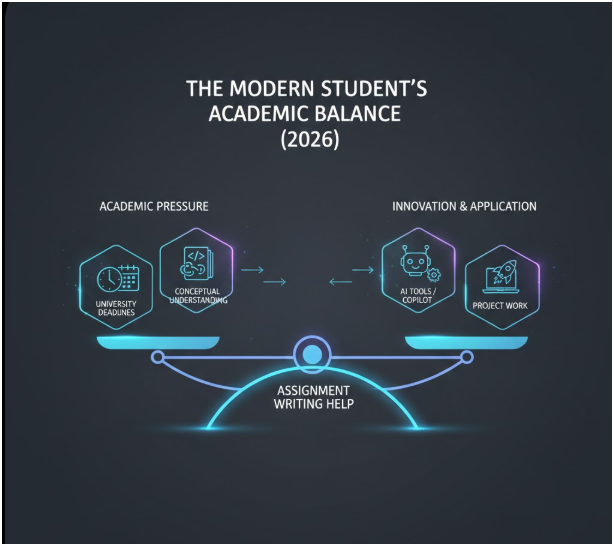
As these tools become more powerful, students face a unique challenge: maintaining academic rigor while leveraging modern efficiency. The pressure to deliver high-quality code and well-researched documentation can lead to significant stress.
Many successful students have realized that while AI can help with syntax, it cannot replace the nuanced logic required for complex projects. To manage this workload effectively, students often look for professional assignment writing help to ensure their theoretical papers and project documentations meet university standards without sacrificing their coding time. This strategic balance allows them to focus on “doing the work” that builds their portfolio while ensuring their grades remain competitive.
Essential Productivity Tips for CS Success
Beyond the software, your “mental operating system” is your most valuable asset. Here is how top-performing students are staying productive in 2026.
The “Intent-First” Learning Model
With AI doing the heavy lifting, the goal of a CS degree has shifted toward System Design and Logic Validation.
- Don’t just copy: When an AI tool generates a function, use a tool like ChatGPT-5 or Claude 4.0 to explain why that specific logic was chosen.
- Build “Bite-Sized” Projects: Instead of one massive project per semester, aim for weekly “mini-builds.” Deploying a small API or a simple smart contract every weekend builds more muscle memory than one month-long crunch.
Master the “Deep Work” Ritual
Coding requires a level of focus that modern notifications are designed to destroy.
- Spatial Computing for Focus: Many students in 2026 use spatial headsets (like Vision Pro or Quest) to create an infinite, distraction-free “virtual office” with three or four monitors floating in a serene environment.
- The Pomodoro 2.0: Use apps that sync your “Focus Mode” across your IDE, phone, and browser, automatically blocking social media the moment you open your terminal.
Navigating Specific Sub-Disciplines
Computer Science in 2026 is no longer a monolithic field. Specialization starts earlier than ever.
1. Cybersecurity and Ethical Hacking
With the rise of automated cyber-attacks, ethical hacking is one of the most in-demand specializations. Students should familiarize themselves with AI-enabled penetration testing tools. Learning how to secure LLMs (Large Language Models) against prompt injection is now just as important as knowing how to prevent SQL injection.
2. Quantum Computing Basics
While still emerging, 2026 has seen the first “Applied Quantum” courses become mainstream. Tools like IBM Quantum Learning allow students to run experiments on real quantum hardware. Even if you don’t plan to be a physicist, understanding “Qubits” and quantum gates will be essential for the next generation of encryption and optimization.
3. Data Science and Real-Time Analytics
Data is no longer static. Students are now expected to build “streaming” pipelines using tools like Apache Kafka or AWS Kinesis. The ability to process data as it happens is a core requirement for modern FinTech and HealthTech applications.
Bridging the Gap: From Theory to Application
One of the biggest “red flags” for recruiters is a student who has high grades but no “real-world” intuition. Universities are excellent at teaching the science, but the application often requires external perspective.
For instance, when working on a capstone project involving machine learning or distributed systems, the complexity can escalate quickly. Specialized computer science assignment help can provide the personalized guidance needed to bridge the gap between a classroom lecture and a production-grade codebase. This type of mentorship is invaluable for understanding how to structure a repository, write clean documentation, and implement industry-standard CI/CD pipelines.
The Role of Soft Skills in a Technical World
Surprisingly, in 2026, the most successful “tech” students are the ones with the best communication skills. As AI takes over the “writing” of code, humans are taking over the “architecting” and “explaining” of solutions.
- Documentation is King: If you can’t explain how your code works to a non-technical stakeholder, the code is useless.
- Open Source Contribution: Contributing to a project on GitHub is the ultimate “resume.” It proves you can read someone else’s code, follow a style guide, and handle constructive criticism during a Pull Request review.
Final Thoughts for the Class of 2026
The next few years will favor the “Adaptable Architect.” Don’t get too attached to a single language or tool. Instead, focus on the underlying principles of data structures, networking, and security.
About the Author
Hi, I’m Lachlan Nguyen. I am a passionate tech educator and academic consultant currently associated with MyAssignmentHelp, where I specialize in guiding students through the ever-evolving landscape of Computer Science. With years of experience in software development and academic mentoring, I’ve seen firsthand how the shift from traditional classroom learning to AI-integrated coding has transformed student life.