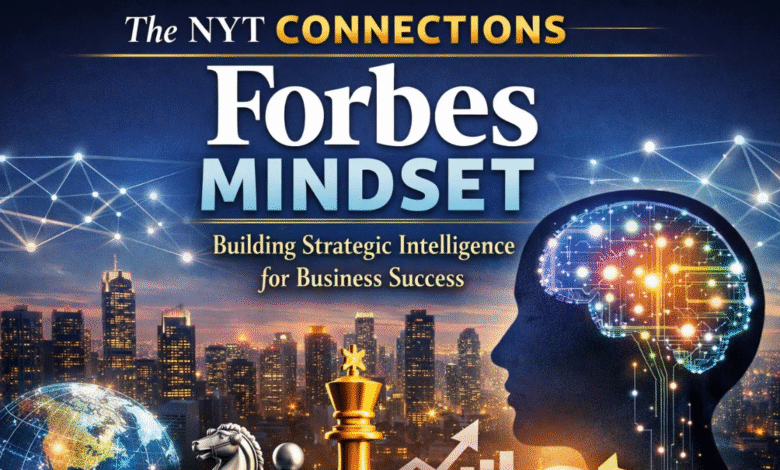
The NYT Connections Forbes Mindset: Building Strategic Intelligence for Business Success
NYT Connections Forbes: In today’s hyper-competitive landscape, success is rarely about isolated facts or singular breakthroughs. It’s about seeing the hidden patterns that others miss, connecting disparate dots to reveal opportunity, and building systems that turn insight into advantage. Two seemingly distinct brands
The New York Times’ “Connections” puzzle and the global business authority of Forbes encapsulate this modern imperative. One is a daily exercise in categorical thinking and lateral logic; the other, a century-old beacon of entrepreneurial acumen and strategic intelligence. This article explores the powerful conceptual framework that emerges when you analyze NYT connections forbes not as separate entities, but as complementary models for strategic thinking.


At its core, the “Connections” game forces players to move beyond linear thought, to group ideas by nuanced, often non-obvious relationships. This is the essence of innovation. Meanwhile, Forbes chronicles and codifies the application of such connective thinking in the real world tracking market trends, executive moves, technological disruptions, and the flow of capital. By fusing the cognitive workout of nyt connections forbes-style analysis, we unlock a methodology for problem-solving that is both rigorous and creative.
This isn’t just about playing a game or reading a magazine; it’s about cultivating a disciplined yet flexible intelligence that can navigate complexity, anticipate shifts, and build enduring value in any field. Here, we will dissect this synergy, providing a comprehensive guide to applying this powerful dual lens to business strategy, leadership, and personal growth.
The Cognitive Framework of NYT Connections
The New York Times’ Connections puzzle is a masterclass in constrained pattern recognition. Players are presented with sixteen words and must group them into four secret categories of four items each. The challenge lies in the words’ deliberate ambiguity; a single term like “Java” could belong to “Programming Languages,” “Coffee Terms,” or “Indonesian Geography.” Success requires abandoning first impressions, testing multiple mental models, and accepting that the correct grouping is often the least obvious one. This process directly mirrors the early stages of strategic analysis, where data points are plentiful but their significant relationships are hidden.
This cognitive exercise builds mental muscles critical for business leadership: lateral thinking, associative reasoning, and the ability to hold multiple hypotheses simultaneously. When facing a market dilemma a sudden shift in consumer behavior, a new competitor, or an internal operational failure leaders must avoid the trap of the obvious, first-order conclusion. Just as in Connections, the most salient feature of a data point may be a red herring. The true solution requires re-categorizing information, looking for thematic rather than superficial links, and having the patience to iterate through possibilities. This disciplined approach to categorization is a foundational skill for anyone seeking to apply a nyt connections forbes methodology to complex problems.
The Forbes Ethos of Applied Intelligence
Forbes magazine and its digital empire represent the translation of insight into action. Its core narratives revolve around wealth creation, entrepreneurial success, leadership principles, and market foresight. The Forbes worldview is one of applied intelligence it’s not enough to be smart; you must be strategically smart, leveraging knowledge, networks, and timing to build and scale ventures. Its famous lists (The Forbes 400, 30 Under 30) aren’t just rankings; they are studies in the patterns of success, offering a taxonomy of achievement much like the categories in a Connections puzzle, but on a global, real-money scale.
The authority of Forbes stems from its relentless focus on outcomes and its curation of actionable intelligence. It dissects business models, profiles decision-makers, and tracks the flow of capital to provide a connected view of the economic landscape. This is the “so what” after the pattern recognition. While Connections trains the brain to find hidden groups, Forbes demonstrates what to do with those groups once identified. It answers questions like: What market category is being formed by these connected technologies? Which investor movements signal a new trend cluster? This ethos completes the loop, moving from abstract cognitive exercise to concrete strategic imperative, a vital component of the integrated NYT connections forbes framework.
Pattern Recognition as a Business Superpower
In volatile markets, pattern recognition is the precursor to prediction and preparedness. Executives are inundated with data sales figures, sentiment analysis, supply chain alerts, competitor announcements. The ability to sift this avalanche for meaningful, connected signals is what separates reactive companies from proactive leaders. The practice of playing Connections is analogous to training for this exact scenario. You learn to ignore noise, resist jumping to conclusions based on a single data point, and systematically test how different pieces of information might relate to one another under a unifying theme.
This superpower extends beyond internal data to macro-trend analysis. Consider the convergence of artificial intelligence, biotechnology, and computing power. Viewed in isolation, each is a powerful field. Viewed through a connective lens, they reveal a nascent category: computational biology and personalized medicine, a market sector attracting massive investment and talent. This is the practical application of NYT connections forbes thinking: using disciplined categorization to identify emerging commercial landscapes before they become obvious to all. It turns information into a strategic mapping tool, allowing leaders to place bets, allocate resources, and position their organizations in the white space between established categories.
From Puzzles to Portfolios: Strategic Investment Thinking
The world of investing, particularly in venture capital and growth equity, is fundamentally a game of connections. Investors must look at a startup and see not just its current product, but its potential to define or dominate a future category. They must connect the team’s expertise, the technology’s scalability, the market’s latent need, and the competitive moat to form a coherent thesis. This is a high-stakes version of the Connections puzzle, where the categories are market opportunities, and mis-categorization can lead to capital incineration. The mindset fostered by analyzing NYT connections and Forbes dynamics is directly applicable here.
A Forbes-featured investor doesn’t just follow hot trends; they build a portfolio based on a web of interconnected beliefs about the future. They might connect “remote work,” “spatial computing,” and “digital identity” to invest in the future of the virtual office. This requires the same skill set as solving a tricky puzzle: rejecting the obvious (e.g., “just another video chat app”) to find the deeper, thematic link that binds a set of innovations. By applying this categorical rigor, investors can construct more resilient, thematic portfolios that anticipate convergence, rather than simply chasing dispersion. The table below illustrates this connective investment thesis.
Table: Connective Investment Thesis – From Categories to Capital Allocation
| Observed Trend/Data Point Cluster (The “Words”) | Superficial Category (The “Red Herring”) | Connective, Thematic Category (The “Solution”) | Strategic Investment Implication |
|---|---|---|---|
| Plant-based meats, Vertical farming, CRISPR gene editing, Food waste apps | “Food Tech” | Resource-Positive Agrifood Systems | Investing in companies that address the entire cycle of sustainable food production, efficiency, and distribution, not just standalone products. |
| VR headsets, Haptic feedback suits, Blockchain deeds, Digital fashion NFTs | “Gaming & Crypto” | Ownership & Identity in Immersive Digital Worlds | Backing infrastructure for verifiable assets and experiences in persistent virtual environments (the “metaverse”), beyond speculation. |
| mRNA platforms, Wearable biosensors, AI-driven drug discovery, Telehealth platforms | “Healthcare Innovation” | Predictive, Personalized, & Decentralized Health Management | Capital allocation towards integrated systems that shift care from reactive treatment to continuous, AI-assisted prevention and maintenance. |
Building a Culture of Connective Intelligence
An organization’s greatest asset is the collective intelligence of its people, but this intelligence is often siloed. Engineering, marketing, sales, and finance may each have brilliant insights, but without mechanisms to connect them, opportunities are lost. Leaders who embrace a nyt connections forbes philosophy actively work to break down these barriers. They create forums and processes that force cross-pollination of ideas, essentially setting up organizational puzzles for teams to solve together. This could be an innovation sprint where diverse departments are given a set of customer pain points and market signals to categorize and solve.
Fostering this culture requires rewarding connective thinking. It means celebrating the employee who links a customer service complaint to a potential product feature, or the analyst who correlates an obscure regulatory change with a new market opportunity. It moves performance evaluation beyond task completion to include pattern contribution. As leadership expert and author Margaret Heffernan once noted in a different context, “For good ideas and true innovation, you need human interaction, conflict, argument, debate.” In our framework, this interaction is the engine of finding better, more strategic categories. By making connection-seeking a valued and visible behavior, companies can tap into a wellspring of latent innovation that discrete, siloed work can never reveal.
Innovation Through Forced Association
Some of history’s greatest innovations arose from the collision of unrelated fields. The printing press merged wine press mechanics with movable type. Airbnb connected unused residential space with a trust platform and travel needs. This process, often called “forced association” or “combinatorial innovation,” is the deliberate practice of the NYT connections forbes mindset. It involves taking concepts, technologies, or business models from one “category” and rigorously exploring what happens when they are shoved into another. What if healthcare adopted subscription models (like software)? What if automotive applied direct-to-consumer sales (like mattresses)?
This is not random brainstorming; it is a structured exploration of the adjacency matrix between industries. Leaders can facilitate this by running workshops where teams are given two seemingly disparate lists one of their core competencies, another of trends from unrelated sectors and tasked with finding viable connections. The goal is to escape the incremental innovation of “make our product 10% better” and venture into the realm of category creation. This method requires the open-mindedness of a Connections player (where “Ham” could go with “Sandwich” or “Shakespearean Characters”) and the commercial pragmatism of a Forbes subject, always asking, “Is there a scalable, profitable market for this new combination?”
Navigating Media and Information Overload
We live in an age of infinite information and finite attention. The digital media landscape, including publishers like The New York Times and Forbes, is a constant stream of headlines, analyses, and alerts. Without a framework for processing this flow, it becomes noise. The NYT connections Forbes approach provides a critical filter. Instead of consuming news as discrete, alarming events, you begin to consume it as data points for your ongoing cognitive puzzle: What emerging categories do these stories hint at? Which “words” keep appearing together? Is this a genuine trend or a temporary cluster?
This shifts you from a passive consumer to an active analyst. A story about a factory automation deal, another about rising logistics costs, and a third about a new immigration policy aren’t just separate items on a business news feed. Through our connective lens, they become pieces pointing toward a category: “Solutions for Resilient, Onshore Manufacturing.” This allows you to curate your information intake strategically, seeking out sources that fill gaps in your mental model rather than just reacting to the loudest headlines. You develop what might be called “strategic literacy,” the ability to read the news not for what happened yesterday, but for what it signals about tomorrow.
Leadership and Decision-Making in Ambiguity
Modern leadership is defined by decision-making under conditions of ambiguity, where data is incomplete, and outcomes are uncertain. The classic command-and-control model, which seeks a single “right answer,” crumbles in this environment. The NYT connections forbes model offers a superior alternative: probabilistic, portfolio-based thinking. Just as a puzzle solver must entertain multiple category hypotheses before committing, a leader must consider multiple strategic scenarios. The goal is not to find the one perfect path, but to identify the most robust set of actions that succeed across several plausible futures.
This involves openly discussing and mapping the “categories” of possible outcomes. For instance, in planning a product launch, leadership teams should explicitly define categories like “Viral Social Adoption,” “Niche Enterprise Tool,” and “Regulatory Hurdle Delay.” They then stress-test their plans against each other. This process, akin to solving the puzzle backward, reduces the risk of catastrophic surprise and builds organizational agility. It replaces blind conviction with informed confidence, a style of leadership that is both humble about the unpredictable and decisive in preparing for it. This nuanced approach is what separates managers who simply execute from leaders who navigate.
The Ethical Dimensions of Connective Power
The power to define categories is, ultimately, a power to shape reality. When businesses successfully connect concepts to create a new market category (“the sharing economy,” “the metaverse”), they don’t just describe the world they actively construct its future rules, norms, and value flows. With these NYT connections, Forbes-derived power comes significant ethical responsibility. Connective thinking can be used to create predatory categories that obscure risk (e.g., certain complex financial instruments pre-2008) or to greenwash unsustainable practices by linking them to trendy but vague themes like “eco-friendly.”
Therefore, this intellectual framework must be paired with a strong ethical compass. Leaders must ask not only “Can we connect these ideas to build a business?” but also “Should we?” What are the second- and third-order consequences of this new category? Does it promote equity, sustainability, and genuine value, or does it primarily extract it? The pursuit of profit through innovation must be tempered by a commitment to creating categories that solve meaningful human and planetary problems. This elevates the practice from clever strategy to legacy-building, ensuring that the patterns we help bring into the world are beneficial ones.
Continuous Learning and Mental Agility
The categories of yesterday are not the categories of tomorrow. Technology evolves, consumer values shift, and global dynamics realign. A mindset forged in the static application of known formulas is doomed to obsolescence. The true value of engaging with both the NYT Connections puzzle and Forbes-level analysis is the cultivation of continuous learning and mental agility. It is a lifelong practice of breaking and reforming your own cognitive categories, a deliberate discomfort that keeps thinking fresh and relevant. This is the core personal habit that underpins the entire NYT connections forbes philosophy.
Committing to this practice means regularly seeking out information that challenges your existing mental models. It means engaging with domains outside your expertise, reading history to understand long-term patterns, and consistently putting yourself in problem-solving scenarios where the answer isn’t Googleable. It is the intellectual equivalent of cross-training. As the business landscape undergoes perpetual reorganization, the individuals and organizations that thrive will be those most adept at mental reorganization. They won’t just adapt to the new categories; they will have the cognitive tools to participate in defining them.
Conclusion: Mastering the Interconnected Game
The journey from the deceptively simple grid of NYT Connections to the complex, high-stakes arena chronicled by Forbes is a journey of applied cognitive discipline. It reveals that success in business, and in navigating modern life, is less about accumulating facts and more about mastering the relationships between them. By consciously training in the art of non-obvious categorization and coupling it with the ruthless pragmatism of value creation, we equip ourselves with a formidable dual lens. This integrated NYT connections Forbes mindset is not a passive theory; it is an active practice of strategic sensemaking.
Ultimately, this framework teaches us that the world is not a collection of isolated events or industries, but a dynamic, interconnected puzzle. The most powerful players are those who can best perceive the latent patterns, construct the most compelling new categories, and mobilize resources to bring those visions to life. Whether you are an entrepreneur, an investor, a manager, or simply a professional seeking an edge, embracing this connective discipline is your path from being a solver of other people’s puzzles to becoming the architect of your own future. Start looking for the categories hidden in plain sight they are the maps to the opportunities others have missed.
Frequently Asked Questions (FAQs)
How can the NYT Connections game directly improve my business strategy?
The NYT Connections game trains pattern recognition, lateral thinking, and the rejection of obvious assumptions skills directly transferable to strategic planning. By practicing how to find non-obvious links between disparate elements, you enhance your ability to see emerging market trends, identify competitive threats from unexpected angles, and innovate through combinatorial thinking. This cognitive conditioning, when paired with the real-world business acumen exemplified by NYT connections and Forbes analysis, creates a more agile and insightful strategic mindset.
What is the main difference between simply brainstorming and using this “Connections” approach?
Traditional brainstorming often generates ideas without a rigorous structural framework, leading to a scattered list. The NYT connections forbes-inspired approach imposes a critical constraint: you must find a unifying, categorical theme that logically binds a specific set of items (data points, trends, resources). This forces deeper analysis, challenges surface-level thinking, and leads to more coherent, actionable strategic clusters rather than just random ideas. It’s the difference between free association and disciplined synthesis.
Can this framework be applied by individuals in large, traditional corporations?
Absolutely. In fact, it can be particularly powerful in such environments where silos are strong. An individual can apply this lens to their own domain, seeking to connect insights from different departments, internal reports, and customer feedback to build a compelling case for innovation or process improvement. By presenting findings not as a lone idea but as a clearly articulated pattern (a solved “puzzle”), they can more effectively cut through bureaucracy and gain buy-in from leadership, demonstrating a nyt connections forbes level of strategic communication.
How do I avoid the pitfall of seeing connections that aren’t really there (apophenia)?
The Forbes side of the nyt connections Forbes equation provides the necessary guardrail: empirical validation and market pragmatism. Once you identify a potential pattern or new category, you must stress-test it with data, financial modeling, and customer discovery. Look for quantitative evidence, seek disconfirming information, and run small, cheap experiments. The goal is not to prove your cleverness in seeing a pattern, but to validate that the pattern represents a real opportunity or threat with evidence beyond mere coincidence.
Where can I find real-world case studies of this kind of thinking in action?
Look to the profiles and analyses published in Forbes and similar business journals. The stories of successful startups often revolve around category creation (e.g., Tesla re-categorizing cars as “software platforms on wheels”). Corporate turnarounds frequently involve leaders re-categorizing the company’s core assets and market position. By reading these cases with the explicit intent to reverse-engineer the “categories” the leaders perceived and built upon, you will see countless examples of the NYT connections Forbes’ mindset driving tangible business outcomes.
You may also read
The FutureTechGirls Sassy Revolution: Where Unapologetic Confidence Meets Cutting-Edge Code